

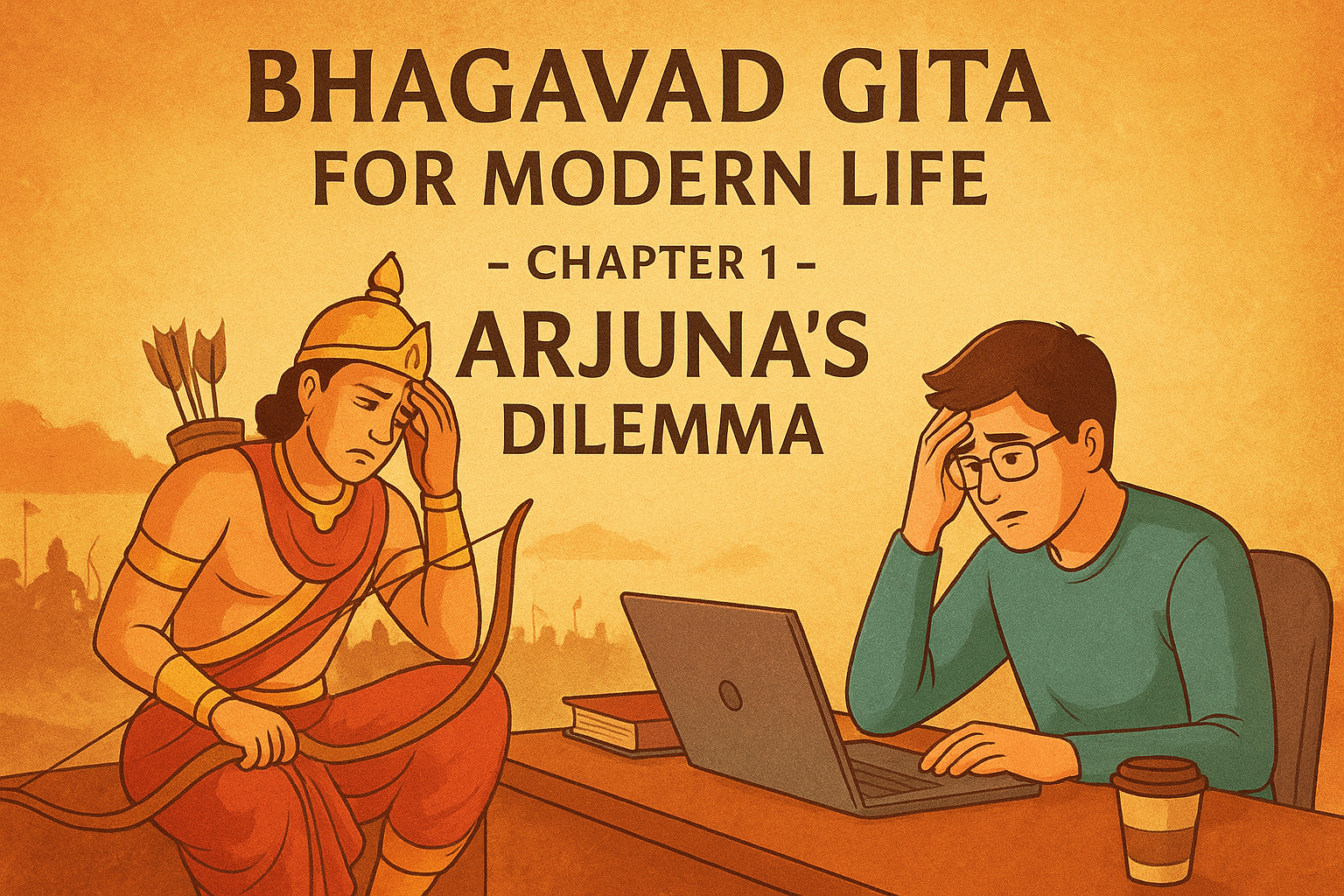
Introduction: Why Gita Still Matters Today
When we hear the word Bhagavad Gita, many imagine a scripture locked in old Sanskrit shlokas, sitting in a temple or on a shelf. But what if I told you that Gita is less about “religion” and more about real-life psychology and decision-making? The very first chapter—Arjuna Vishada Yoga—sets the stage with Arjuna’s breakdown before the war.
At first glance, it looks like a warrior’s hesitation. But if we compare this scene with modern times, Arjuna could be you, me, or any professional standing at the edge of a big decision—career, relationships, or even life’s direction.
Let’s explore how Arjuna’s inner conflict mirrors our struggles today and why his story is still relevant.
Chapter 1 in the Gita: Arjuna Vishada Yoga (The Yoga of Arjuna’s Despondency)
The chapter begins with the battlefield of Kurukshetra, where armies of the Pandavas and Kauravas face each other.
Arjuna, the mighty warrior, asks Krishna (his charioteer) to drive the chariot to the middle of the battlefield. But the moment he sees his relatives, teachers, and friends standing against him, his courage breaks down. His bow slips from his hand, his body trembles, and his mind becomes clouded.
Arjuna says:
“I see my own people ready to fight, and my heart is overwhelmed by sorrow. I cannot fight this war.”
This is the emotional turning point where even the bravest warrior becomes a vulnerable human being.
Modern Comparison: Arjuna as a Corporate Professional
Think of Arjuna not as a warrior, but as a modern man or woman:
- The Battlefield → Modern Workplace
Kurukshetra represents the office boardroom, a business startup, or even a competitive exam hall. Every person today fights their own wars—targets, deadlines, competition, expectations. - The Opponents → Our Own People
Just like Arjuna sees his loved ones on the other side, today’s battles are often with colleagues, relatives, or even our own inner circle. For example, a business partner becoming a rival, or family members not supporting your career choice. - Arjuna’s Breakdown → Our Mental Health Crisis
Arjuna’s trembling, anxiety, and hopelessness perfectly describe what we now call burnout, depression, and decision paralysis. In fact, modern psychology often deals with exactly this kind of “performance anxiety” and “overthinking.”
Lesson 1: It’s Okay to Break Down, But Don’t Stay There
Arjuna’s hesitation teaches us a very humane lesson—doubt and fear are natural. Even the strongest leaders, CEOs, athletes, or parents have moments of collapse.
But the danger is when we get stuck in that state. Many modern individuals—students before exams, employees before promotions, entrepreneurs before launches—often freeze like Arjuna, losing clarity.
The Gita reminds us that breakdowns are the first step towards breakthroughs, provided we don’t stop there.
Lesson 2: The Inner Battle is Greater than the Outer Battle
Arjuna’s real enemy was not the Kauravas, but his own confusion and attachments.
In today’s life:
- We think our problem is a tough boss, lack of money, or competition.
- But actually, our deeper battle is self-doubt, lack of focus, and fear of failure.
Once we overcome the inner Kurukshetra, the outer world aligns automatically.
Lesson 3: Seek Guidance Instead of Drowning in Confusion
Arjuna turns to Krishna for help. He admits:
“I am confused about my duty. Please guide me.”
This act of surrender is powerful. It shows that asking for help is not weakness, but wisdom.
In modern life, Krishna could represent:
- A mentor in your career,
- A therapist for mental health,
- A spiritual teacher,
- Or even your inner wisdom when you meditate.
The message: Don’t fight your battles alone. Seek clarity.
Famous Shloka from Chapter 1
One of the striking moments is when Arjuna says:
गाण्डीवं श्रंसते हस्तात्त्वक्चैव परिदह्यते।
न च शक्नोम्यवस्थातुं भ्रमतीव च मे मनः।। 1.30।।
“Gandivam sramsate hastat, tvak chaiva paridahyate; Na cha saknomy avasthatum, bhramativa cha me manah.”
“My bow Gandiva slips from my hand, my skin burns, I am unable to stand, and my mind is reeling.”
This is an ancient expression of what we call today: panic attack and anxiety symptoms.
Lesson 4: Don’t Let Emotions Hijack Your Dharma (Duty)
Arjuna wanted to escape from the war because of emotional weakness. But Krishna reminds him later (in Chapter 2) that running away from responsibilities is not the answer.
For us, this means:
- Don’t quit a job just because the pressure feels unbearable today.
- Don’t abandon relationships just because of temporary conflicts.
- Don’t give up on dreams just because of initial failures.
Instead, pause, breathe, and then seek clarity.
Modern Impact: Why Chapter 1 is Relevant Today
Arjuna’s dilemma is not about swords and arrows—it is about human psychology.
In today’s world, his story teaches us:
- Mental Health is Real – Even the strongest can collapse.
- Clarity is Power – Confusion is the biggest enemy.
- Seek Guidance – Don’t suffer alone; mentors, therapy, or spirituality can help.
- Balance Duty and Emotions – Escaping is easier, but not always right.
Practical Tips Inspired by Arjuna’s Struggle
- Journal Your Inner Conflict – Just like Arjuna expressed his confusion, writing down your thoughts can lighten your mental burden.
- Practice Mindfulness – When emotions hijack clarity, sit quietly and breathe.
- Talk to a Mentor – Don’t hesitate to share your struggle with someone wiser.
- Reframe the Battlefield – See challenges as opportunities for growth, not as punishments.
Conclusion: The First Step of Transformation
Chapter 1 of the Gita doesn’t give solutions—it shows the problem honestly. And that itself is powerful. Because unless we recognize our confusion, we can’t seek clarity.
Arjuna’s trembling hands are our own, his clouded mind is ours, and his battlefield is our daily life. The Gita begins not with victory, but with vulnerability—reminding us that acknowledging weakness is the true start of strength.
So the next time you feel overwhelmed at work, in family, or in personal choices, remember Arjuna at Kurukshetra—you’re not alone, and clarity will come if you seek it.
Discover more from Online Guruji
Subscribe to get the latest posts sent to your email.
What an amazing collection of **hello kitty coloring pages**! Perfect for Sanrio lovers, offering hours of creative fun. Check them out: hello kitty coloring pages
Bet20plays – never heard of it, but I gave it a try. UI is good, easy to use. Games are okay, nothing groundbreaking though. Give it a whirl if you’re bored! Find it at: bet20plays
Gotta say, casino55ace has been treating me alright. Good selection of games and the payouts are decent. Give it a shot when you’re feeling lucky. More info here casino55ace.
777cbgame is a blast! Reminds me of the old-school arcades. Go check it out to see what I mean 777cbgame!
Hello88com is a solid choice. Plenty of games and a decent sign-up bonus. Why not give it a try hello88com!
Jumped on Joygame777 and I’m having a good time. Lots of ways to win! Give it a try joygame777!
[3073]9 wicket লগইন এবং অ্যাপ ডাউনলোড | বিকাশ দিয়ে ক্যাসিনো গেম খেলুন,9 wicket লগইন করার নিয়ম জানুন এবং অ্যাপ ডাউনলোড করুন। এখানে বিকাশ দিয়ে ক্যাসিনো গেম খেলা এবং অনলাইন স্লট গেম খেলার নিয়ম সহজভাবে দেখুন। আজই যোগ দিন। visit: 9 wicket
[1689]bet99 | Link vào chính thức và hướng dẫn chơi baccarat,bet99 cung cấp link vào chính thức để tải app bet99 nhanh chóng. Khám phá mẹo quay hũ nổ hũ và hướng dẫn nạp tiền casino qua momo tiện lợi. Truy cập ngay! visit: bet99