

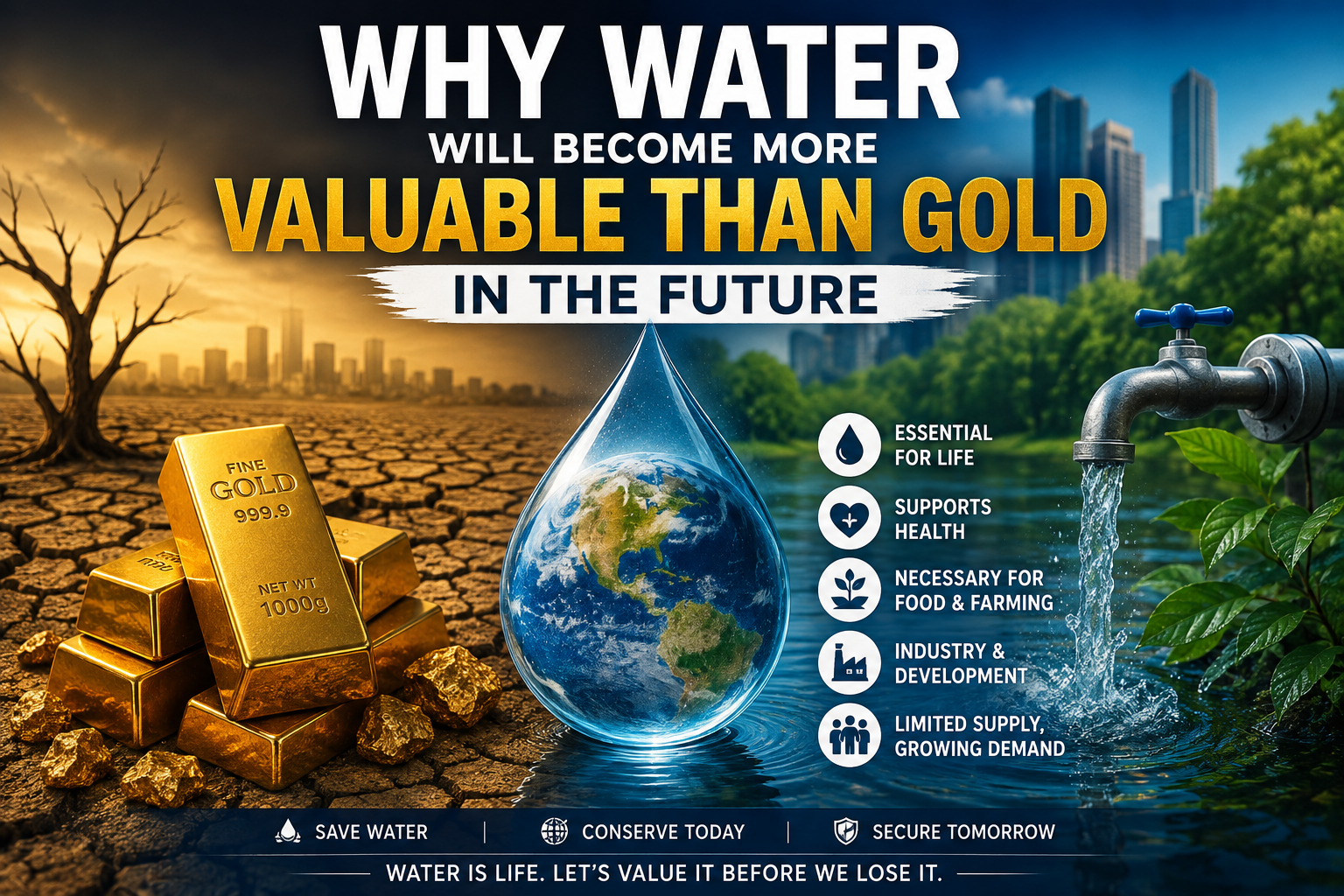
Water is something most of us use without thinking twice.
We turn on the tap in the morning, take a shower, make tea, wash vegetables, cook food and flush the toilet. For many families, water feels like an unlimited part of everyday life.
But what if it isn’t?
Around the world, freshwater resources are under increasing pressure because of population growth, pollution, groundwater depletion, climate change and rising demand from agriculture and industries. This is why many experts believe that water could become one of the most strategically important resources of the future.
Gold may be rare and expensive, but we can live without it.
We cannot live without water.
That simple fact could completely change the way we think about wealth, development and even security in the coming decades.
Water Is More Important Than Gold
Gold has been considered valuable for thousands of years. It is used in jewellery, technology, investments and financial systems.
But gold is not essential for human survival.
Water is.
The human body can survive only a limited time without water. Every cell, tissue and organ depends on it. Agriculture needs water to grow food. Factories need water to manufacture products. Electricity generation often depends on water. Cities require huge quantities of water every day.
This makes water fundamentally different from ordinary commodities.
You can postpone buying gold.
You cannot postpone drinking water.
The World Has Plenty of Water—So Why Is There a Problem?
At first, this sounds confusing.
Earth is often called the “blue planet” because approximately 71% of its surface is covered by water. So why do we keep hearing about water shortages?
The answer is that most of Earth’s water is saltwater found in oceans.
Only a small fraction is freshwater, and an even smaller portion is readily available for human use.
Freshwater is found in rivers, lakes, wetlands, glaciers, groundwater and other sources. But these resources are not evenly distributed across the planet.
Some regions receive abundant rainfall, while others experience long periods of drought.
And climate change is making this imbalance more complicated.
Groundwater Is Becoming a Hidden Concern
One of the biggest water problems is happening beneath our feet.
Groundwater is stored underground and is an important source of drinking water and irrigation in many parts of the world.
The problem begins when humans extract groundwater faster than nature can replenish it.
Imagine having a bank account.
If you withdraw money faster than you earn it, your savings eventually disappear.
Groundwater works in a similar way.
When farmers, industries and cities continuously pump groundwater without allowing enough time for natural recharge, underground reserves can decline.
The worrying part is that groundwater depletion is often invisible.
A dry river is easy to notice.
An underground water reserve slowly disappearing is not.
Agriculture Uses Huge Amounts of Water
When people think about water consumption, they often imagine drinking, bathing or washing.
But agriculture is one of the biggest users of freshwater.
Every meal we eat has a hidden water footprint.
Rice, wheat, fruits, vegetables, dairy products and other foods require water at different stages of production.
This means that the future of water is closely connected to the future of food.
If farmers don’t have enough water, crop production can suffer.
If crops fail, food prices can rise.
And when food becomes expensive, the impact reaches every household.
This is why water security and food security are deeply connected.
Climate Change Is Making the Situation More Difficult
Climate change does not simply mean that temperatures will rise.
It can also affect rainfall patterns, glaciers, droughts, floods and the availability of freshwater.
Some areas may experience longer dry periods, while others may face intense rainfall and flooding.
That creates another problem.
Heavy rain does not always mean that water resources are safely replenished. When rainfall happens extremely quickly, much of the water may run off into rivers and eventually the ocean instead of slowly entering groundwater systems.
In other words, having more rain doesn’t automatically mean having more usable water.
Why India Needs to Take Water Seriously
For India, the water question is particularly important.
The country has a huge population, a large agricultural sector and rapidly growing cities. At the same time, many regions face groundwater stress, seasonal water shortages and pollution problems.
Urbanisation is adding another layer of pressure.
As cities grow, more people need water for homes, businesses, construction and industries.
But water supply systems cannot always expand at the same speed as population and development.
This creates a difficult question:
How will future Indian cities provide enough clean water for everyone?
The answer cannot simply be drilling more borewells.
We need better water management, conservation, recycling, rainwater harvesting and responsible consumption.
The Water Crisis Could Become an Economic Crisis
Water shortages don’t remain limited to the environment.
They can affect the economy.
Think about what happens if a region experiences a severe water shortage.
Farmers may produce fewer crops.
Food prices may increase.
Industries may face production problems.
Cities may spend more money transporting water.
Families may have to purchase water.
Businesses may face higher operating costs.
Eventually, a water problem can become a financial problem for millions of people.
This is one reason water could become increasingly valuable in the global economy.
Could Water Really Become More Valuable Than Gold?
Not necessarily in terms of the price of one litre compared with the price of one gram of gold.
The comparison is more about strategic value.
Gold is valuable because it is scarce, desirable and economically useful.
Water is valuable because it is essential.
If clean freshwater becomes significantly harder to access, its economic and strategic importance could rise dramatically.
Imagine two communities.
One has gold stored in a vault but no reliable water supply.
The other has abundant clean water but very little gold.
Which community would be better positioned to survive?
The answer is obvious.
Water wins.
Technology Could Help Solve the Problem
The future is not necessarily hopeless.
Technology is already changing the way humans manage water.
Smart irrigation systems can reduce agricultural water waste.
Sensors can detect leaks.
Water treatment technology can make polluted water usable.
Desalination can convert seawater into freshwater, although it requires significant energy and infrastructure.
Artificial intelligence can also help analyse weather patterns, monitor water systems and improve irrigation decisions.
Future cities could use smart water networks that automatically detect leaks and adjust supply according to demand.
The goal should not simply be to find more water.
The goal should be to waste less of the water we already have.
Rainwater Harvesting Could Become a Necessity
Rainwater harvesting sounds simple, but it can play an important role in water conservation.
Instead of allowing rainwater to flow away through drains, buildings can collect and store it or direct it toward groundwater recharge systems.
For homes, schools, apartments and offices, rainwater harvesting can become part of a larger strategy for reducing dependence on groundwater.
In the future, environmentally responsible buildings may treat rainwater as a resource rather than waste.
Every Drop Has a Hidden Cost
We often think of water only in terms of what comes out of our tap.
But every drop has a story.
Water was collected, transported, treated and distributed before reaching our homes.
Electricity and infrastructure are required to move it.
When we waste water, we are not only wasting water.
We are also wasting the energy and resources used to provide it.
A leaking tap may seem insignificant.
But millions of leaking taps can represent an enormous amount of wasted water.
What Can Ordinary Families Do?
The water crisis can feel like a problem for governments and scientists.
But households also have a role.
Simple habits can make a difference:
- Turn off the tap while brushing your teeth.
- Repair leaking taps and pipes quickly.
- Use buckets instead of unnecessarily long showers.
- Reuse suitable household water for plants or cleaning.
- Avoid wasting water while washing vehicles.
- Choose water-efficient appliances where possible.
- Support rainwater harvesting.
- Teach children why water conservation matters.
The most important change is not one dramatic action.
It is developing a mindset:
Don’t treat water as unlimited.
Children Need to Learn the Value of Water
Today’s children will live in the world we are creating now.
They may experience environmental challenges that previous generations did not face at the same scale.
That is why water education should begin at home.
Instead of simply telling a child, “Don’t waste water,” parents can explain why.
A child who understands that groundwater takes years to replenish may think twice before leaving a tap running.
Schools can also make water conservation practical through rainwater harvesting projects, gardening, water audits and environmental activities.
When children learn to value water early, conservation becomes a habit rather than a rule.
The Future May Belong to Water-Smart Cities
The cities of tomorrow will need to rethink how they use water.
Instead of the traditional model—take water, use it and throw it away—future cities may increasingly follow a circular approach.
Wastewater can be treated and reused.
Rainwater can be captured.
Leaks can be detected using sensors.
Buildings can recycle water for non-drinking purposes.
Green spaces can help absorb rainwater.
Smart technology can monitor consumption.
In such cities, water management could become just as important as roads, electricity and public transport.
What Happens If We Ignore the Problem?
Ignoring water shortages could create consequences far beyond empty taps.
Water stress can contribute to:
- Higher food prices
- Agricultural losses
- Increased household expenses
- Migration
- Pressure on cities
- Industrial disruption
- Environmental damage
- Greater competition for freshwater resources
Water problems can also affect social equality.
Wealthier households may be able to purchase water or install expensive solutions.
Poorer families may have fewer options.
That makes access to clean water not just an environmental issue but also a social and economic one.
Water May Become the New Measure of Wealth
For centuries, societies have measured wealth through land, gold, oil, buildings and money.
The future may force us to think differently.
A region with reliable rainfall, healthy rivers, protected groundwater and effective water infrastructure could become extremely valuable.
Companies that develop efficient water technologies may become increasingly important.
Farmers who use water-efficient agricultural methods may have an advantage.
Cities that successfully recycle and conserve water may become more resilient.
In this sense, water could become one of the most important forms of strategic wealth in the 21st century.
The Real Question Is Not “Will Water Run Out?”
Earth will continue to have water.
The more important question is:
Will everyone have access to enough clean and affordable freshwater?
That is the challenge we need to prepare for.
We don’t need to wait for a dramatic global water crisis before changing our behaviour.
Every repaired leak, protected lake, restored wetland, harvested rainwater drop and efficient irrigation system contributes to a more sustainable future.
Final Thoughts
Gold may shine.
Oil may power economies.
Technology may transform our lives.
But water quietly makes all of it possible.
We rarely appreciate something when it is easily available. A tap that works every morning feels ordinary—until one day it doesn’t.
The future value of water may not be measured only by its price.
It may be measured by how much life, food, health and economic stability depends on it.
Perhaps the most important lesson is simple:
We don’t need to wait until water becomes more valuable than gold to start treating it like something precious.
The time to save water is not when the well is empty.
It is while there is still water in it.
Discover more from Online Guruji
Subscribe to get the latest posts sent to your email.
This ecosystem looks solid, especially the payment options. For designers hunting tools, checking out ph957 club might give some UX insights. Need to compare its workflow against other builders.
This analysis correctly identifies the shift from luxury wealth to essential infrastructure value. Resource scarcity is the ultimate risk factor, forcing global investment into sustainable systems. Understanding these deep economic shifts is crucial for any modern portfolio, whether it’s physical assets or accessing stable platforms like gf666 বৈধ.
https://addlinks.pro/Eyn3O
Super impressed with the customer support team, they answered my questions in minutes. The gameplay is fair and rewarding. okadaplaycasino is legit!
Really impressed with the welcome offer they have right now. It gave me a great start and I’ve already had a few decent wins. Cheers to bd09bat for the great experience.
The login process is seamless and I didn’t run into any glitches. It is rare to find a site that works this efficiently on mobile. Give aurahokilogin a try if you want a hassle-free setup.
https://addlinks.pro/OibIH
https://addlinks.pro/6DdgY
Just found this legit spot for secure gaming! Check out kingph download apk game to verify the source and start playing safely today!