

“Wasn’t it just New Year’s Day a few weeks ago? Yet somehow, half the year is already gone. The days disappear in everyday responsibilities—helping my child with schoolwork, managing household concerns, navigating misunderstandings with my husband, or worrying about family issues. Life stays busy, but when I pause and look back, I often wonder where the months went. Time seems to be running faster than ever, while many of the things I wanted to do for myself remain untouched. The calendar keeps moving, but sometimes I feel as though I’m still standing exactly where I was.”
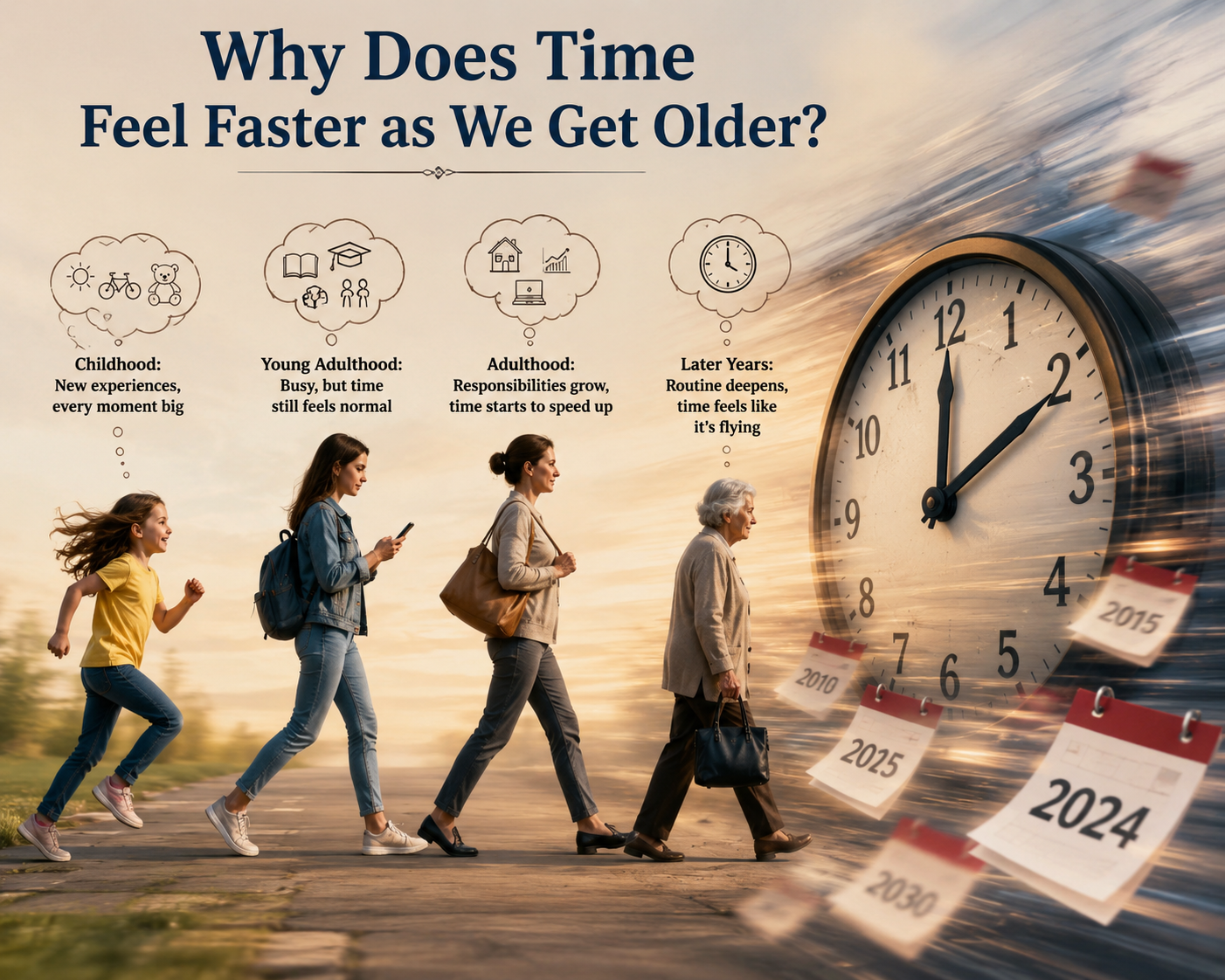
As children, a single summer vacation felt like an entire lifetime. Waiting for a birthday seemed to take forever. School terms felt endless, and the days stretched out in front of us like an open road.
But somewhere along the journey into adulthood, something changed.
Now, years seem to pass in the blink of an eye. One moment you’re celebrating New Year’s Day, and before you know it, festive lights are back in the stores and another year is coming to an end.
Many people assume this feeling is simply a part of aging. But scientists, psychologists, and neuroscientists have spent decades studying why time appears to speed up as we grow older.
The surprising answer is that time itself isn’t changing.
Our brains are.
The Childhood Summer That Never Ended
Think back to when you were ten years old.
A two-month summer vacation felt enormous. There was time to play, explore, visit relatives, ride bicycles, climb trees, and still feel like weeks remained before school started again.
Now compare that to adulthood.
A two-month period can disappear between office deadlines, household responsibilities, family commitments, and endless notifications.
What happened?
The clock hasn’t changed.
The way your brain experiences time has.
One Year Means Different Things at Different Ages
One of the most popular explanations is known as the proportional theory of time.
Imagine you are ten years old.
One year represents 10% of your entire life experience.
That’s a huge portion of everything you’ve ever known.
Now imagine you’re fifty.
One year represents only 2% of your life.
The same 365 days now feel much smaller compared to all the years you’ve already lived.
It’s similar to adding one glass of water to a small bucket versus adding the same glass to a large swimming pool.
The amount is identical, but its significance feels different.
This may partly explain why childhood years seem longer while adult years appear to race by.
Childhood Is Filled With Firsts
Children experience the world through constant discovery.
Their lives are packed with first experiences:
- First day of school
- First bicycle ride
- First best friend
- First family trip
- First sports competition
- First sleepover
Every new experience demands attention from the brain.
The brain records these moments in vivid detail because they are unfamiliar and exciting.
As adults, however, many days become predictable.
We wake up at the same time.
Drive the same route.
Perform similar tasks.
Eat at familiar places.
Watch familiar content.
Follow familiar routines.
Since the brain has seen these experiences thousands of times before, it spends less energy recording them in detail.
The result?
Time seems to move faster.
The Hidden Effect of Routine
Routine is useful.
It helps us function efficiently and reduces mental effort.
But routine has an unexpected side effect.
It compresses our memories.
Think about last Tuesday.
Can you remember every detail?
Probably not.
Now think about a memorable vacation or a wedding you attended years ago.
You can likely recall specific conversations, sights, smells, and emotions.
Why?
Because unique experiences create stronger memory markers.
When the brain looks back at a period filled with variety, it sees many memory points and concludes that the time was long and rich.
When it looks back at repetitive routines, it finds fewer markers and interprets the period as having passed quickly.
Why Vacations Feel Longer Than Work Weeks
Have you ever noticed something strange?
While you’re on vacation, time seems to move quickly.
But when you look back later, the vacation feels surprisingly long and packed with memories.
This is known as the “holiday paradox.”
A week spent exploring a new city might include dozens of memorable experiences:
- New foods
- New streets
- New people
- New sights
- New emotions
The brain stores all these details.
Months later, that single week feels substantial because it contains so many memories.
In contrast, a month of routine work may leave behind relatively few distinct memories.
The brain compresses it into what feels like a much shorter period.
Technology May Be Making Time Feel Faster
Modern life is filled with constant stimulation.
Notifications arrive every few minutes.
Videos autoplay endlessly.
Social media platforms are designed to keep us engaged.
Before we realize it, an hour of scrolling becomes three hours.
Many people have experienced sitting down to check one message and suddenly discovering that half the evening has disappeared.
Technology isn’t literally speeding up time.
But it can reduce our awareness of it.
When our attention is continuously fragmented, we become less present in each moment.
As a result, entire days can feel like they vanished without leaving a strong memory behind.
The Brain Measures Experiences, Not Minutes
Here’s one of the most fascinating discoveries about time perception.
The brain doesn’t actually measure life the way a clock does.
A clock measures seconds.
The brain measures experiences.
This explains why a five-minute embarrassing moment can feel endless.
It also explains why three enjoyable hours with friends can seem like thirty minutes.
Emotion, attention, and memory all influence how we experience time.
In many ways, our perception of time is a psychological construction rather than a simple reflection of the clock on the wall.
Can We Slow Time Down Again?
The good news is that many researchers believe we can influence how quickly life feels.
We may not be able to stop aging, but we can change how our brains experience time.
1. Learn Something New
Take up a new hobby.
Learn a language.
Try painting.
Join a dance class.
Novel experiences force the brain to pay attention and create stronger memories.
2. Travel to New Places
You don’t need an expensive international vacation.
Even exploring a new neighborhood or visiting a nearby town can introduce enough novelty to enrich your memories.
3. Break Your Routine
Take a different route to work.
Cook a new recipe.
Read a different genre of books.
Small changes create fresh experiences.
4. Practice Mindfulness
Many of us spend our days thinking about yesterday or worrying about tomorrow.
Mindfulness encourages us to notice what’s happening right now.
The more present we are, the richer our experiences become.
5. Create Meaningful Moments
The brain remembers emotional experiences.
A heartfelt conversation, a family gathering, or helping someone in need often leaves a stronger impression than hours spent scrolling through social media.
The Real Secret to Making Life Feel Longer
Perhaps the biggest lesson from the science of time perception is this:
Life doesn’t necessarily feel long because we have more years.
Life feels long because we have more memorable moments.
Children aren’t blessed with extra time.
They’re blessed with curiosity.
Everything is new.
Everything is interesting.
Everything feels worth noticing.
As adults, we often lose that sense of discovery.
We become busy, distracted, and trapped in routines.
But maybe the answer isn’t to find more time.
Maybe it’s to pay more attention to the time we already have.
Because at the end of the day, the years that feel longest are rarely the years when we were busiest.
They’re the years when we were most alive.
And perhaps that’s the real secret.
Time doesn’t slow down when we get younger.
It slows down when we keep discovering, learning, wondering, and fully experiencing the world around us.
But somewhere along the journey into adulthood, something changed.
Now, years seem to pass in the blink of an eye. One moment you’re celebrating New Year’s Day, and before you know it, festive lights are back in the stores and another year is coming to an end.
Many people assume this feeling is simply a part of aging. But scientists, psychologists, and neuroscientists have spent decades studying why time appears to speed up as we grow older.
The surprising answer is that time itself isn’t changing.
Our brains are.
Discover more from Online Guruji
Subscribe to get the latest posts sent to your email.
https://shorturl.fm/ncboF
https://shorturl.fm/rStwe
https://shorturl.fm/MDTuh
https://shorturl.fm/TRm2K
Finally a platform that actually works smoothly in my region. The login process is seamless and the app performance is top notch. bajiloginpakistanapp is definitely the way to go.
Analyzing the house edge here requires more than just browsing the features; it demands a deep dive into the underlying probability distribution. For a truly objective view, check out ppgaming link. The structure seems solid, but math always rules!
Very satisfied with the withdrawal speed. No long waiting times or weird requirements. Truly a professional platform at vn123win12.
[3954]Melbet – অনলাইন ক্যাসিনো গেমস বাংলাদেশ – melbet লগইন, অ্যাপ ডাউনলোড এবং ডিপোজিট,অনলাইন ক্যাসিনো গেমিং সাইট বাংলাদেশি প্লেয়ারদের জন্য Melbet। এখানে সাইন ইন অথবা রেজিস্টার করুন, অ্যাপ ডাউনলোড করুন এবং প্রমোশন ও ভিআইপি তথ্য যাচাই করুন। visit: melbetapp
This platform blends psychology with strategy for smart play. Unlike pure luck sites, Scater Plot games reward disciplined bankroll management and intelligent wagering in a secure, licensed environment.
JLJL99AppLogin – Anything that makes logging in easier is a win in my book. Seriously, who has time to remember a million passwords? This app gets me straight to the games I want. Login faster: jljl99applogin
https://addlinks.pro/Oi8FO