

In a World Full of Screens, Some Skills Still Belong to the Human Heart
Technology has transformed childhood in ways previous generations could never have imagined. Today’s children can talk to AI assistants, attend online classes, play immersive games, and access information from anywhere in the world within seconds. A child with a smartphone now holds more information than entire libraries once contained.
There is no doubt that technology offers incredible opportunities. It helps children learn faster, connect globally, and explore new ideas. Yet as digital tools become a bigger part of daily life, an important question emerges.
Are there some childhood skills that technology can never replace?
The answer is yes.
No matter how advanced artificial intelligence becomes, no matter how realistic virtual worlds get, certain human abilities remain deeply rooted in real-life experiences. These skills shape character, relationships, emotional intelligence, and resilience. They cannot be downloaded, automated, or fully replicated by any machine.
As parents, educators, and caregivers, understanding these irreplaceable childhood skills is becoming more important than ever.
Everyday Household Activities Build Critical Thinking Better Than We Realize
Many parents think critical thinking develops only through school assignments, educational apps, or academic exercises. In reality, some of the most powerful lessons happen during simple everyday activities at home.
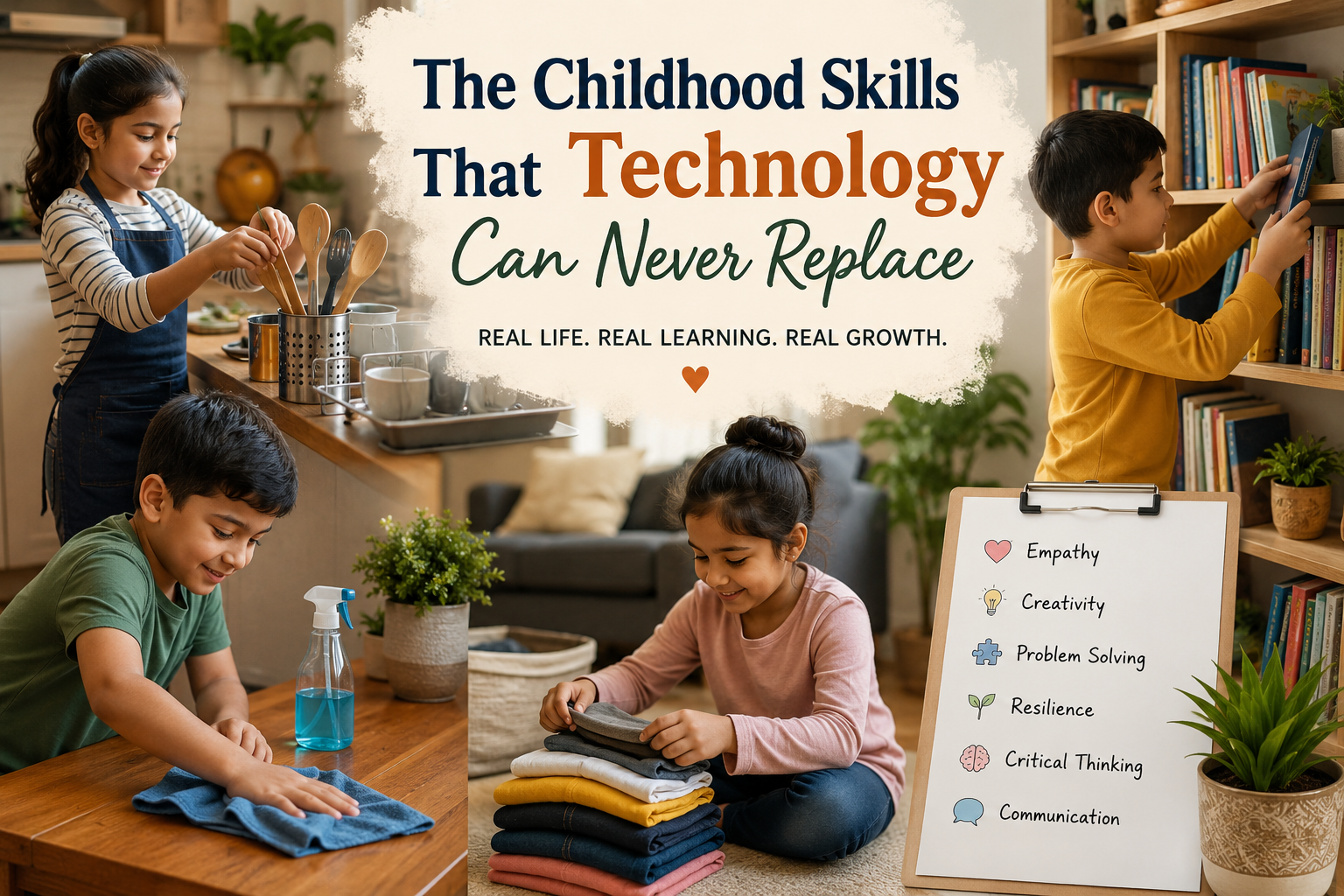
Consider tasks such as organizing kitchen utensils, dusting different areas of the house, arranging a bookshelf, sorting clothes, or helping prepare a shopping list.
At first glance, these may seem like ordinary household chores. However, each activity requires children to observe, analyze, compare, categorize, and make decisions.
For example, while arranging kitchen utensils, a child naturally starts identifying similarities and differences. They decide where each item belongs, which objects are used together, and how space can be utilized efficiently. This process activates logical thinking and problem-solving skills.
Similarly, organizing a bookshelf encourages children to create systems. They may sort books by size, subject, color, author, or frequency of use. Every choice involves reasoning and decision-making.
Even dusting the house teaches observation skills. Children learn to notice details, identify areas that need attention, plan their work, and evaluate results. These seemingly simple tasks strengthen focus, responsibility, and independent thinking.
Unlike digital activities that often provide instant instructions, household responsibilities encourage children to think for themselves. They learn to make judgments, solve small problems, and adapt when things do not go as planned.
In many ways, these everyday experiences become real-life exercises in critical thinking—skills that no screen or app can fully replace.
1. The Ability to Build Genuine Human Connections
Children learn how to connect with others not through screens but through real interactions.
A friendship formed while sharing lunch at school, playing in a park, or solving a disagreement face-to-face teaches lessons that technology simply cannot provide.
Human relationships involve:
- Reading facial expressions
- Understanding body language
- Listening carefully
- Showing empathy
- Resolving conflicts
While social media and messaging apps allow communication, they cannot fully teach the emotional depth that comes from real human contact.
A child learns kindness not from an app but from comforting a friend who is upset. They learn trust through shared experiences, not through digital interactions.
These emotional connections form the foundation of healthy adulthood.
2. Empathy: Understanding How Others Feel
Empathy is one of the most important life skills a child can develop.
It is the ability to understand and share another person’s feelings.
Technology can explain empathy. It can define empathy. AI can even discuss empathy.
But empathy itself is learned through human experience.
Children develop empathy when they:
- Care for a younger sibling
- Help a friend
- Comfort a classmate
- Observe parents showing compassion
- Interact with people from different backgrounds
Real empathy grows through observation, participation, and emotional experiences.
A machine may recognize emotions. Humans actually feel them.
That difference matters.
3. Creative Imagination Beyond Algorithms
Technology can generate images, stories, music, and videos.
But true imagination begins inside a child’s mind.
Think about childhood before constant digital entertainment.
Children turned cardboard boxes into castles.
They used sticks as swords.
Blankets became secret forts.
Clouds became animals.
Entire worlds were created from nothing more than imagination.
These moments helped children develop creativity, problem-solving abilities, and original thinking.
When children constantly consume ready-made entertainment, opportunities for imagination can decrease.
Creativity flourishes when children occasionally experience boredom.
Sometimes the best ideas emerge when there is nothing to watch and nowhere to scroll.
4. Resilience: Learning to Handle Disappointment
Life does not always go according to plan.
Children need opportunities to fail, struggle, and try again.
Technology often focuses on speed and convenience. Answers appear instantly. Problems are solved quickly.
Real life works differently.
A child who loses a game, performs poorly on a test, or faces rejection learns valuable lessons about perseverance.
These experiences teach:
- Patience
- Emotional control
- Determination
- Adaptability
Resilience develops when children encounter challenges and discover that they can overcome them.
No app can build resilience for them.
It must be experienced.
5. The Art of Face-to-Face Communication
Communication is much more than words.
Eye contact, tone of voice, facial expressions, pauses, and gestures all contribute to meaningful conversations.
Children who spend most of their social time online may have fewer opportunities to practice these important skills.
Face-to-face conversations help children learn:
- Confidence
- Active listening
- Respectful disagreement
- Public speaking
- Emotional awareness
These abilities remain essential in school, workplaces, relationships, and leadership roles.
Technology can assist communication, but it cannot replace the value of genuine human interaction.
6. Patience in an Instant World
Modern technology encourages immediate results.
Movies stream instantly.
Messages arrive instantly.
Information appears instantly.
As a result, waiting can feel uncomfortable.
Yet patience remains one of life’s most valuable skills.
Children learn patience when they:
- Wait for a plant to grow
- Practice a musical instrument
- Learn a new sport
- Build a difficult puzzle
- Work toward long-term goals
These experiences teach that meaningful achievements often require time and effort.
Success rarely happens overnight.
Patience helps children navigate challenges throughout life.
7. Moral Judgment and Ethical Thinking
Technology can provide information.
It cannot replace personal values.
Children constantly face choices involving honesty, fairness, responsibility, and integrity.
These decisions require moral judgment.
A child deciding whether to tell the truth after making a mistake is engaging in ethical thinking.
A student choosing to help a struggling classmate is making a moral choice.
These lessons come from:
- Family discussions
- Real-life experiences
- Cultural values
- Personal reflection
Technology can support learning, but character development remains deeply human.
8. Curiosity About the Real World
One of childhood’s greatest gifts is curiosity.
Children naturally ask questions:
- Why is the sky blue?
- How do birds fly?
- Where does rain come from?
- Why do leaves change color?
Technology can answer these questions instantly.
But curiosity grows strongest through exploration.
A child observing ants in a garden learns differently than one watching a video about ants.
Touching soil, climbing trees, collecting leaves, and exploring nature create powerful learning experiences.
Real-world discovery engages all the senses.
These experiences help children become lifelong learners.
9. Problem-Solving Without Immediate Assistance
Technology often provides quick solutions.
But independent problem-solving remains essential.
When children encounter challenges and work through them on their own, they develop confidence and critical thinking skills.
Whether building a toy, resolving a disagreement, or completing a difficult project, problem-solving strengthens the brain.
Children learn:
- Persistence
- Analytical thinking
- Creativity
- Decision-making
The goal is not to eliminate technology but to ensure children still have opportunities to think independently.
10. Gratitude and Appreciation
Technology gives children access to countless conveniences.
Yet gratitude often develops through experiences rather than possessions.
Children learn appreciation when they:
- Receive help from others
- Spend meaningful time with family
- Experience acts of kindness
- Contribute to their communities
Gratitude helps children focus on what they have rather than constantly seeking more.
Research consistently shows that grateful individuals tend to experience greater happiness and stronger relationships.
No digital device can teach gratitude as effectively as real life can.
Why These Skills Matter More Than Ever
Ironically, the more advanced technology becomes, the more valuable human skills become.
Artificial intelligence may perform calculations faster than humans.
Computers may process information more efficiently.
Machines may automate many tasks.
But qualities such as empathy, resilience, creativity, patience, integrity, and emotional intelligence remain uniquely human strengths.
These abilities help children thrive not only academically but also socially, emotionally, and professionally.
The future will not belong solely to those who understand technology.
It will belong to those who combine technological knowledge with deeply human skills.
Finding the Right Balance
The solution is not to reject technology.
Technology is an important part of modern life and offers tremendous benefits.
The goal is balance.
Children need opportunities to:
- Play outdoors
- Build friendships
- Solve problems independently
- Experience boredom occasionally
- Explore nature
- Participate in family conversations
- Learn from mistakes
These experiences nurture skills that no device can replace.
Technology should be a tool, not a substitute for childhood itself.
Final Thoughts
The world our children are growing up in is changing rapidly. Artificial intelligence, smartphones, virtual reality, and digital learning will continue shaping the future.
But amid all these innovations, the most important childhood lessons remain timeless.
The ability to care, imagine, persevere, communicate, explore, and connect with others cannot be programmed into a machine.
These skills are learned through laughter, friendships, challenges, mistakes, adventures, conversations, and everyday life.
As parents and educators, perhaps our greatest responsibility is not only preparing children for a technological future but also protecting the human qualities that make childhood meaningful.
Because while technology will continue evolving, the heart of childhood remains wonderfully, beautifully human.
Discover more from Online Guruji
Subscribe to get the latest posts sent to your email.
https://shorturl.fm/mETZe
https://shorturl.fm/loBeU
https://shorturl.fm/NI3bw
https://shorturl.fm/p3FIe
https://shorturl.fm/G1wfS
Just zoning out at this meeting and found your post on 5jili’s secure gaming hub; the walkthrough for 5jili slot download looks solid, but I’ll stick to cautious optimism until more data trends confirm their reliability.
https://shorturl.fm/sOvVA
https://shorturl.fm/4uXiz
Initially skeptical about these patterns, I actually see some statistical merit here. The structure of phwin 25 seems robust; check out phwin 25 online casino for a clearer view. Impressive depth!
Seen this approach; it reminds me of reading basic strategy charts. Keep that focus on smooth navigation, like checking out the ph777 link slot download. Consistency beats complexity every time at the felt.
https://shorturl.fm/JLeEl
https://shorturl.fm/E81UM
The odds here are some of the best I have seen for football and basketball. It is my go to spot for every weekend game. Definitely visit apuestadeportiva.
No more login issues for me since I started using this portal. It is fast, secure, and gets me straight to my favorite games. Use ole777login for a hassle free entry.
This site has a really cool vibe and the bonuses are actually generous. I have had some great wins here recently. Check out mm5lion for more action.
Everything about this site feels professional and trustworthy. The rewards system is quite generous for loyal players. Check out wakanda123situs for a fun time.
Solid platform with a great community vibe. It is always exciting to see who is winning today. I am really enjoying bdtak999.
The structure of jl333 is intriguing; it feels less like a casino and more like a calculated betting matrix. Understanding the rhythm is key, much like deep e-sports analysis. Check out jl333 login for a feel for that balance.
Interesting analysis! Seeing patterns in numbers is key, and a secure platform is crucial for enjoying games. Just checked out jl365 login – seems they prioritize both fun and safety, which is great for peace of mind while playing!
Dude, this whole betting scene is deep. Reading this made me think about how much info you gotta check, even with guides like the 1xbet philippines app review. Gotta be careful about what’s legit, you know?
Be wary of glossy UIs; security trumps aesthetics always. While k6732 app casino looks smooth, validate every login path. Prudence is your best defense!
Just what I was looking for. The stability of the app is impressive and everything runs just as it should. Keep it up bdck4444aps