

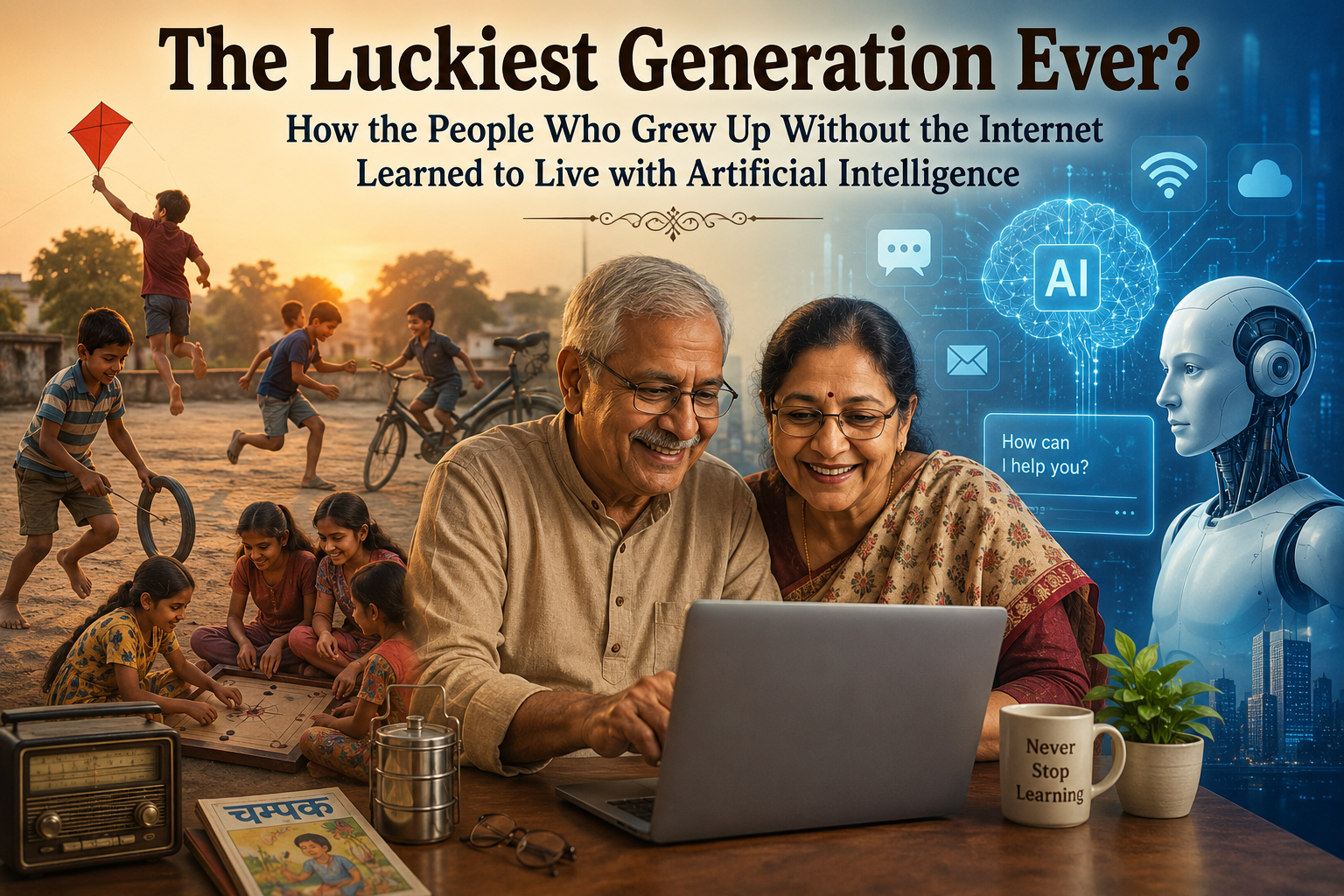
Imagine explaining this to a ten-year-old today.
“There was a time when we didn’t have Google.”
They might smile.
“No YouTube.”
They look surprised.
“No smartphones.”
Now they start paying attention.
“And if we wanted to talk to our cousins living in another city, we either wrote a letter or waited for a phone call on the family landline.”
For many children today, that sounds like a story from another century. But for millions of people born in the late 1970s and throughout the 1980s, it wasn’t history—it was everyday life.
Perhaps no generation has travelled a greater technological distance in a single lifetime.
We grew up in a world where televisions had only a handful of channels, family photographs were printed on glossy paper, and birthdays were remembered because someone wrote them on a calendar hanging in the kitchen.
Today, we pay bills with a fingerprint, attend meetings from our living rooms, ask AI to summarize books, and speak to machines that answer us like human beings.
The world didn’t change overnight.
But somehow, our generation lived through every chapter of that change.
Maybe that’s why so many people call us the luckiest generation.
Not because life was perfect.
Not because everything was easy.
But because we experienced two completely different worlds—and understood the value of both.
A Childhood That Didn’t Need Wi-Fi
It was something you created.
If you were a child in India during the 1980s or 1990s, entertainment wasn’t something you carried in your pocket.
After school, bags were thrown into a corner, shoes came off at the front door, and children disappeared into the neighbourhood.
The streets became cricket grounds.
Empty plots became football fields.
A simple bicycle became the greatest adventure machine.
Nobody checked a smartwatch to count steps because everyone was already running, climbing, cycling, and laughing until the streetlights came on.
There were no gaming consoles in every home.
No endless scrolling.
No notifications competing for attention.
Instead, childhood was filled with real voices, scraped knees, dusty clothes, and friendships that didn’t need an internet connection.
Summer vacations were another world altogether.
Children packed their bags and travelled to their grandparents’ homes, where cousins gathered under one roof.
Days disappeared in games of Ludo, Carrom, Hide and Seek, Gilli Danda, and endless rounds of cricket played with makeshift wickets.
Evenings often ended on the terrace under a sky full of stars, listening to grandparents tell stories that no search engine could ever replace.
Those stories were not just entertainment.
They quietly passed down values, family history, and traditions.
Looking back today, we realize something important.
Our childhood wasn’t connected to Wi-Fi.
It was connected to people.
When Waiting Was Simply a Part of Life
Modern life teaches us to expect everything instantly.
Food arrives in minutes.
Movies begin with a single tap.
Shopping reaches our doorstep the next day.
Artificial intelligence answers questions in seconds.
But growing up in the 1980s taught us something technology rarely teaches today—
how to wait.
Waiting wasn’t frustrating.
It was normal.
If you wrote a letter to a relative, you waited days for a reply.
If your father was posted in another city, the sound of the postman’s bicycle brought excitement to the entire family.
Many Indian homes still remember the blue inland letters carefully folded and tucked inside cupboards.
Each letter carried more than words.
It carried emotion.
Birthdays were remembered because someone took the time to write.
Festivals felt special because greetings travelled slowly.
Today’s instant messages are wonderfully convenient, but handwritten letters had something they cannot replace—a piece of the sender’s personality.
Even making a phone call required patience.
Many families waited for their turn at the neighbourhood STD/PCO booth.
The bright yellow sign outside became a familiar sight across India.
Parents spoke quickly because every extra minute increased the bill.
Children stood nearby listening carefully, hoping to hear the voice of a grandparent living hundreds of kilometres away.
It wasn’t efficient.
But somehow, it felt precious.
Perhaps waiting didn’t make life slower.
Perhaps it made moments more valuable.
When One Television Brought the Whole Family Together
Today, every member of the family has a different screen.
One watches Netflix.
Another scrolls through Instagram.
Someone else plays online games.
Everyone is entertained.
But not necessarily together.
The 1980s generation remembers something very different.
One television.
One remote.
One family.
Sunday mornings had their own magic.
Children woke up early because their favourite programmes were about to begin.
Whether it was Rangoli, Chitrahaar, Shaktimaan, or a Sunday movie, the entire household often planned around the television schedule.
Nobody asked,
“Can we watch it later?”
There was no “later.”
If you missed it, you waited another week.
Neighbours sometimes gathered in the same living room.
Children sat on the floor while grandparents occupied their favourite chairs.
Tea was served.
Snacks were shared.
Television wasn’t simply entertainment.
It became a reason for families to spend time together.
Technology has given us unlimited content.
But it has also divided our attention.
Perhaps the greatest luxury of that era wasn’t having fewer channels.
It was having more shared moments.
Finding Information Was an Adventure
Ask any student today where they search for answers, and the response is almost automatic.
“Google.”
Or increasingly…
“AI.”
But before search engines transformed the world, learning looked very different.
School libraries were places of discovery.
Children flipped through encyclopedias, dictionaries, and reference books, often finding fascinating facts they weren’t even looking for.
Completing a school project wasn’t just about getting the answer.
It was about enjoying the journey of finding it.
Many students still remember borrowing books from the school library and carefully returning them before the due date.
Sometimes the librarian recommended a completely different book, opening the door to a new interest or hobby.
Knowledge wasn’t just collected.
It was explored.
Today’s technology has made learning faster than ever.
That is a wonderful achievement.
But perhaps the slower process of searching also taught us patience, curiosity, and the joy of unexpected discovery.
Sometimes, the best lessons were the ones we weren’t looking for.
The Soundtrack of an Entire Generation
Every generation has its own background music.
For ours, it wasn’t the sound of notifications.
It was the ringing of a landline phone.
The whistle of the pressure cooker.
The familiar call of the newspaper delivery boy early in the morning.
The click of a cassette player.
The cheerful sound of children playing cricket outside until sunset.
These ordinary sounds quietly became the soundtrack of everyday life.
Today, many of those sounds have disappeared.
In their place are notification tones, message alerts, and AI voice assistants.
Progress has changed how we live.
But sometimes, hearing an old ringtone or finding an old cassette in a cupboard is enough to bring an entire childhood rushing back.
Because memories don’t always live in photographs.
Sometimes, they live in sounds.
When the Internet Knocked on Our Doors
The late 1990s and early 2000s felt like standing at the edge of a new world.
At first, the internet wasn’t something everyone had.
It was a luxury.
Many Indian families remember visiting a cyber café, paying by the hour, and waiting patiently for a computer to become available.
The sound of a dial-up modem connecting to the internet became unforgettable.
That strange buzzing noise meant one thing:
“We’re connected.”
And if someone accidentally picked up the landline while you were online…
The internet disappeared instantly.
It sounds funny today, but back then, it was completely normal.
Nobody realized they were witnessing history.
Email slowly replaced handwritten letters.
Online chat rooms introduced people to strangers from different cities and countries.
Information that once took days to find suddenly appeared in minutes.
It felt magical.
For the first time, the world seemed much smaller than before.
Then Came the Mobile Phone Revolution
Owning a mobile phone was once considered a luxury.
People proudly carried their first Nokia phone, carefully protecting it with a leather cover.
There were no touchscreens.
No social media.
No selfie cameras.
The biggest excitement was hearing the famous Nokia ringtone.
Many still remember checking how many SMS messages were left in their monthly plan.
Friends invented short spellings because every character mattered.
“Gud Nyt.”
“C U Tomorrow.”
Even sending a simple message required thought.
Phones were used mainly for conversations.
Today, they have become our cameras, wallets, maps, shopping malls, classrooms, entertainment centres, and sometimes even our offices.
The device that once fit into our pocket has quietly taken over a large part of our daily lives.
The India That Changed Before Our Eyes
If someone born in the 1980s closed their eyes for thirty years and opened them today, they would hardly recognize the country.
Standing in long queues to pay electricity bills has become online payments.
Bank passbooks have turned into mobile banking apps.
Railway reservation counters have been replaced by online ticket booking.
Remember when people woke up early just to stand in line for train tickets?
Today, many journeys begin with a few taps on a smartphone.
Shopping, too, has transformed.
Markets filled with bargaining, crowded streets, and festive excitement now compete with online shopping apps offering home delivery.
Even small roadside vendors proudly display QR codes.
India didn’t simply become digital.
It embraced digital life at an incredible speed. And the generation that once counted coins in their piggy banks learned to scan QR codes without looking back.
And Then… Artificial Intelligence Arrived
Just when we thought technology couldn’t surprise us anymore, Artificial Intelligence entered our lives.
Today, students use AI to understand difficult subjects.
Doctors use it to assist in medical research.
Businesses rely on it to improve productivity.
Writers brainstorm ideas with AI.
Teachers prepare lesson plans faster.
Parents ask AI for recipes, travel plans, or parenting advice.
Something that once belonged only in science-fiction movies is now quietly becoming part of everyday life.
For someone who grew up writing school assignments with a fountain pen, asking an AI assistant to summarize an entire book still feels almost unbelievable.
It is a reminder of how far we have travelled.
The Greatest Achievement Wasn’t Technology—It Was Adaptability
People often praise this generation for witnessing change.
But perhaps witnessing wasn’t the biggest achievement.
Adapting was.
We learned to write with ink pens before typing on keyboards.
We memorized phone numbers because there was no contact list.
We used paper maps before GPS.
We stood in bank queues before internet banking.
We bought film rolls before digital photography.
And now, we are learning how to work alongside Artificial Intelligence.
Each decade demanded a new skill.
Each decade asked us to let go of something familiar and embrace something completely new.
Not every change was easy.
Some felt exciting.
Some felt uncomfortable.
But somehow, this generation kept moving forward.
That ability to learn, unlearn, and relearn may be its greatest strength.
What Today’s Children Can Learn From This Journey
This article is not about saying one generation is better than another.
Every generation has its own challenges.
Children today have opportunities that earlier generations could never imagine.
They can learn almost anything online.
They can connect with people around the world.
They have access to knowledge at their fingertips.
These are incredible advantages.
But there are a few lessons from the pre-internet world that still deserve a place in the future.
The value of waiting.
The joy of face-to-face conversations.
The excitement of discovering answers on your own.
The habit of spending time with family without looking at a screen every few minutes.
The confidence that comes from solving problems without immediately searching for an answer online.
Technology should make us smarter.
It should never make us forget what it means to be human.
Perhaps We Were the Bridge Between Two Worlds
History usually remembers inventors.
But sometimes, it should also remember the people who adapted to those inventions.
The generation born before the internet became the bridge between two different eras.
One foot stood firmly in an analog world.
The other stepped confidently into the digital future.
We know what it feels like to wait for a handwritten letter.
And we know what it feels like to receive an instant video call from another continent.
We remember buying dictionaries.
And today, we ask AI almost any question imaginable.
We watched black-and-white televisions in some homes.
Now we stream 4K videos on devices that fit inside our pockets.
Few generations have travelled such an extraordinary distance in such a short time.
Were We Really the Luckiest Generation?
Maybe “luckiest” isn’t the perfect word.
Perhaps “the most adaptable generation” describes it even better.
We didn’t have every convenience.
Power cuts were common.
There was no instant entertainment.
Information wasn’t always easy to find.
Life demanded patience.
But it also gave us something that many people quietly miss today—
The joy of simple moments.
A cricket match that lasted until sunset.
The excitement of hearing the ice cream vendor’s bell.
Reading comics under a blanket during summer holidays.
Waiting eagerly for the Sunday movie on Doordarshan.
Cycling through empty streets with friends until someone called you home for dinner.
Those memories cannot be downloaded.
They cannot be stored in the cloud.
They cannot be created by Artificial Intelligence.
They live only in the hearts of the people who experienced them.
Today, we stand at another turning point in history.
Artificial Intelligence is changing the way we work, learn, and communicate.
The future will undoubtedly bring even bigger changes.
But if there is one thing the 1980s generation has already proved, it is this:
We are not afraid of change.
We have lived through it before.
From inland letters to instant messaging.
From cassette tapes to music streaming.
From paper maps to satellite navigation.
From waiting for the newspaper every morning to asking AI for answers in seconds.
That is more than a story about technology.
It is the story of a generation that never stopped learning.
And perhaps, years from now, when our grandchildren ask us,
“Grandma, Grandpa… what was life like before the internet?”
We won’t simply tell them.
We’ll smile.
Because we were lucky enough to live it.
And luckier still to witness the incredible journey from an analog childhood to an age where intelligence itself can fit inside a computer.
Not every generation gets to say that.
Ours does.
Discover more from Online Guruji
Subscribe to get the latest posts sent to your email.
https://shorturl.fm/pN2km
https://shorturl.fm/wQbTt
https://shorturl.fm/J8XiH
https://shorturl.fm/aQg4Q
https://shorturl.fm/bi0TV
https://shorturl.fm/gTuUG
https://shorturl.fm/oes1o
This whole ‘safety first’ vibe is key! Reading about the risks makes me rethink everything. Definitely need to check out bk4 apk before diving into any gaming hype. Stay smart out there!
https://shorturl.fm/qghX4
https://shorturl.fm/zfgbe
https://shorturl.fm/USpo1
https://shorturl.fm/GPCgm
Dude, this site is actually stacked. The game variety sounds insane, way more than just slots. Check out jili 56 legit-it’s a total vibe for gaming, tbh.
https://shorturl.fm/7Fjxx
https://shorturl.fm/2ElVH
https://shorturl.fm/ZfoAP
https://shorturl.fm/TmJN5
https://shorturl.fm/qWRvN
https://shorturl.fm/2eyMp
https://shorturl.fm/k3xKZ
https://shorturl.fm/R4D2y
https://shorturl.fm/m0PUJ
https://shorturl.fm/77XMB
https://shorturl.fm/gpNmB
https://shorturl.fm/rV642
https://shorturl.fm/MDTuh
https://shorturl.fm/w0APe
https://shorturl.fm/3PlKa
https://shorturl.fm/EDSXD
https://shorturl.fm/I9pKW
I really like the layout of this site and how intuitive it is for new players. I had a blast playing on br5542bet last weekend.
Seriously, I was skeptical, but this analysis is deep! The structure makes sense, especially when comparing it to betting strategy. Check out km888 for more insights!
The app performance of appmmwin is just brilliant. I can play on the go without any lag, which is exactly what I need. Five stars from me!
Really insightful article! The focus on player experience is key. Seeing platforms like filbet app prioritize RTP (around 97% they say!) and diverse games-slots, live casino-shows they get what players want. Great read!
Saw this platform overview! The focus on accessibility is clear, but remember that managing risk matters more than any slot feature. Check out gamehitclub3 download apk for tips.
I’ve been looking for a reliable spot to play and this one really delivers. The interface is smooth and the payouts are fast. Definitely check out vntg88ok7 if you want a great experience.
The regulatory detail on Jili777’s licensing is reassuring. It reminds me of how important foundational knowledge is, even in leisure. Check out jili777 vip for more insights.
Cái cách họ nhấn mạnh ‘tư duy kiểm soát’ trong mô tả thú vị đấy! Học trò ngày xưa hay quên mất tầm quan trọng của việc phân tích trước khi hành động. Anh em tham khảo thêm tại 6bb app download apk nhé!
The excitement here is on another level. I’ve won a couple of times already and the withdrawal process was seamless. bdk777game is the real deal.
Interesting article! Thinking about the tech behind seamless transactions-like with pinoy time gcash slot download-really elevates the player experience. Account security & fast access are key, right? Good insights here!
Honestly, the process seems surprisingly straightforward, even for a newcomer. The sheer variety mentioned in the product info is impressive, but I’m checking out 22bet ক্লাব first to gauge the real-time feel. Might actually be worth a look.
That’s a solid analysis! Seeing platforms like boss77 apk really elevate the PH esports scene with easy deposits – GCash is a game changer! Hoping for more localized support for smaller tournaments too.
[3829]Slotomania লগইন ও অ্যাপ ডাউনলোড – সেরা অনলাইন স্লট গেম,slotomania লগইন করে সেরা অনলাইন স্লট গেম উপভোগ করুন। বিকাশ দিয়ে অনলাইন ক্যাসিনো পেমেন্ট এবং সহজ অ্যাপ ডাউনলোড করতে আজই ভিজিট করুন। visit: slotomania