

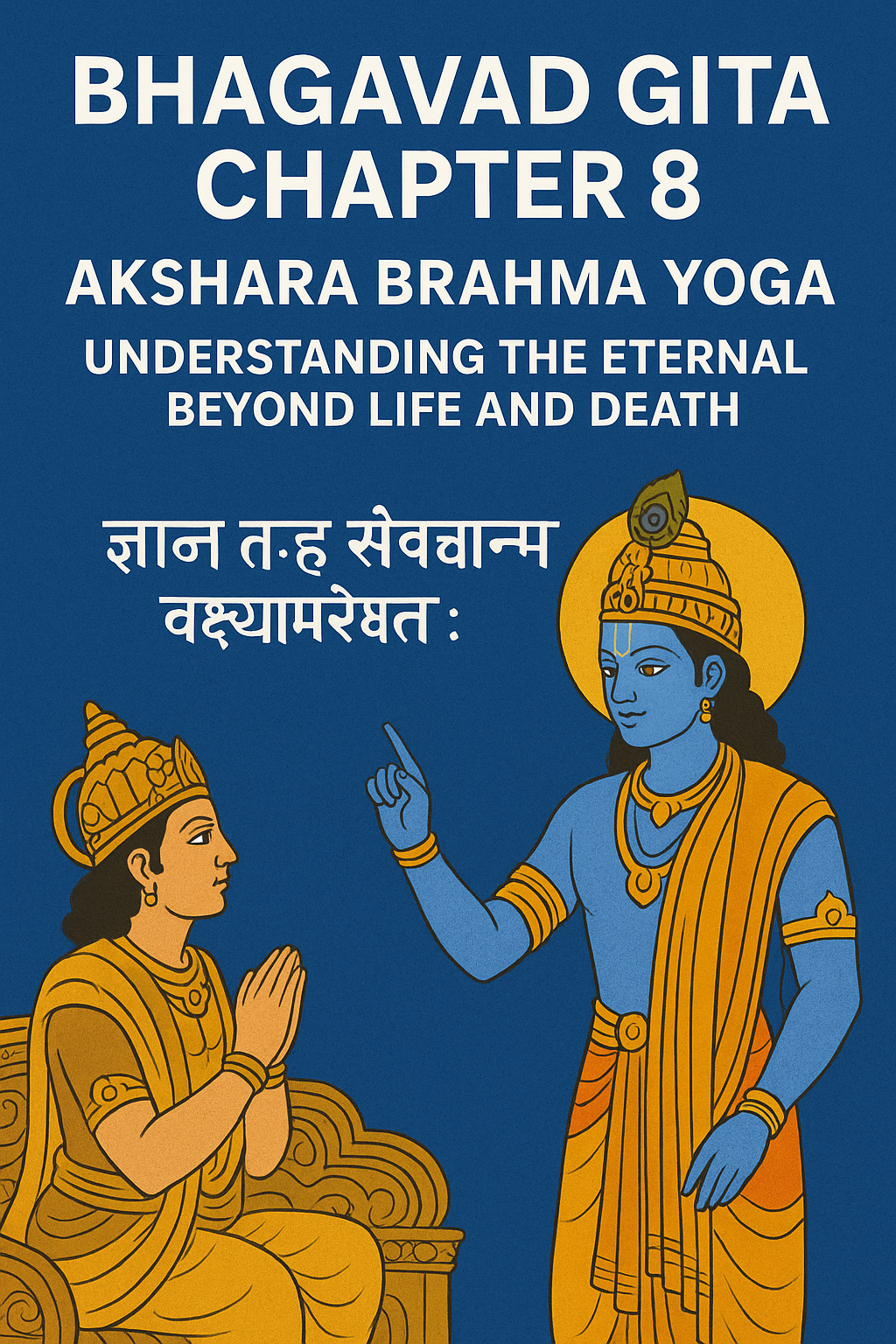
Introduction: The Search for the Eternal
Life and death have always been the biggest mysteries for humankind. From the time of birth, every soul unknowingly walks towards death, but what lies beyond remains a question. Arjuna too wondered about the eternal, the imperishable, and the ultimate journey of the soul. In Chapter 8 of the Bhagavad Gita, known as Akshara Brahma Yoga, Lord Krishna answers these questions, guiding us to understand what Brahman (the eternal truth) is, what karma means in the larger context, and how one can reach liberation (moksha).
This chapter beautifully explains how our last thought at the time of death shapes our next birth—or leads us to freedom beyond the cycle of life and death. Let us dive deeper into the essence of this chapter.
1. Arjuna’s Questions: The Curiosity of a Seeker
At the start of Chapter 8, Arjuna asks Lord Krishna six important questions:
- What is Brahman (the eternal reality)?
- What is the self (Adhyatma)?
- What is karma?
- What is the material world (Adhibhuta)?
- What is the divine (Adhidaiva)?
- Who is the presiding deity of sacrifice (Adhiyajna)?
These are not just Arjuna’s questions—they reflect the curiosity of every spiritual seeker who wants to know about life, death, and what lies beyond.
2. Krishna’s Answers: The Key Concepts
- Brahman (Eternal Reality): That which never perishes. It is beyond time, birth, and death.
- Adhyatma (The Self): The eternal soul residing within every being.
- Karma: All actions that shape our destiny and future births.
- Adhibhuta (Material World): The ever-changing physical universe that eventually dissolves.
- Adhidaiva (The Divine Principle): The cosmic forces that govern existence.
- Adhiyajna (Lord within): Lord Krishna himself, who sustains and receives all sacrifices.
3. The Power of the Final Thought
One of the most profound teachings of this chapter is:
“Whatever one remembers at the time of leaving the body, that alone he attains in his next life.”
This means the state of mind at the time of death determines the future of the soul. If one remembers God with devotion and surrender, liberation is assured. Hence, practicing constant remembrance of the Divine in daily life is crucial.
4. Two Paths After Death: Light and Darkness
Lord Krishna explains two eternal paths:
- Path of Light (Archiradi Marga): Souls who follow knowledge, meditation, and devotion reach liberation and do not return to the cycle of rebirth.
- Path of Darkness (Dhoom Marga): Souls attached to worldly desires and ignorance take this path, leading to rebirth.
This teaching inspires us to choose our actions and mindset wisely.
5. Importance of Devotion (Bhakti Yoga)
Krishna emphasizes that devotion is the easiest and most effective way to reach Him. Rituals, austerities, or sacrifices may be complex, but sincere devotion (bhakti) connects us directly with the Divine.
6. The Concept of Time: The Cosmic Clock
Krishna explains that the material world goes through cycles of creation and destruction. Day and night for Brahma (the creator) are beyond human imagination—his one day lasts thousands of human ages. Everything created is temporary, but the soul and Brahman remain eternal.
This gives us perspective: our struggles, achievements, and attachments are temporary. What truly matters is our connection with the eternal.
7. Krishna’s Assurance: The Promise of Liberation
Krishna assures Arjuna that anyone who constantly remembers Him, meditates upon Him, and dies with surrender in the heart will attain liberation, never to return to the cycle of birth and death.
This is the ultimate message of hope and faith—God is accessible to all who surrender with love.
8. Practical Lessons from Chapter 8
- Live Mindfully: Your daily thoughts shape your final thoughts.
- Practice Devotion: Even small acts of prayer or chanting God’s name prepare the soul for liberation.
- Detach from the Temporary: Understand that material possessions and achievements are fleeting.
- Remember the Divine: Make God a constant companion in life, not just at the time of death.
- Balance Karma with Bhakti: Perform your duties, but surrender the results to God.
9. Relevance in Modern Life
In today’s fast-paced, stressful world, Chapter 8 offers peace and clarity:
- It teaches us to focus on what is permanent instead of chasing temporary gains.
- It reminds us that death is not an end but a transition.
- It encourages us to live a spiritually connected life, reducing anxiety and fear of the unknown.
Conclusion: The Path Beyond Life and Death
Chapter 8 of the Bhagavad Gita, Akshara Brahma Yoga, takes us beyond the material realm, giving us a roadmap to liberation. It explains the eternal truth of the soul, the imperishable Brahman, and the power of remembrance at the time of death.
Lord Krishna’s timeless wisdom reassures us that life’s ultimate goal is not wealth, fame, or power, but eternal union with the Divine. By living with devotion, performing our duties, and remembering God, we too can walk the path of light and find eternal peace.
Discover more from Online Guruji
Subscribe to get the latest posts sent to your email.
Gave Win5bet a go the other day. Simple enough layout, easy to navigate. Can’t hurt to have a look and see if they’ve got anything that tickles your fancy. Have a look: win5bet
888betstanzania is pretty good, especially if you’re in Tanzania. Localized experience and decent sports betting options. Nothing too fancy but just good old basic betting experience. Give them a try! 888betstanzania
The mobile app is a game changer. I can play anywhere without any glitches. It’s much more convenient than the browser version. Cheers to bt777app
Finally found a place where the login is stable and the games actually load quickly. The user experience is top notch here. liga2000login
Solid platform with a very trustworthy feel. The sign up process was a breeze and I started playing within minutes. Big thanks to pamanempirelogin
I’ve been trying a few different sites lately, but the experience here is surprisingly smooth. The payouts are fast and the interface is very user-friendly. Highly recommend r888bet for anyone looking for a reliable spot.
Best app for gaming in the PH right now. The graphics are crisp and the game variety is amazing. Love how pkjililinkapp handles everything so professionally.
Finally found a reliable link that actually works without any redirects. The interface is very user-friendly. Highly recommend jepor987link to everyone.
Solid platform with a lot of great promotions for new players. Everything runs perfectly on my mobile phone via vnvwin88