

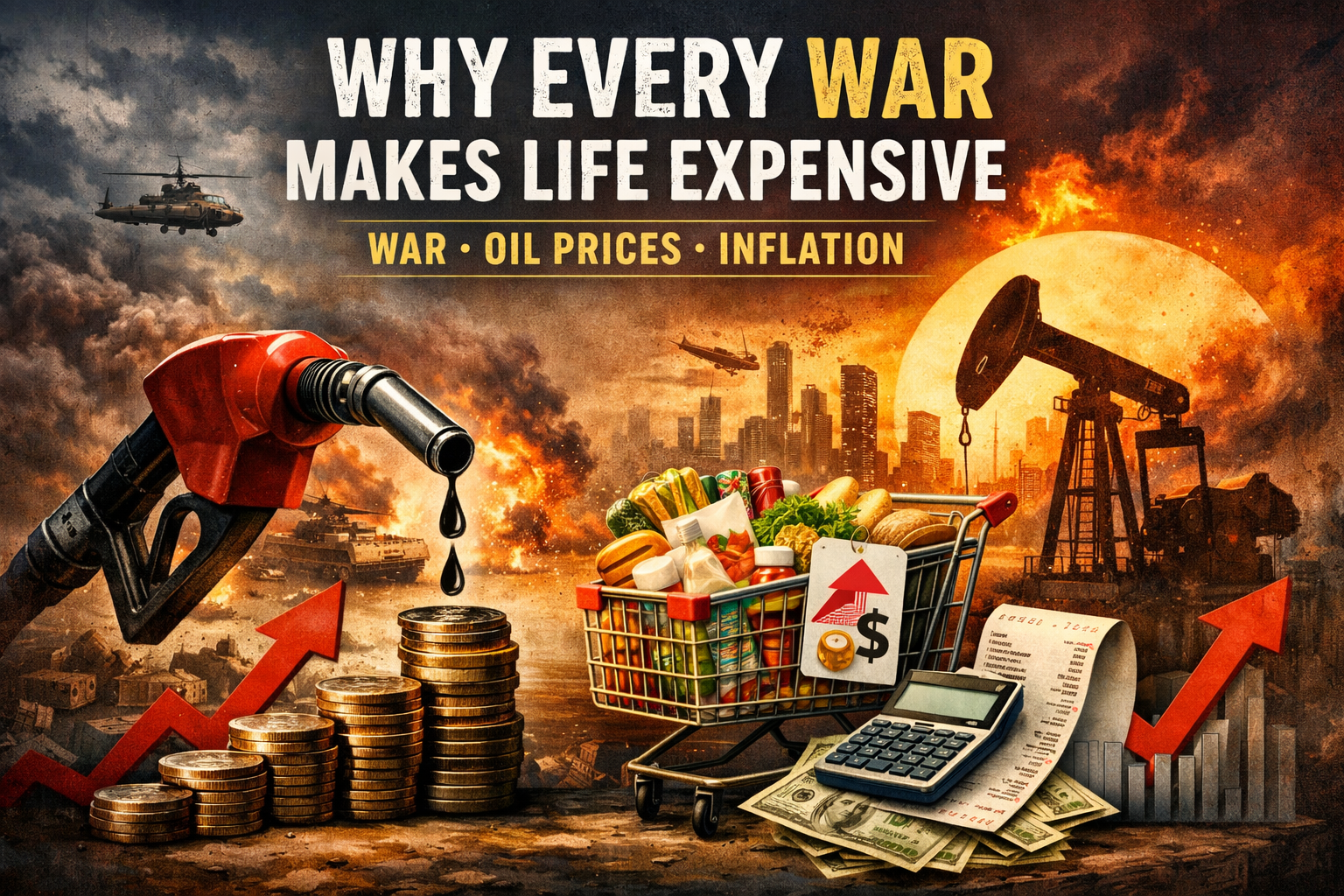
When War Feels Far Away but Costs You More
When we hear news about wars happening in distant parts of the world, many people assume it has little to do with their daily lives. After all, if the conflict is thousands of kilometers away, how could it possibly affect what we pay for groceries, fuel, or electricity?
Yet history shows a very different reality. Almost every major war in modern times has led to rising prices across the world. Even people living in peaceful countries begin to feel the economic pressure through inflation, higher fuel costs, and increasing living expenses.
The reason behind this is something economists often call the inflation chain. War disrupts supply, increases uncertainty, and pushes up the price of critical resources—especially oil. Once fuel becomes expensive, the cost of transportation, manufacturing, and food production also rises.
Slowly but steadily, the ripple effect reaches ordinary households.
In this article, we will explore why wars make life expensive, how oil prices trigger inflation, and why middle-class families are usually the ones who feel the biggest financial pressure.
The First Shock: War Creates Global Uncertainty
One of the biggest economic impacts of war is uncertainty.
Markets depend heavily on stability. When a war begins, governments, investors, and businesses suddenly face unpredictable conditions. Trade routes may be disrupted, sanctions may be imposed, and industries may shut down.
Because of this uncertainty:
- Investors become cautious.
- Companies reduce production.
- Global trade slows down.
When supply becomes uncertain but demand remains strong, prices naturally rise.
This is the first step in the inflation chain.
Even if a country is not directly involved in the war, the global economic system is so interconnected that disruptions quickly spread across borders.
Oil: The Most Powerful Link in the Inflation Chain
Oil plays a critical role in the global economy. It fuels transportation, powers industries, and supports agriculture. Because of this, even a small increase in oil prices can trigger widespread inflation.
Wars often occur in or around regions that are important for oil production or transportation. When conflict threatens oil supplies, global markets react immediately.
For example, oil prices can rise because:
- Production facilities are damaged.
- Shipping routes become unsafe.
- Countries impose trade restrictions.
- Oil-producing nations reduce supply.
As oil prices rise, the cost of fuel increases worldwide.
And when fuel becomes expensive, almost everything else follows.
Transportation Costs Rise First
The first visible effect of rising oil prices is increased transportation costs.
Every product we buy travels through multiple transportation stages:
- Trucks carrying goods between cities
- Ships transporting imports and exports
- Trains delivering raw materials
- Air cargo for fast-moving products
When fuel prices rise, transportation companies increase their charges.
This extra cost is passed down to businesses, which then raise the price of their products.
Eventually, consumers see higher prices in supermarkets, online stores, and local markets.
Food Prices Begin to Climb
Food is one of the sectors most affected by the inflation chain.
Agriculture depends heavily on fuel and energy. Farmers use diesel for tractors, irrigation pumps, and transportation of crops. Fertilizer production also depends on energy resources like natural gas.
When energy costs rise due to war-related oil price increases:
- Farming becomes more expensive
- Food transportation costs rise
- Storage and refrigeration costs increase
As a result, food prices start climbing.
For middle-class families, this becomes especially difficult because food is one of the largest monthly expenses.
Even a small percentage increase in grocery prices can significantly affect household budgets.
Manufacturing Becomes More Expensive
Factories and manufacturing industries are also highly sensitive to energy costs.
War-driven inflation increases the cost of:
- Electricity
- Raw materials
- Transportation of goods
When production becomes more expensive, companies must raise prices to maintain profitability.
This leads to higher costs for everyday items such as:
- Clothing
- Electronics
- Household appliances
- Construction materials
Gradually, the cost of living rises across multiple sectors.
Global Trade Disruptions Add More Pressure
War often disrupts global trade networks.
Shipping routes may become dangerous, ports may close, and economic sanctions may block trade between countries. These disruptions reduce the availability of goods in the global market.
When supply decreases but demand remains constant, prices increase.
For example:
- Grain shortages can push up food prices.
- Semiconductor shortages can make electronics more expensive.
- Metal shortages can raise construction costs.
These shortages create additional inflation pressure beyond oil prices.
Currency Instability Makes Imports Costlier
Another hidden impact of war is currency instability.
During global conflicts, investors tend to move their money into safer assets or stronger currencies. This can weaken the currencies of developing countries.
When a country’s currency weakens:
- Imports become more expensive.
- Fuel prices increase further.
- Foreign goods cost more.
Countries that depend heavily on imported oil or raw materials face even stronger inflation.
This is why global conflicts often create economic stress in countries that are not even part of the war.
The Middle-Class Feels the Pressure the Most
Inflation affects everyone, but the middle class usually feels the strongest impact.
Wealthy individuals often have investments that grow during inflation, while lower-income households may receive government support programs.
Middle-class families, however, face a difficult situation:
- Salaries grow slowly.
- Living costs rise quickly.
- Savings lose value due to inflation.
As a result, many families experience financial stress.
They may start cutting expenses, delaying purchases, or reducing savings for long-term goals like education or retirement.
Job Security Concerns Also Increase
War-driven economic uncertainty can also affect the job market.
When businesses face rising costs and unstable global markets, they often become more cautious about hiring. Some companies reduce expansion plans, while others cut costs to survive.
This can lead to:
- Hiring freezes
- Reduced salary growth
- Layoffs in vulnerable sectors
Employees working in industries dependent on global trade or energy may feel the strongest pressure.
As inflation rises and job security becomes uncertain, households begin to feel a double financial burden.
Government Policies and Economic Responses
Governments usually try to control inflation during global conflicts, but their options are limited.
Common responses include:
- Increasing interest rates to control inflation
- Providing fuel subsidies
- Reducing taxes on essential goods
- Supporting vulnerable industries
However, these measures often take time to show results.
Meanwhile, households continue to face rising costs in daily life.
Lessons from Past Wars
History provides many examples of how wars trigger global inflation.
Major conflicts such as the Gulf War, the Iraq War, and more recent geopolitical tensions have all caused spikes in oil prices and global living costs.
The pattern is usually similar:
- Conflict begins.
- Oil supply fears push prices up.
- Transportation costs increase.
- Food and manufacturing prices rise.
- Inflation spreads across the economy.
Understanding this pattern helps explain why even distant conflicts can affect local economies.
How Families Can Manage Inflation Pressure
While individuals cannot control global wars, they can take small steps to manage financial pressure during inflationary periods.
Some practical strategies include:
Budget awareness
Tracking monthly spending can help identify unnecessary expenses.
Energy conservation
Reducing fuel and electricity usage can help manage rising energy costs.
Smart financial planning
Building emergency savings can protect households during uncertain economic periods.
Diversifying income
Additional income sources can provide financial stability during economic shocks.
Even small financial adjustments can help families stay resilient during inflationary cycles.
Conclusion: War’s Invisible Impact on Everyday Life
War is often viewed as a distant geopolitical event, but its economic consequences travel far beyond the battlefield.
Through the inflation chain, global conflicts can increase oil prices, raise transportation costs, disrupt supply chains, and push up the price of everyday goods.
What begins as a geopolitical conflict gradually transforms into higher grocery bills, expensive fuel, and financial stress for millions of households.
For middle-class families especially, this hidden economic impact can make life significantly more expensive.
Discover more from Online Guruji
Subscribe to get the latest posts sent to your email.
It’s fascinating how accessible online gaming is becoming, especially with platforms prioritizing localized payment options like GCash. Strategic play, as emphasized by ph25 slot, seems key to responsible enjoyment – and quick registration is a plus!
Excellent breakdown of the inflation chain mechanism. As someone analyzing consumer spending patterns across digital entertainment platforms, I’ve seen how rising energy costs directly influence discretionary budgets. Your explanation of these economic ripple effects really clarifies why understanding global dynamics matters for businesses adapting to changing market conditions – insight we value at nunstar club.
The ‘uncertainty’ factor is the most overlooked risk. Geopolitical shocks force us to diversify our thinking, not just our portfolios. Understanding these macro-risks is crucial, whether you’re analyzing supply chains or just looking for a stable form of entertainment. For a break from the economic stress, you might explore options like g perya link.
The inflation chain reveals how macro-geopolitical risk translates into micro-financial stress. In such volatile times, financial resilience and diversifying income streams become paramount. Understanding these risk vectors, whether through market analysis or stable digital platforms like the one accessible via the jl588 apk, is key for modern households.
Heads up: remember budgeting! Don’t let the excitement of the casino feel obscure real-life finances. Check out lucky game apk for fun, but keep that parent-level caution in mind!
Finding a reliable betting platform for Bangladeshi fans is tough but this one delivers consistently. The cricket odds update in real time and I can place parlays without any lag. The registration process was super quick and my account verification finished same day. I appreciate the responsible gaming tools and the round the clock customer chat that actually solves issues. Definitely my weekly pick. bdjeetwinlogin
This platform has completely changed how I enjoy online gaming. The interface is super clean and works perfectly on my phone. I appreciate how fast the cashouts are and the variety of games keeps things fresh. Support team goes above and beyond to resolve any issue right away. It is rare to find a site that balances fun with total reliability. I am definitely staying loyal to this one. krbetwiz