

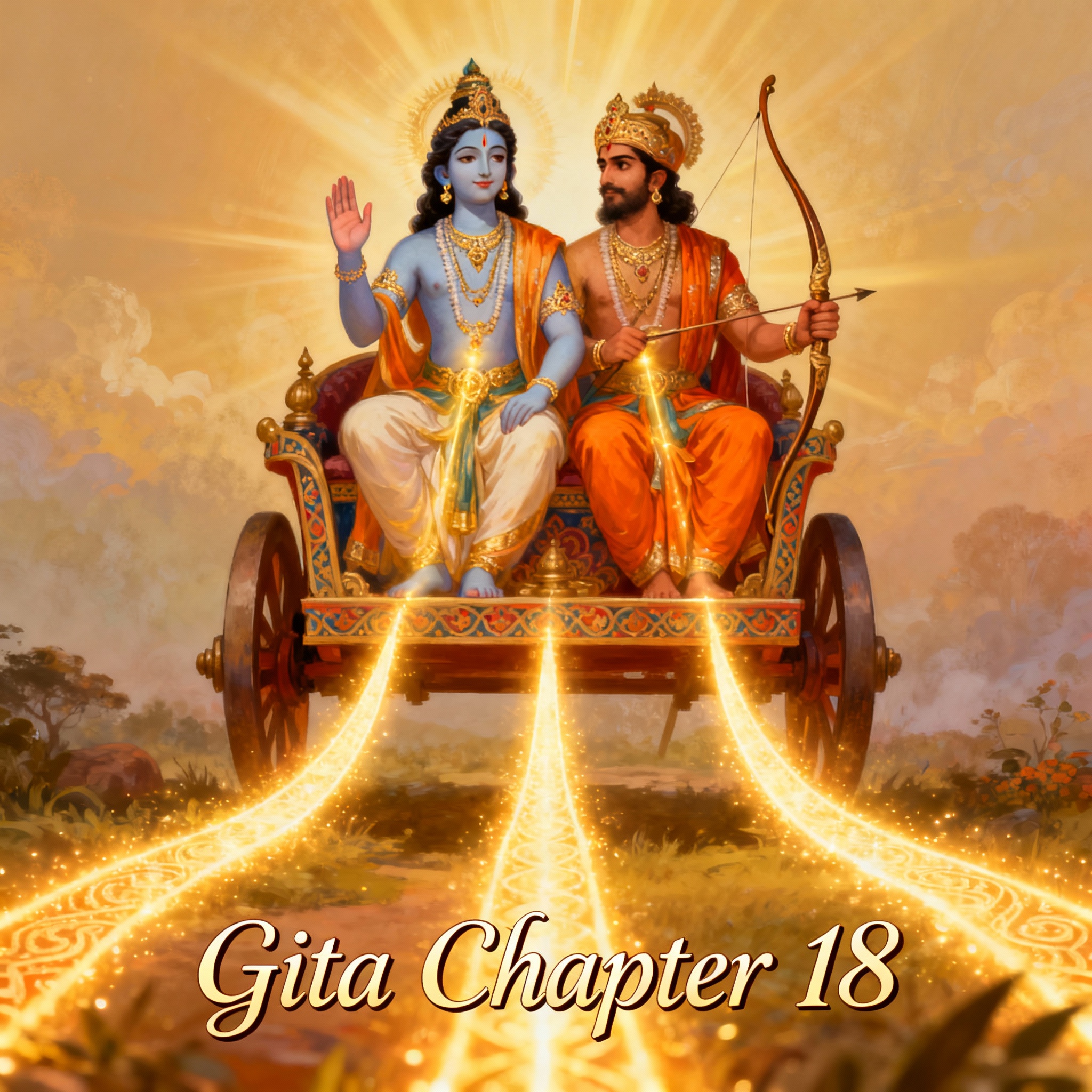
Introduction: The Final Dialogue of Wisdom
The Bhagavad Gita Chapter 18 is the last and most comprehensive chapter of the Gita, also known as Moksha Sannyasa Yoga. In this chapter, Lord Krishna brings together all the spiritual wisdom of the previous 17 chapters and explains the ultimate path to liberation. Here, Arjuna, still eager for clarity, asks Krishna about the difference between sannyasa (renunciation) and tyaga (detachment).
Krishna responds by teaching that true liberation does not lie in escaping from the world but in living in it with detachment, duty, and devotion. This chapter serves as a summary of the entire Gita and is often considered the essence of Krishna’s teachings.
The Meaning of Renunciation (Sannyasa) and Detachment (Tyaga)
At the beginning of the chapter, Arjuna asks: “What is the difference between giving up actions (sannyasa) and giving up attachment to actions (tyaga)?”
- Sannyasa means renouncing selfish desires and ego-driven actions. It is not about abandoning duties but about abandoning the mental craving for results.
- Tyaga means giving up attachment to the fruits of action. A true Tyagi performs duties without expectation, remaining balanced whether success or failure comes.
Krishna emphasizes that giving up action itself is not possible, because life demands action. What we can renounce is the ego and desire that bind us.
The Three Types of Renunciation
Krishna explains that renunciation too is influenced by the three gunas (qualities of nature):
- Renunciation in Tamas (Ignorance):
When a person gives up duty out of laziness, fear, or confusion, thinking it is renunciation, it is tamasic. - Renunciation in Rajas (Passion):
When a person gives up duty because it feels troublesome or brings discomfort, this is rajasic renunciation, and it leads to suffering. - Renunciation in Sattva (Goodness):
When a person performs duty but gives up attachment to results, this is sattvic renunciation—the highest and purest form.
True renunciation is not about escaping life but about living in the world without being enslaved by desires.
Five Causes of All Action
Krishna reveals that every action has five causes:
- The body
- The doer (ego)
- The senses
- The different efforts
- The divine factor (God’s will)
This means no action is ever the result of just one person’s effort. Recognizing this prevents arrogance and cultivates humility.
For modern life: When we achieve success, we must remember it’s not “I alone did it.” Many factors—family, society, nature, and divine grace—play a role.
The Threefold Division of Knowledge, Action, and Doer
Krishna categorizes knowledge, action, and the doer based on the three gunas:
Knowledge
- Sattvic Knowledge: Sees one divine reality in all beings.
- Rajasic Knowledge: Sees diversity but with selfish motives.
- Tamasic Knowledge: Misunderstood, limited, and superstitious.
Action
- Sattvic Action: Performed without attachment, for duty’s sake.
- Rajasic Action: Done with desire, greed, and ego.
- Tamasic Action: Performed out of ignorance, carelessness, or harm.
Doer
- Sattvic Doer: Disciplined, humble, free of ego.
- Rajasic Doer: Attached, greedy, restless, selfish.
- Tamasic Doer: Lazy, careless, stubborn, and harmful.
In daily life, Krishna advises us to cultivate sattvic qualities in all three areas.
Threefold Division of Intellect and Steadiness
Krishna further explains how intellect (buddhi) and determination (dhrti) are influenced by gunas.
- Sattvic Intellect: Knows right from wrong and guides life towards truth.
- Rajasic Intellect: Confused between good and bad, influenced by desires.
- Tamasic Intellect: Considers wrong as right, blinded by ignorance.
For us, developing a sattvic intellect means learning to discern wisely—choosing long-term good over short-term pleasure.
The Threefold Division of Happiness
Krishna beautifully explains that not all happiness is equal:
- Sattvic Happiness: Comes from self-discipline, meditation, knowledge, and purity. At first it feels difficult, but in the end it brings peace.
- Rajasic Happiness: Comes from indulgence in pleasures of the senses. Sweet in the beginning, but bitter in the end.
- Tamasic Happiness: Comes from laziness, ignorance, and intoxication. It dulls the mind and leads to destruction.
Modern relevance: True joy lies not in momentary pleasures but in inner peace. Meditation, discipline, and selfless living bring lasting fulfillment.
Varna and Duties According to Guna
Krishna describes how duties (svadharma) arise from a person’s natural qualities:
- Brahmanas (teachers, seekers): Qualities of wisdom, discipline, and devotion.
- Kshatriyas (leaders, protectors): Courage, strength, leadership, and determination.
- Vaishyas (merchants, farmers): Business, agriculture, trade.
- Shudras (workers, service providers): Service and support to society.
Important point: Krishna emphasizes that one should not abandon one’s duty, even if imperfect. It is better to do your own duty poorly than to perform another’s duty perfectly.
This is a universal truth—even today, we must focus on our own path rather than comparing with others.
Supreme Duty: Devotion to God
Towards the end of the chapter, Krishna gives his final and ultimate teaching:
“Abandon all varieties of duties and simply surrender unto Me. I shall deliver you from all sins; do not fear.” (18.66)
This is the essence of the Gita: complete surrender to God with trust and devotion.
Krishna does not ask Arjuna to run away from battle but to fight with faith, detachment, and surrender. Similarly, in our lives, the message is not to escape challenges but to face them with God’s support.
Arjuna’s Transformation
After hearing Krishna’s words, Arjuna declares:
“My delusion is gone, my doubts are cleared. I shall act according to Your command.”
This shows Arjuna’s inner transformation—from confusion to clarity, from weakness to strength, from despair to determination.
Similarly, the Gita teaches us to transform our own lives—from doubt to confidence, from fear to courage, from bondage to freedom.
The Essence of Chapter 18
- True renunciation is giving up ego and attachment, not action.
- All action has divine participation; humility is essential.
- Knowledge, action, and happiness are influenced by the three gunas—choose sattvic.
- Perform your own duty sincerely, even if imperfect.
- The final path to liberation is devotion and surrender to God.
Modern Relevance of Chapter 18
The wisdom of this chapter applies deeply to modern challenges:
- In careers: Success comes not just from effort but also from humility and divine grace.
- In relationships: Detachment helps reduce conflict and ego clashes.
- In stress: Sattvic discipline, meditation, and balanced action lead to peace.
- In personal growth: Doing one’s own duty wholeheartedly creates purpose.
The ultimate lesson: Live fully, perform your duty, surrender the results, and trust the divine plan.
Conclusion: The Grand Finale of the Gita
Chapter 18 is the culmination of the Gita’s wisdom. It unites action, knowledge, devotion, and renunciation into one simple truth:
Surrender to God with love, do your duty with detachment, and liberation will follow.
Arjuna’s transformation reflects what each of us seeks—the shift from inner conflict to inner clarity.
The Gita’s final message resonates even today: We are not asked to abandon life but to live it with wisdom, courage, and surrender.
Discover more from Online Guruji
Subscribe to get the latest posts sent to your email.
A5 game? Yeah, I’ve heard some whispers around the gaming community. Might be worth a look to see what the fuss is about. Worth a punt, just be smart and responsible at a5 game!
Yo, Bet27’s been alright to me. Solid selection of games and the payouts are pretty quick. Definitely worth checking out if you’re looking for something new. Remember to gamble responsibly, eh? Give bet27 a shot!
Been checking out vin5555k. Seems decent enough. Worth a look if you’re looking for something new. Visit vin5555k.
Gave okebet168cc a go last night. Had some fun, won some, lost some. It’s all about the thrill, right? Find it at okebet168cc.
Pokebet88casino is where it’s at tonight. Trying my luck hope I win big. Maybe i’ll see you there pokebet88casino!
Just got the download 188bet app. So far, it’s really clean and responsive. Navigation is a breeze. For those constantly on the go, downloading is a must! download 188bet
Looking for some real sports action? 188betthethao is where I head. Always a good time. Get in the game: 188betthethao
Just had a solid run on 99winlogin. Smooth login process too, which is a huge plus. Fast access here: 99winlogin
No more struggling with broken links. This login page is fast and secure. It is the most convenient way to access ponislotlogin without any hassle.
[7283]Planbet অফিসিয়াল লগইন | বিকাশ পেমেন্ট ও লাইভ ক্যাসিনো গাইড,planbet-এ যুক্ত হয়ে সেরা অনলাইন স্লট গেম এবং লাইভ ক্যাসিনোর অভিজ্ঞতা নিন। বিকাশ পেমেন্টের মাধ্যমে দ্রুত লেনদেন করে আজই অ্যাপটি ডাউনলোড করুন। visit: planbet
The app version is just a game changer. I can place my bets anywhere and the payouts are processed quickly. Give 888winbetapp a try if you want a stable platform.
I’ve been looking for a reliable platform like this for a while. The interface is super smooth and everything works perfectly. Definitely giving phjilikkk a try today!
Finally found a place that actually gives some decent tips and a fair gaming environment. My winning streak started after I found solusiwinslot. Highly recommended for all slot lovers.
Really impressed with the customer support and the overall vibe of the platform. It feels safe and reliable for long term play. bet119
Had a really smooth experience signing up and starting to play. The promotions are quite generous for new players. Highly suggest krwin2888.
The variety of slots here is insane. I spent the whole night playing and had a great time. Definitely visit okjilicasino if you love slots.