

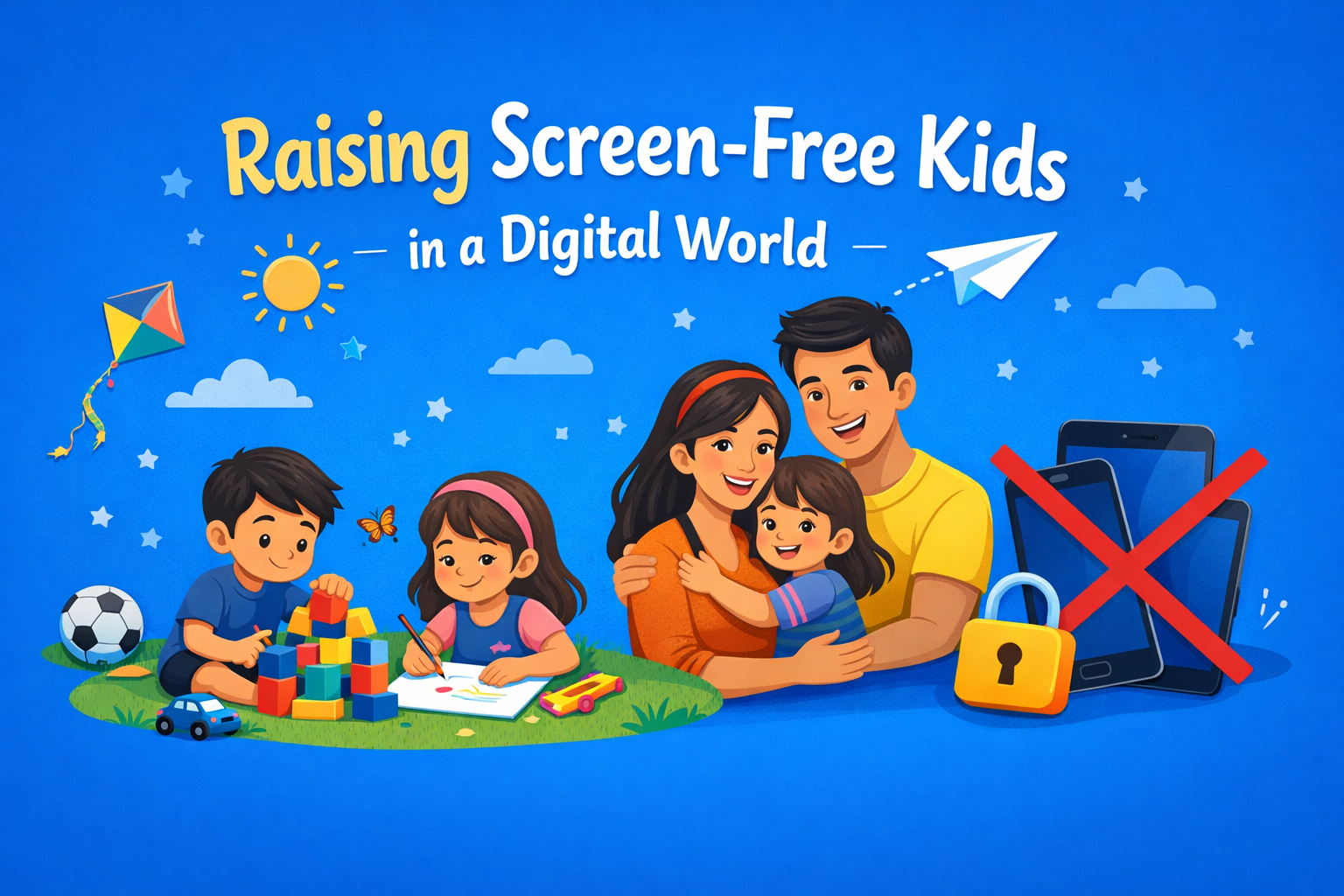
In today’s world, screens are everywhere. Mobile phones wake us up, laptops define our work, TVs entertain us, and tablets quietly occupy our children. From online classes to cartoons, games, and reels — childhood is slowly shifting from playgrounds to pixels.
Many parents silently ask themselves a difficult question:
“Can I really raise my child screen-free in a digital world?”
The honest answer is — not completely screen-free, but definitely screen-smart.
And yes, it is possible to raise emotionally strong, curious, creative children without letting screens control their childhood.
The Reality of Screen Exposure in Children Today
Screens are not the enemy. The problem begins when screens replace:
- real conversations
- outdoor play
- boredom
- imagination
- emotional bonding
Most children today spend 4–6 hours daily on screens, often more than the time they spend talking to parents or playing freely. Studies now link excessive screen time with:
- poor attention span
- delayed speech
- emotional outbursts
- sleep problems
- anxiety and irritability
Yet screens are deeply woven into modern life. So instead of guilt or fear, parents need awareness, balance, and intention.
What Does “Screen-Free” Really Mean?
Screen-free parenting does not mean:
- zero technology
- isolating children from the digital world
- feeling guilty for online classes or educational videos
It means:
- screens are tools, not babysitters
- children experience real life before digital life
- screens don’t replace human connection
Screen-free is a mindset, not a strict rulebook.
Why Early Childhood Without Screens Matters So Much
The early years (0–10 years) are when a child’s brain develops the fastest. During this phase, children learn best through:
- touching
- running
- falling
- talking
- imagining
- observing real people
When screens dominate early childhood:
- imagination becomes passive
- patience reduces
- boredom tolerance disappears
A bored child once created games.
Now, a bored child demands a phone.
The Hidden Cost of Screens Parents Often Miss
Many parents say,
“My child becomes calm only when I give the phone.”
But calmness is not the same as emotional regulation.
Screens suppress emotions temporarily. Children don’t learn:
- how to manage frustration
- how to wait
- how to resolve conflicts
- how to sit with feelings
Over time, screens become emotional crutches — not learning tools.
Is It Possible to Raise Screen-Free Kids Today?
Yes — if parents shift from control to connection.
Children don’t need perfect parents.
They need present parents.
You don’t have to fight screens aggressively. You just have to make real life more attractive than screens.
Practical Ways to Raise Screen-Free (or Screen-Smart) Kids
1. Be a Role Model First
Children don’t listen to advice.
They observe behaviour.
If a child sees parents constantly scrolling, they learn:
“This is normal adult behaviour.”
Try:
- phone-free meals
- phone-free conversations
- no scrolling while talking to your child
This single step creates powerful impact.
2. Replace Screens, Don’t Just Remove Them
Never just say “no screen” without offering an alternative.
Replace screens with:
- board games
- art and craft
- outdoor play
- kitchen activities
- storytelling
- traditional games
A child who is engaged doesn’t miss screens.
3. Let Children Experience Boredom
Boredom is not dangerous.
It is the birthplace of creativity.
When children say,
“I’m bored.”
Don’t panic.
Don’t hand over the phone.
Let boredom teach them:
- imagination
- problem-solving
- self-entertainment
This skill will help them for life.
4. Create a Daily Rhythm, Not Strict Rules
Instead of shouting:
“No phone!”
Create routines:
- fixed homework time
- fixed outdoor play time
- fixed family time
- fixed screen time
Predictability makes children feel secure and cooperative.
5. Encourage Outdoor Play Every Day
Nature is the strongest antidote to screen addiction.
Outdoor play improves:
- focus
- immunity
- emotional balance
- sleep quality
Even 30–60 minutes daily can make a big difference.
6. Use Screens Intentionally, Not Automatically
Ask yourself before giving a screen:
- Is this necessary?
- Is this educational or just distracting?
- Am I using the screen because I’m tired?
Intentional screen use reduces guilt and overuse.
What About Online Education and Digital Skills?
This is a common fear:
“If my child avoids screens, will they fall behind?”
The truth is:
- Digital skills can be learned quickly
- Emotional intelligence takes years
A child who has:
- curiosity
- focus
- confidence
- learning ability
will easily adapt to technology later.
But a child addicted to screens struggles to adapt to real life.
Teaching Digital Discipline Instead of Digital Fear
Instead of making screens “forbidden fruit,” teach:
- time limits
- purpose-based usage
- self-control
Explain:
“Screens are useful, but too much harms our body and mind.”
When children understand why, they cooperate better.
Traditional Indian Parenting Wisdom Still Works
Earlier generations didn’t raise children with screens.
They raised them with:
- stories
- values
- responsibility
- community
Grandparents often say:
“Bachche phone ke bina bhi khush reh sakte hain.”
They’re right — because happiness doesn’t come from stimulation, it comes from connection.
The Emotional Benefit of Screen-Free Parenting
Parents who reduce screen dependency often notice:
- better communication
- fewer tantrums
- improved sleep
- stronger parent-child bonding
Children feel seen, heard, and valued, not just distracted.
A Gentle Reminder for Parents
You will have tired days.
You will give screens sometimes.
And that’s okay.
Parenting is not about perfection.
It is about conscious effort.
Even small changes — 10 minutes less screen time, 10 minutes more connection — create long-term impact.
Final Thoughts: Childhood Is Not a Digital Experiment
Screens will always be there.
Childhood won’t.
One day, your child will grow up and forget:
- cartoons
- games
- apps
But they will remember:
- how safe they felt with you
- how heard they were
- how free they felt to play
Raising screen-free kids in a digital world is not about rejecting technology —
It is about protecting childhood.
Discover more from Online Guruji
Subscribe to get the latest posts sent to your email.
It’s fascinating seeing how Philippine gaming has evolved – from PAGCOR’s roots to platforms like JL59 PH embracing both tradition & tech. Responsible play is key, always! Check if jl59 ph legit offers resources – a solid history builds trust, right?
Just finished the setup and everything is running perfectly. The installation process was straightforward and the rewards are legit. Go get it at jl777download now.
Simple, clean, and effective. I don’t like cluttered websites and this one gets straight to the point. g9999 is perfect for players who hate unnecessary noise.
The VIP perks are actually worth it. I feel like a high roller even with modest bets. If you want a premium feel then cassinovip222 is where it is at.
Just joined last week and I am already impressed by the payout speed. It is rare to find such a transparent platform these days. Cheers to bddaka88
Finally found a platform that actually delivers on its promises. The bonuses are generous and the gameplay is addictive. Just visit 1777xsgame to start winning.