

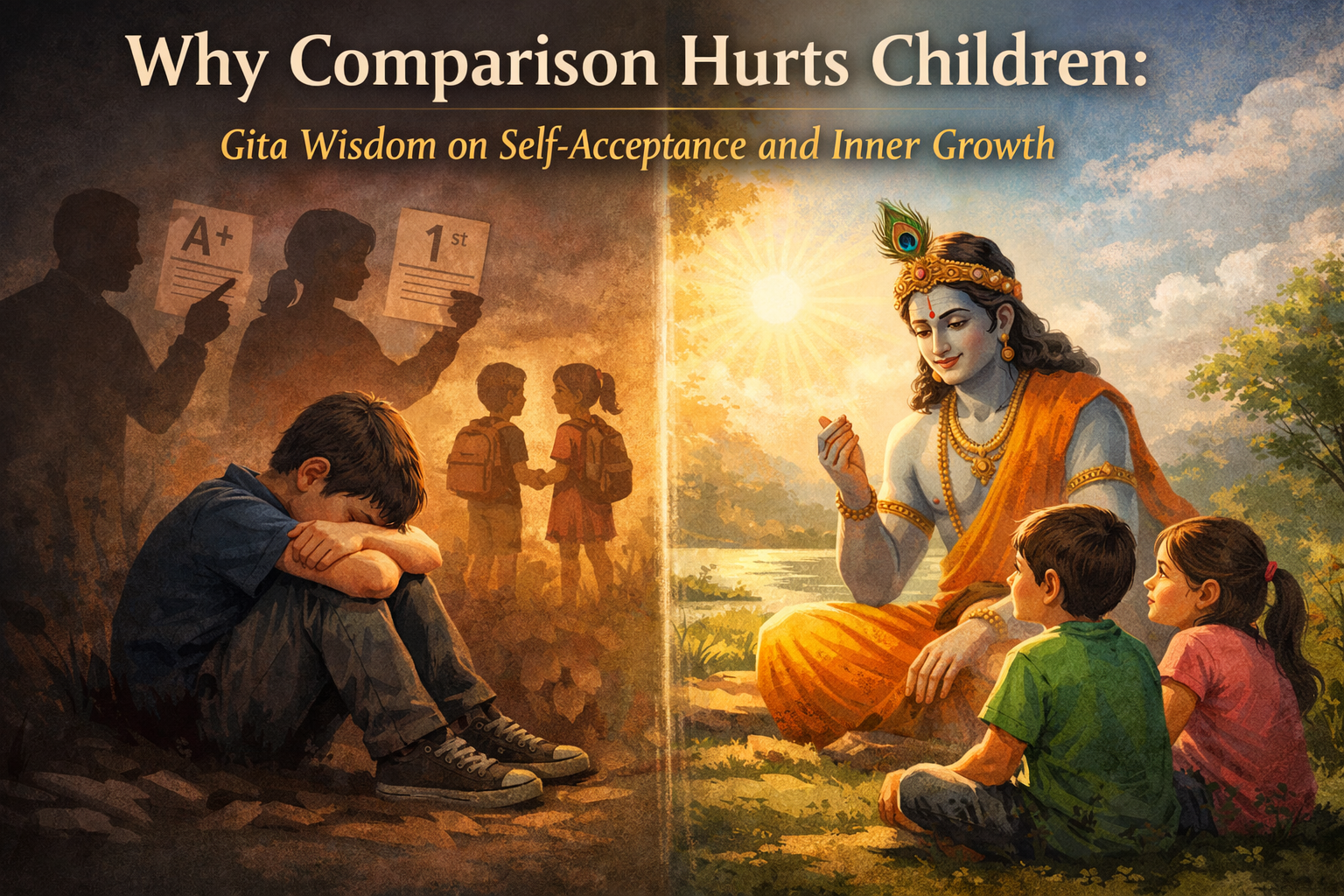
In almost every home today, one sentence echoes more often than we realize:
“Look at Sharma ji’s child…”
It may sound harmless, even motivating. But for a child’s tender mind, comparison slowly becomes a silent wound — one that chips away at confidence, self-worth, and inner peace.
Marks, looks, talents, behavior, social skills — children are constantly measured against others. And unknowingly, parents become part of a system that teaches children a dangerous belief:
“I am valuable only when I am better than someone else.”
The Bhagavad Gita offers a radically different, deeply compassionate perspective — one that frees children from comparison and guides them toward self-acceptance, inner growth, and emotional strength.
The Hidden Cost of Comparison in Childhood
Comparison does not always show immediate damage. It works quietly, over years.
A child who is constantly compared may:
- Doubt their abilities even when doing well
- Develop fear of failure and perfectionism
- Lose interest in learning
- Feel jealousy, resentment, or shame
- Grow up seeking validation from others
Externally, the child may appear obedient or high-performing. Internally, they feel never enough.
The Gita understands this human struggle deeply.
Gita Wisdom: You Have a Right to Effort, Not Comparison
One of the most powerful verses of the Bhagavad Gita says:
“Karmanye vadhikaraste, ma phaleshu kadachana”
(You have the right to your actions, not to the results.)
This verse directly challenges the culture of comparison.
When children are taught to focus on results, they naturally compare:
- Who scored more?
- Who is better?
- Who is ahead?
But when children are taught to value effort, intention, and growth, comparison loses its grip.
The Gita reminds us:
➡️ Each soul walks a unique journey
➡️ Growth cannot be measured by others’ timelines
Why Comparison Breaks Self-Acceptance
Self-acceptance means:
- “I am worthy even while learning”
- “I can grow at my own pace”
- “My value is not conditional”
Comparison destroys this foundation.
A child who hears:
- “Why can’t you be like your cousin?”
- “Your friend understands faster than you”
- “Others manage, why can’t you?”
slowly internalizes:
“Something is wrong with me.”
The Gita teaches Swadharma — one’s own nature and path.
Swadharma: Every Child Has a Different Nature
In the Gita, Krishna explains that every individual is born with different qualities (gunas) and tendencies.
Trying to force everyone into the same mold leads to imbalance and suffering.
Applied to parenting, this means:
- One child may excel academically
- Another may be creative, sensitive, or empathetic
- One may speak confidently
- Another may observe quietly
Comparison ignores Swadharma and pushes children to reject who they are.
True growth begins when a child feels:
“I am allowed to be myself.”
How Comparison Creates Fear, Not Motivation
Many parents believe comparison motivates children.
In reality, it often creates fear-based behavior.
Children start working:
- To avoid embarrassment
- To please parents
- To beat others
Not to understand, enjoy, or grow.
The Gita clearly warns against fear-driven action.
Fear clouds judgment, weakens the mind, and disconnects us from inner wisdom.
A child driven by fear may succeed temporarily — but carries anxiety, burnout, and self-doubt into adulthood.
The Gita’s Definition of Growth Is Inner, Not External
Modern society measures success through:
- Marks
- Trophies
- Rankings
- Applause
The Gita measures growth through:
- Self-control
- Emotional balance
- Effort with sincerity
- Inner peace
- Detachment from ego
When children are compared, they learn to chase external validation.
When children are guided by Gita wisdom, they learn to develop inner stability.
Emotional Damage Caused by Constant Comparison
Comparison doesn’t just affect performance — it affects emotions.
Children may experience:
- Jealousy toward peers
- Anger toward parents
- Withdrawal and silence
- Loss of confidence
- Feeling unloved or unseen
The Gita emphasizes Samatvam — emotional balance.
A child who is constantly compared struggles to remain emotionally balanced because their worth feels unstable.
Teaching Children Self-Acceptance Through Gita Wisdom
Here’s how parents can consciously replace comparison with growth-oriented guidance:
1. Shift Focus from “Who is better” to “How you are growing”
Ask:
- “What did you learn today?”
- “What was challenging for you?”
- “What effort did you put in?”
Not:
- “Who scored more?”
- “Why didn’t you top?”
2. Celebrate Effort, Not Outcome
The Gita honors sincere effort over results.
Praise children for:
- Trying again
- Practicing patiently
- Staying honest with effort
This builds self-trust.
3. Help Children Recognize Their Unique Strengths
Every child has something special.
Encourage:
- Creativity
- Kindness
- Curiosity
- Responsibility
- Emotional awareness
Comparison narrows vision. Appreciation expands it.
4. Model Non-Comparative Behavior
Children learn more from observation than instruction.
Avoid:
- Comparing siblings
- Talking about others’ children constantly
- Measuring success socially
Live the values you want them to absorb.
Inner Growth Happens When Children Feel Safe to Be Themselves
The Gita’s ultimate message is liberation — freedom from unnecessary suffering.
Comparison is one of the earliest sources of suffering in a child’s life.
When parents remove comparison:
- Children explore freely
- Mistakes become learning tools
- Confidence grows naturally
- Inner strength develops
A child who feels accepted does not need to compete for worth.
What Happens When Children Stop Comparing?
Children who are guided away from comparison:
- Develop intrinsic motivation
- Become emotionally resilient
- Handle failure better
- Respect others without jealousy
- Grow into balanced adults
They understand:
“I don’t need to be better than others. I need to be better than yesterday.”
This is pure Gita wisdom.
A Gentle Reminder for Parents
Parenting is not about raising the best child in the room.
It is about raising a secure, confident, and emotionally healthy human being.
The Bhagavad Gita does not ask us to win races.
It asks us to walk our path with sincerity, courage, and awareness.
When we stop comparing our children, we give them the greatest gift:
the freedom to grow as themselves.
Closing Thought (Perfect for Engagement)
“A flower does not compete with another flower. It just blooms.”
The Bhagavad Gita reminds us — children are meant to bloom, not compete.
Discover more from Online Guruji
Subscribe to get the latest posts sent to your email.
Interesting analysis! The shift towards mobile gaming is huge, and platforms like Jilibb PH are responding well. Easy access via jilibb ph download apk is key for Filipino players, plus legit licensing builds trust. Great points about RNG too!
The login process is super quick and the games are top notch. Had a great run last night and won big. Highly recommend 178jililogin
I’ve been trying a few different sites lately and this one really stands out. The games load fast and the payouts are legit. Definitely my new favorite spot for spinning pk44slots.
Finding a trustworthy login portal has always been a hassle but this one delivers exactly what it promises. My profile syncs perfectly across devices and I never worry about my account security. The community feel is really refreshing compared to other platforms. Start your journey with gk8login
This site is a hidden gem! The graphics are great and the gameplay is very fluid. I’m spending a lot of time on iddragon212 lately
The app version is a game changer. Much more convenient to play on the go than using a browser. Download 377betappapk for the best mobile experience.