

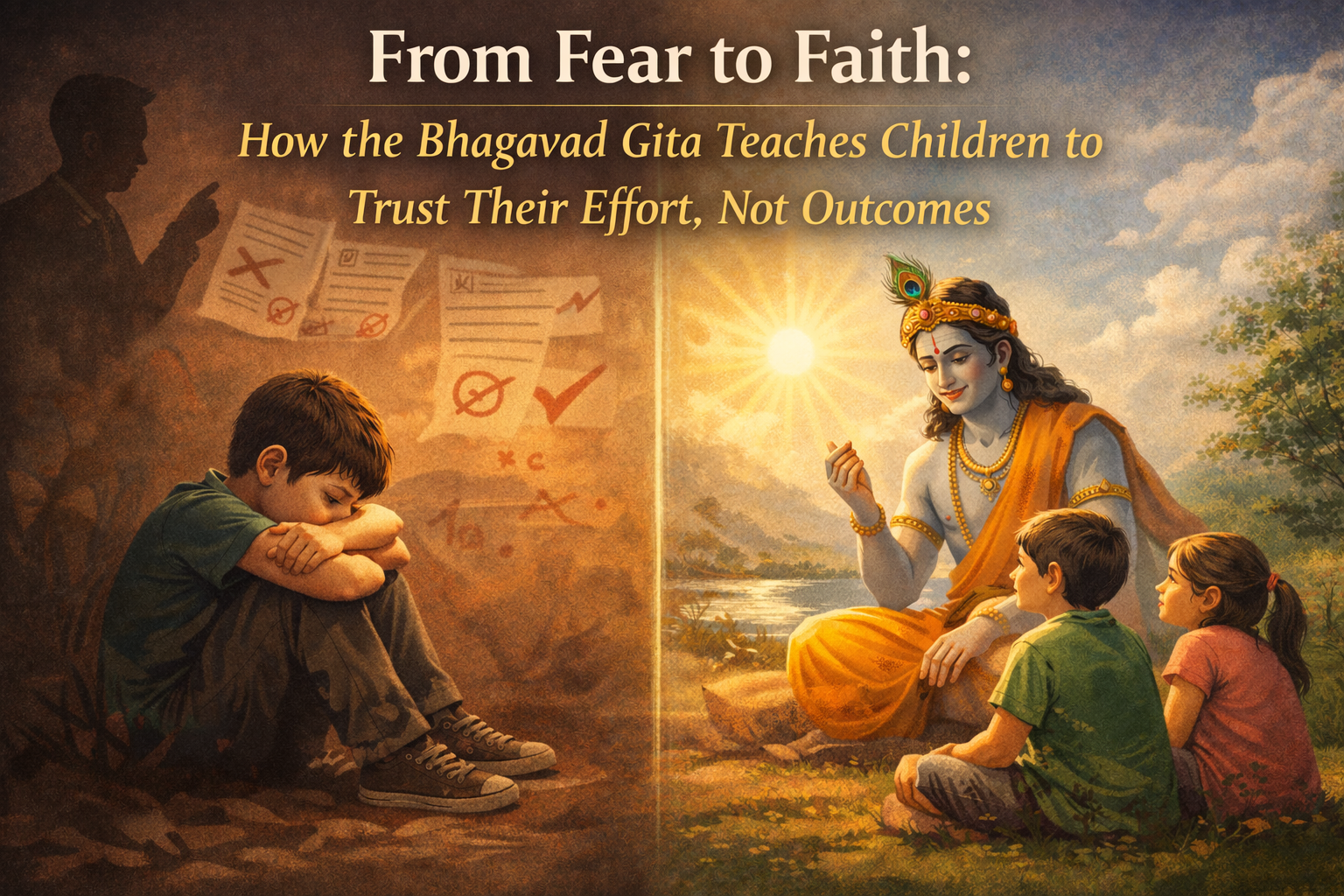
In today’s world, children are growing up under constant pressure — to perform, to prove, and to succeed. From exams and competitions to social expectations and peer approval, children are silently taught one lesson again and again:
“Your value lies in your results.”
Over time, this belief creates fear — fear of failure, fear of disappointing parents, fear of being “not good enough.” What children truly need is not more pressure, but faith — faith in their effort, their ability to learn, and their inner strength.
The Bhagavad Gita offers timeless wisdom that gently guides children from fear to faith — by teaching them to trust effort over outcomes.
Understanding Fear in Children: Where Does It Begin?
Children are not naturally fearful learners.
Fear enters when:
- Love feels conditional
- Mistakes invite criticism
- Results define appreciation
- Comparison replaces understanding
Slowly, children start believing:
“If I don’t succeed, I will lose love and respect.”
This fear blocks curiosity, creativity, and confidence.
The Gita’s Core Teaching: Faith in Action, Not Results
One of the most powerful teachings of the Bhagavad Gita says:
“Karmanye vadhikaraste, ma phaleshu kadachana”
(You have the right to action, not to the fruits of action.)
For children, this verse is deeply liberating.
It teaches them:
- Focus on what you can control — effort
- Let go of what you cannot — outcomes
- Grow through the process
- Stay balanced in success and failure
This shift replaces fear with faith.
Why Outcomes Are Unreliable but Effort Is Always Yours
Results depend on many factors:
- Exam difficulty
- Mood and health
- External competition
- Timing and circumstances
But effort is always in a child’s control.
When children trust effort:
- They try again after failure
- They don’t fear mistakes
- They feel confident regardless of results
Faith in effort builds inner stability.
Fear-Based Parenting vs Faith-Based Parenting
Fear-Based Messages:
- “What if you fail?”
- “You must get top marks”
- “This decides your future”
Faith-Based Messages:
- “Do your best”
- “Learning matters more than marks”
- “You will grow from every experience”
The Gita encourages faith-based action — effort done with sincerity, not anxiety.
Faith Is Not Blind Hope — It Is Inner Confidence
The Gita does not promote blind optimism.
It promotes Shraddha — deep inner trust.
For children, Shraddha means:
- Trusting their ability to learn
- Believing effort will lead to growth
- Staying calm under pressure
- Accepting outcomes with maturity
A child with Shraddha walks confidently, even through uncertainty.
How Fear Weakens Children Emotionally
Fear-driven children often:
- Avoid challenges
- Fear mistakes
- Seek constant approval
- Lose joy in learning
- Become anxious or withdrawn
The Gita teaches Abhaya — fearlessness rooted in self-awareness.
When children trust effort, fear slowly loses power.
Teaching Children to Trust Effort in Daily Life
1. Praise Process, Not Performance
Instead of:
- “You scored well!”
Say:
- “You prepared sincerely”
- “You stayed focused”
This reinforces effort-based confidence.
2. Normalize Uncertainty
Teach children:
- Not every effort brings immediate success
- Growth happens over time
- Setbacks are part of learning
The Gita accepts uncertainty as part of life.
3. Encourage Honest Effort Over Perfection
Perfection creates fear.
Effort creates growth.
Let children:
- Try freely
- Make mistakes
- Learn without shame
Faith Helps Children Stay Calm in Success and Failure
The Gita teaches Samatvam — emotional balance.
A child grounded in effort:
- Does not become arrogant in success
- Does not break down in failure
- Remains steady and composed
This emotional balance is true strength.
Role of Parents: From Controllers to Guides
Parents often try to control outcomes:
- Marks
- Ranks
- Achievements
The Gita invites parents to become guides, not controllers.
Your role is to:
- Encourage effort
- Provide support
- Offer perspective
- Stay calm regardless of results
Children absorb your faith.
Faith Replaces Fear with Courage
When children trust effort:
- Courage grows naturally
- They take healthy risks
- They explore their potential
- They develop resilience
Faith is not the absence of fear — it is the strength to move despite fear.
How Gita Wisdom Builds Lifelong Confidence
Children raised with effort-based faith:
- Handle setbacks better
- Face exams calmly
- Trust their abilities
- Don’t define themselves by outcomes
They grow into adults who are:
- Confident yet humble
- Ambitious yet balanced
- Strong yet compassionate
A Gentle Reminder for Parents
Your child does not need to win every race.
They need to believe they can run again.
The Bhagavad Gita does not promise success — it promises inner strength.
When children learn to trust effort over outcomes, they move from fear to faith — and that faith becomes their greatest shield in life.
🌱 Closing Thought
“Effort builds character. Faith builds courage.”
The Bhagavad Gita teaches children to stand strong — regardless of results.
Discover more from Online Guruji
Subscribe to get the latest posts sent to your email.
Smart bankroll management is key in any online game! Seeing platforms like fairplay24 login offer local payment options (GCash, PayMaya) & Tagalog support is a huge step towards responsible gaming here in the Philippines.
Simple, clean, and rewarding. I love the daily promotions they offer to loyal players. Give brsh777 a shot!
[2226]betcris লগইন এবং অ্যাপ ডাউনলোড | বিকাশ দিয়ে অনলাইন ক্যাসিনো,betcris লগইন করুন এবং সেরা অনলাইন স্লট গেম উপভোগ করুন। বিকাশ দিয়ে অনলাইন ক্যাসিনো পেমেন্ট করে আজই আপনার অ্যাকাউন্ট তৈরি করুন। visit: betcris
Fast deposits and even faster withdrawals. That is all I care about and this site delivers perfectly. Big thanks to phj8jili.