

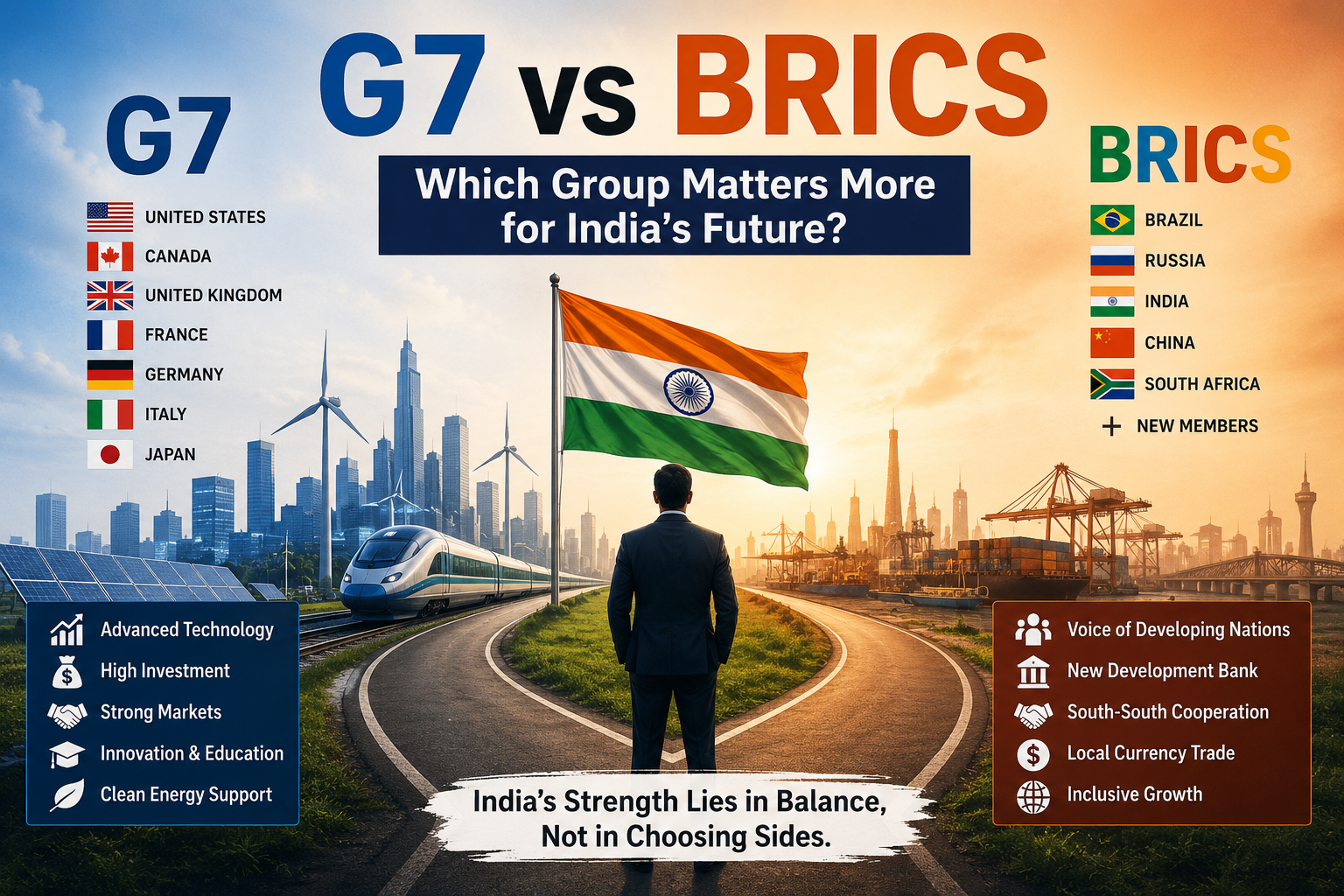
Imagine a small textile business owner in Surat. His products are sold in the United States and Germany, while the cotton he buys is influenced by global trade patterns involving countries like Brazil and China. At the same time, the fuel prices affecting his transportation costs depend on international relationships stretching from the Middle East to Russia.
He may never attend an international summit, but decisions taken at meetings of groups like G7 and BRICS can indirectly affect his business, income, and future.
This is the reality of today’s interconnected world.
When we hear terms like G7 and BRICS, many of us assume they are discussions meant only for politicians and economists. But the truth is that these groups influence everything from job opportunities and investments to fuel prices, technology, and economic growth.
As India rises to become one of the world’s most important economies, a common question is being asked: Which group matters more for India’s future—G7 or BRICS?
The answer may surprise you. India does not want to choose between them. Instead, it is building relationships with both.
And that strategy could become one of India’s biggest strengths in the coming decades.
The G7: Where Money, Technology, and Innovation Meet
Think about the smartphone in your hand, the software used by Indian IT companies, or the foreign companies investing in India’s highways, airports, and renewable energy projects.
Many of these connections lead back to G7 countries.
The G7 includes some of the world’s richest economies. These countries have advanced technology, strong financial systems, and massive consumer markets.
For India, G7 nations are important because they bring investment, innovation, and business opportunities.
When companies from Japan build metro systems in India or when American firms invest in Indian technology startups, ordinary Indians benefit through jobs, infrastructure, and economic growth.
Simply put, if India wants faster development and access to cutting-edge technology, cooperation with G7 countries is essential.
BRICS: Giving a Voice to Emerging Economies
Now imagine another side of the story.
For many years, developing countries felt that global economic decisions were largely influenced by Western powers.
Countries like India, Brazil, and South Africa wanted a stronger voice.
That desire eventually led to the formation of BRICS.
For India, BRICS is more than just an economic group. It is a platform where emerging nations can work together, discuss common challenges, and build alternatives to traditional global institutions.
This is particularly important because India is not just a growing economy—it is also seen as a leader of the developing world.
Through BRICS, India strengthens its influence across Asia, Africa, and Latin America.
The Indian Way: Why Choosing One Side Doesn’t Make Sense
In Indian families, we often hear a simple piece of advice: “Never put all your eggs in one basket.”
India seems to be following the same principle in global diplomacy.
Rather than depending entirely on Western economies or aligning itself exclusively with developing nations, India is maintaining strong relationships with both.
This balanced approach allows India to attract investments from developed countries while also expanding its leadership among emerging economies.
It is not about choosing sides.
It is about creating opportunities from every direction.
What Does This Mean for Ordinary Indians?
The impact may not always be visible, but it is real.
A software engineer in Bengaluru benefits when technology partnerships with G7 nations create new jobs.
A farmer may benefit when trade agreements improve export opportunities.
A startup founder gains access to global investors.
A student benefits from educational collaborations and research partnerships.
At the same time, stronger ties through BRICS can open new markets for Indian products and increase India’s influence in shaping future economic policies.
In other words, global diplomacy eventually reaches every household in some form.
Conclusion
The debate should not be “G7 versus BRICS.”
The real story is how India is using both platforms to strengthen its economy and expand its influence.
G7 brings investment, technology, and innovation.
BRICS offers strategic influence, new partnerships, and leadership among developing nations.
India’s future will not be built by choosing one over the other. It will be built by successfully engaging with both.
And perhaps that is why India’s rise on the global stage is attracting attention from every corner of the world.
Discover more from Online Guruji
Subscribe to get the latest posts sent to your email.
Honestly, the process seems detailed, but remember risk management is key. Don’t just follow the guide; check things like 399bet apk app ডাউনলোড first. Proceed with caution!
https://shorturl.fm/yw2WM
https://shorturl.fm/8GRHj
Heads up: the slick feel of ga88 cc game is good, but always check platform security first. Don’t just trust the flashy UI; vet the withdrawal process too. Stay vigilant!
https://shorturl.fm/otZjh
https://shorturl.fm/suYtT
Interesting read! Managing your bankroll is key in any online gaming, and seeing platforms like jljl55 ph app login focus on secure registration & funding is a good sign. Responsible play is paramount, especially with mobile access!
The core takeaway is the necessity of adaptability. Whether optimizing global trade routes or building a seamless digital experience, managing diverse inputs is key. This focus on interconnected, high-flow platforms is crucial for growth, mirroring the sophisticated systems available via amjili app download apk.
Love how JL76 treats gaming like pro sports analytics! For transparent RTP and real-time tracking in the Philippines, head to jl76 game for mobile-first slots, live dealers, fishing arcs, and smart gameplay intelligence today.
https://addlinks.pro/CPZ5m
https://addlinks.pro/AGiSU
https://addlinks.pro/6TTMO
Yo, this whole setup is wild! The game variety sounds sick, but check out 4567bd for some more action. Seriously, gotta see what else they got besides the basic slots.