

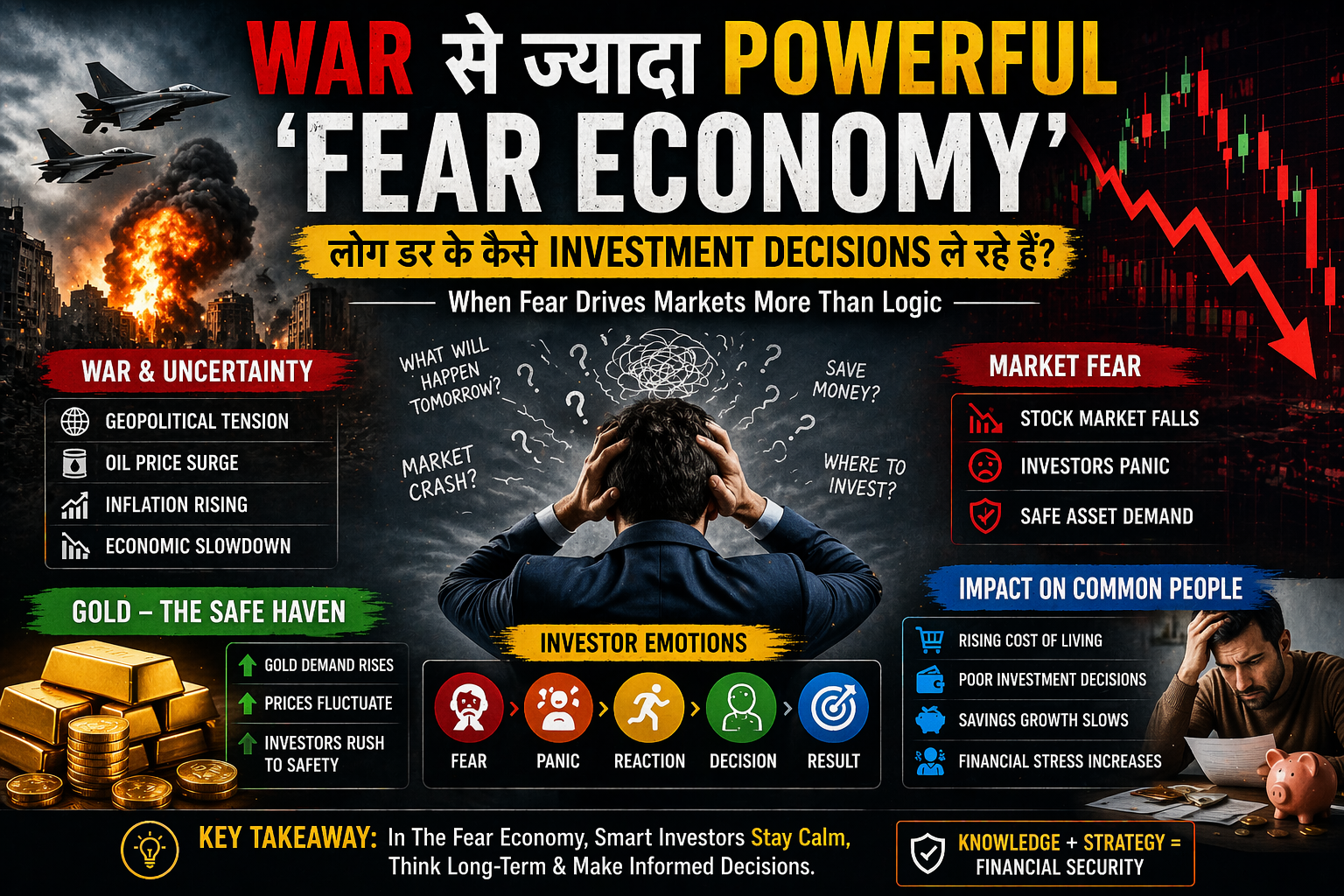
When we think of war, we imagine borders, weapons, and soldiers. But in today’s world, something far more powerful is shaping global behavior—fear.
Welcome to the era of the “Fear Economy.”
In 2026, investors are not just reacting to data, interest rates, or company performance. They are reacting to uncertainty, headlines, and psychological triggers. Whether it’s rising tensions in the Middle East, oil supply disruptions, or currency fluctuations, one invisible factor is driving markets more than anything else:
Fear of the unknown
This article explores how fear has become a dominant economic force—and how it is influencing the way people invest their money.
What Is a “Fear Economy”?
A Fear Economy is a situation where economic decisions are driven less by logic and more by emotional responses—especially fear.
In such a system:
- People invest not based on long-term value
- But based on what feels “safe” in uncertain times
- Market movements become unpredictable
- Panic and herd behavior dominate
In simple words:
People stop thinking rationally and start reacting emotionally.
Why Fear Is So Powerful in Financial Decisions
Uncertainty Creates Anxiety
War, inflation, and economic instability create a sense of unpredictability.
Humans naturally try to protect themselves from loss. This triggers a defensive mindset, where safety becomes more important than growth.
Loss Aversion (Psychology of Loss)
According to behavioral finance, people feel the pain of loss more strongly than the joy of gains.
This means:
- Investors are more focused on avoiding loss
- Rather than maximizing profits
This leads to conservative and fear-based decisions.
Media Amplification
Constant news updates, social media discussions, and alarming headlines amplify fear.
Even small events can feel like major crises.
Herd Mentality
When people see others reacting, they follow the crowd.
- “Everyone is buying gold” → I should too
- “Market is falling” → I should exit
This creates chain reactions in markets
How Fear Is Changing Investment Behavior
1. Gold Buying Surges During Fear
Whenever uncertainty rises, people rush toward gold.
Why?
- Gold is seen as a safe-haven asset
- It holds value even during crises
- It is less volatile compared to stocks
This is why gold prices often rise during war or economic stress.
2. Stock Market Panic Selling
Fear causes investors to:
- Sell stocks quickly
- Exit markets at losses
- Avoid long-term investments
Result:
Markets fall faster than expected—not always because of fundamentals, but because of panic.
3. Shift Toward Cash and Liquidity
During uncertain times, people prefer:
- Keeping money in bank accounts
- Holding liquid assets
Safety becomes more important than returns.
4. Commodity Hoarding
Fear of shortage leads to:
- Buying oil, gold, or essential goods
- Stockpiling resources
This can artificially increase prices.
Real-World Example: The 2026 Global Scenario
In 2026, rising geopolitical tensions and supply chain disruptions have created uncertainty in global markets.
What happened?
- Oil prices surged due to supply fears
- Gold prices fluctuated sharply
- Stock markets showed volatility
But the key driver behind all this was not just economic data—it was investor sentiment driven by fear.
The Gold Connection: Fear vs Reality
One of the most interesting aspects of fear economy is its relationship with gold.
Myth:
“War means gold will always rise”
Reality:
- Gold rises when fear increases
- But it can fall if:
- Dollar becomes stronger
- Interest rates rise
This shows that fear is powerful—but not the only factor.
Middle-Class Impact: Silent Financial Pressure
The fear economy doesn’t just affect investors—it directly impacts the middle class.
1. Rising Cost of Living
Fear-driven price increases lead to:
- Expensive fuel
- Higher food prices
- Increased daily expenses
2. Poor Investment Decisions
Many people:
- Buy gold at peak prices
- Sell investments during panic
- Miss long-term growth opportunities
3. Reduced Savings Growth
Fear leads to:
- Low-risk investments
- Lower returns
- Slower wealth creation
The Hidden Winners of Fear Economy
Every crisis creates winners.
In a fear-driven market:
- Gold traders benefit from rising demand
- Commodity investors gain profits
- Institutional investors buy assets at lower prices
While common investors panic, smart investors stay calm and take advantage.
Fear vs Strategy: What Smart Investors Do
Successful investors understand one thing:
Markets move on emotion in the short term, but on fundamentals in the long term
They avoid panic
They don’t react to every news headline.
They focus on long-term goals
Short-term volatility doesn’t shake their strategy.
They diversify
Instead of putting money in one asset (like gold), they balance:
- Equity
- Gold
- Fixed income
They invest during fear
When others are scared, smart investors see opportunities
How to Protect Yourself from Fear-Based Decisions
Don’t Follow the Crowd Blindly
Just because everyone is buying or selling doesn’t mean it’s right.
Set a Clear Investment Plan
Have a goal and stick to it.
Limit News Consumption
Too much negative news increases anxiety and impulsive decisions.
Think Long-Term
Markets recover—but only for those who stay invested.
Stay Emotionally Aware
Recognize when fear is influencing your decisions.
The Future: Will Fear Economy Grow Stronger?
Yes—and here’s why:
- Global tensions are increasing
- Information spreads faster than ever
- Social media amplifies emotions
👉 This means fear will continue to influence markets more than before.
Conclusion: The Invisible War Inside Every Investor
The biggest war today is not just between countries—it is within the human mind.
Fear has become a powerful economic force, shaping markets, influencing decisions, and impacting lives.
But understanding this gives you an advantage.
👉 Because once you realize that fear is driving the market,
you can choose not to be controlled by it.
Final Thought
“In times of fear, the market tests your emotions more than your knowledge.”
Stay calm. Stay informed. Stay strategic.
Discover more from Online Guruji
Subscribe to get the latest posts sent to your email.
Good overview, but remember odds analysis is key. Don’t just browse; calculate. Check out epicwin app for platform access, but always manage expectations first.
Just stumbled upon this while studying and wow! The fishing games look insane. I need to try bigbunny casino slot immediately after my lecture ends, seriously excited now!
The concept of the “Fear Economy” highlights how behavioral finance mirrors psychological principles. Whether it’s market panic or the excitement of chance, human decision-making often defaults to emotional risk assessment. Understanding these psychological cycles is key, whether analyzing global markets or even predicting patterns in entertainment like xpinay club. Excellent read!
The shift from rational data analysis to emotional risk-taking is fascinating. The “Fear Economy” highlights that in high-stakes environments-whether global markets or even entertainment platforms like the jl33 app casino-loss aversion dictates behavior. Understanding that emotional impulse drives decisions is key to navigating uncertainty.
Hey jjnn, curious to see what you offer. Looking for a solid betting experience with good promotions. Give me a reason to stick around. jjnn
Seriously addicted to Kingpk999! The game selection is awesome. Give it a whirl, you won’t regret it kingpk999.
Been looking for a reliable betting site, stumbled upon bet188365. Seems like a decent option with a good range of sports. Might be worth checking out if you’re looking to place some bets. bet188365
Really impressed with the graphics and the overall feel of the platform. It feels very professional and secure. I’m sticking with gtwinapp from now on.
Finally found a slot site that actually pays out! The bonuses here are insane and the graphics are top notch. Just check out bosdolarslot if you want some real action.
Everything is so straightforward here from registration to withdrawal. No hidden catches or annoying hoops to jump through. Love ph22php
Everything from the deposit to the withdrawal was effortless. Big thanks to vnc168a for the professional service.
I love how easy it is to navigate through the different games. The graphics are crisp and the winning potential is huge. Big thanks to 678wincom