

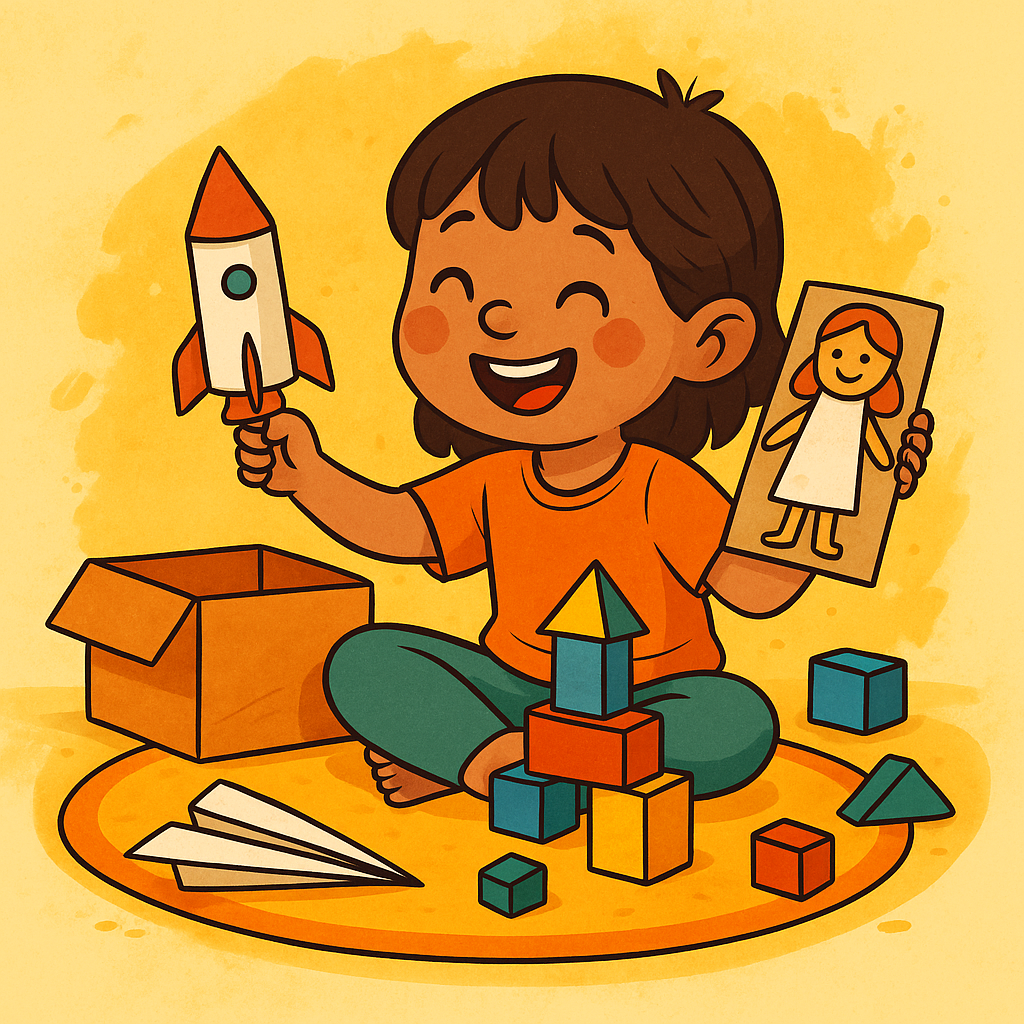
It was a rainy Sunday afternoon when Meera found her 5-year-old daughter, Aanya, unusually quiet. No cartoons on the TV, no tablet in hand. Curious, she peeked into the living room — and smiled. Aanya had turned an old cardboard box into a spaceship, complete with paper wings, crayon buttons, and a sock puppet co-pilot named Zuzu.
There were no fancy lights, no talking apps, and certainly no batteries. But there she was — fully immersed, talking to planets, steering her imaginary shuttle, and giggling with every pretend asteroid she dodged.
That moment reminded Meera of her own childhood — when toys were made from scraps and dreams, not plastic and code. And it made her wonder: could these simple, homemade toys actually be better for her child’s brain than the high-tech gadgets she often felt pressured to buy?
Science now says yes.
In fact, across living rooms, classrooms, and research labs, experts are discovering that homemade toys are doing more than keeping kids entertained — they’re shaping how young minds grow, think, and connect with the world.
Let’s dive into the wonderful, brain-boosting world of homemade toys — and why they might just be your child’s smartest playmate.
Why Homemade Toys Matter in Today’s World
In a world where screens are ever-present and battery-operated toys dominate toy stores, homemade toys offer a refreshing alternative. They aren’t mass-produced. They don’t come with instructions. Instead, they encourage creativity, critical thinking, and problem-solving.
Parents and educators alike are beginning to realize that these simple playthings can have profound effects on brain development — particularly in the early years, when children’s brains are forming at a rapid pace.
1. Sparks Imagination Like Nothing Else
One of the strongest arguments in favor of homemade toys is that they leave room for imagination. A stick can become a magic wand. A cardboard box can be a spaceship or a bakery. Unlike ready-made toys that guide children on how to play, homemade toys say, “You decide.”
When a child is left to make up the storyline, they activate the prefrontal cortex, which is responsible for planning, decision-making, and creative thinking. This kind of imaginative play lays the groundwork for innovative thinking later in life.
2. Builds Fine Motor Skills Naturally
Whether it’s threading beads on a string, stacking hand-painted blocks, or tying a fabric doll’s dress, homemade toys often require hands-on interaction that’s rich in motor skill development.
Such activities help children fine-tune the muscles in their fingers and hands, which is essential for writing, drawing, and daily life skills like tying shoelaces or buttoning shirts. These toys also develop hand-eye coordination, which is crucial for brain-body connection.
3. Encourages Problem-Solving and Resilience
Homemade toys don’t always work perfectly — and that’s the point. Maybe a LEGO-inspired cardboard creation falls apart. Maybe a handmade puzzle is a bit tricky to solve.
This creates opportunities for children to experiment, test, fix, and try again, helping them build resilience and a problem-solving mindset. These “failures” are actually powerful learning moments, encouraging them to persist rather than give up.
4. Strengthens Parent-Child Bonds
Creating toys together is more than just an afternoon activity — it’s quality time that builds emotional closeness. As you cut, glue, paint, or sew with your child, you’re modeling patience, curiosity, and cooperation.
These shared moments are invaluable for a child’s emotional health. Studies show that children who spend more time doing creative activities with parents are more emotionally secure and socially adjusted.
5. Cost-Effective and Eco-Friendly
Let’s not forget one of the most practical benefits — homemade toys are affordable and sustainable. You can create meaningful playthings using recycled materials like newspaper, cloth scraps, old socks, or plastic bottles.
Not only does this reduce plastic waste, but it also teaches children the value of repurposing and sustainability. They learn that fun doesn’t have to come from a store shelf — it can come from creativity and care.
6. Enhances Focus and Patience
Today’s children are used to fast-paced entertainment. With constant screen exposure, their attention spans are shrinking. Homemade toys slow things down.
A self-made maze game or homemade dollhouse doesn’t flash or buzz — it requires focus and engagement. Over time, such toys can increase a child’s concentration, attention span, and patience — essential skills for both academics and life.
7. Tailored to Child’s Development
No one knows your child better than you. Homemade toys allow you to design play tools that match their current interests, skills, and learning stage. Want to teach colors? Make a sorting game. Working on alphabet recognition? Create letter flashcards using cardboard and markers.
This level of customization is hard to find in store-bought toys. You’re literally creating brain-building tools made for your child’s needs.
Real-Life Examples of Homemade Brain Builders
Here are a few simple yet powerful DIY toys that boost brain development:
- Sock Puppets – Boost storytelling, language development, and emotional expression.
- Sensory Bottles – Calm the mind and help with sensory processing.
- Cardboard Kitchen Sets – Encourage pretend play and social learning.
- Fabric Shapes and Numbers – Enhance early math and geometry skills.
- DIY Musical Instruments – Stimulate auditory senses and rhythm coordination.
These toys aren’t just fun — they’re functional brain boosters.
The Science Behind It All
Recent studies in child development confirm what generations of parents already knew — play is not a break from learning; it is the learning.
According to the American Academy of Pediatrics, imaginative play strengthens neural connections in the brain and supports executive function — the very skills responsible for focus, planning, and memory. When play is unstructured (as it often is with homemade toys), it leads to greater cognitive flexibility, emotional regulation, and creativity.
A Return to Simplicity, A Leap Toward Growth
We live in an age where technology promises more — faster, louder, shinier. But what if more isn’t always better?
Homemade toys offer a quiet rebellion against overstimulation. They invite children to slow down, think deeper, and connect more meaningfully — with their thoughts, their hands, their families, and the world around them.
So the next time you think about buying the latest gadget or battery-operated toy, pause. Look around your home. A shoebox, a few crayons, and some imagination might just be the best gift for your child’s brain.
Conclusion: Let’s Build Brains, Not Just Toy Boxes
Homemade toys are more than crafts — they are tools for development, creativity, and connection. They teach children to think, create, persist, and problem-solve — all essential traits for the future.
In a noisy, tech-heavy world, these simple treasures remind us that childhood doesn’t need to be digital to be magical. All it needs is time, love, and a little creativity.
Discover more from Online Guruji
Subscribe to get the latest posts sent to your email.
Bombing fishing, huh? That sounds like some seriously explosive fun! I gotta give it a try. Wish me luck! Dive in with bombing fishing!
Teen Patti Gold 111, huh? Love a good card game. If you’re into Teen Patti, this might be worth a look. I’m not a pro, but I enjoy a quick game now and then. Anyone playing this one regularly? teenpattigold111