

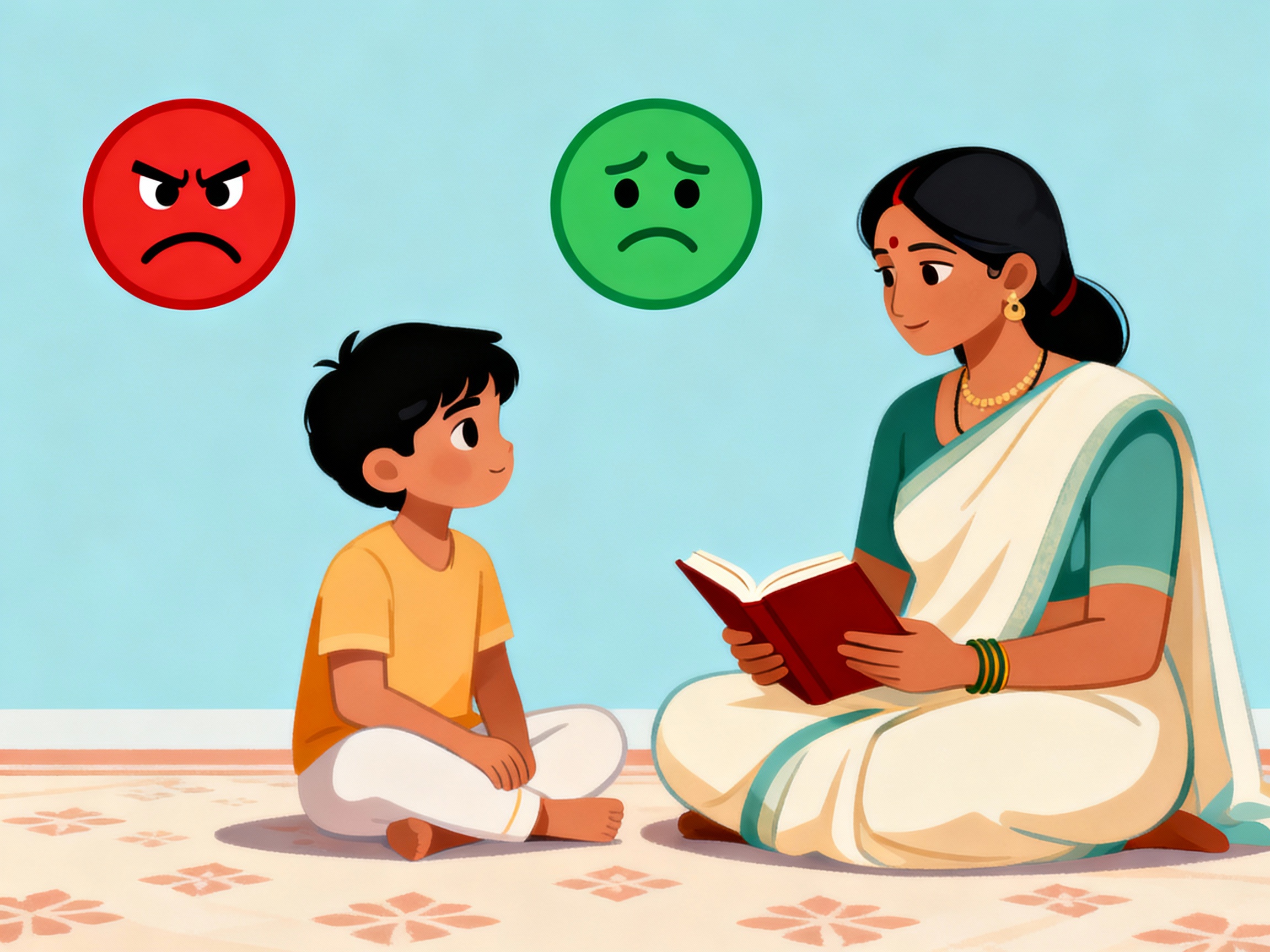
Parenting today feels like emotional firefighting.
Kids get angry over small things, jealousy rises when they compare themselves with friends or siblings, and emotional outbursts often become part of daily life. Despite parents’ love and effort, helping children understand their emotions is not always easy.
But what if the solution was hidden in a 5,000-year-old conversation between Krishna and Arjuna?
Yes—the Bhagavad Gita is one of the most powerful emotional intelligence guides ever written. It is not merely a spiritual scripture; it is a practical psychology book that teaches how to handle anger, jealousy, fear, confusion, comparison, and emotional pain.
In this article, we explore how the Gita can help modern children understand and manage emotions, especially anger and jealousy, in a healthy and empowering way.
1. Why Emotions Matter in Childhood
Children today face constant pressure—academics, competition, peer comparison, digital overload, social media, and unrealistic expectations. This often leads to:
- sudden anger outbursts
- jealousy among friends or siblings
- frustration over failures
- insecurity and comparison
- low confidence
Most parents try to control these emotions from the outside—“don’t get angry,” “stop crying,” “don’t be jealous.”
But emotions cannot be suppressed; they must be understood.
The Gita teaches one powerful concept:
“The mind is both your best friend and your worst enemy.” — Gita 6.5
If kids learn this early, they will become emotionally stable adults.
2. Krishna’s View: What Are Emotions?
Krishna explains that emotions rise from three gunas—Sattva, Rajas and Tamas.
Sattva → Calmness, clarity, kindness.
Rajas → Anger, desires, competition, jealousy.
Tamas → Laziness, fear, confusion.
Children don’t understand “gunas,” but they understand feelings.
So parents can teach:
- Sattva is your “good feeling mode”
- Rajas is your “fire mode”
- Tamas is your “sleepy or sad mode”
This simple explanation helps children understand that emotions are natural and always changing—just like the weather.
3. Teaching Kids the Gita’s Formula for Anger
Anger is one of the biggest challenges in children. Krishna describes anger very precisely:
**“Anger leads to confusion,
confusion leads to loss of memory,
and memory loss leads to destruction of intelligence.” — Gita 2.63**
This is the perfect emotional formula for kids.
How to Explain to Children (in simple words):
- When you get angry → your thinking brain shuts down
- When thinking shuts → you say or do things you regret
- So stopping anger early keeps your intelligence safe
Gita’s 3-Step Anger Control Method for Kids
Step 1: Pause for 5 seconds
Teach your child to say internally: “Stop. Think.”
Even a 5-second pause breaks the chain of reaction.
Step 2: Take a deep breath
Krishna explains breath as a tool for controlling mind (Gita 4.29).
Slow breathing instantly reduces anger.
Step 3: Change the environment
Move away from the argument or the object causing anger.
This is practical Dharma.
A Parent Tip:
Instead of saying “don’t get angry,” say:
“Let’s activate Sattva mode.”
Kids respond better to positive instruction.
4. Why Kids Feel Jealous — Gita’s Perspective
Jealousy comes from comparing oneself with others.
The Gita says:
“One who is content with what they have is truly peaceful.” — Gita 4.22
Kids become jealous because they feel “not enough.”
- “My friend got more marks.”
- “She has a better toy.”
- “He plays better than me.”
- “Papa loves my sister more.”
But Krishna tells Arjuna:
“Everyone has their own role, their own path.” — Gita 3.35
This is the key to stopping jealousy.
How to Explain to Children:
- Everyone has their own talents
- Everyone grows at their own speed
- You don’t need to be like anyone else
- You have your own special gift
This removes comparison-based jealousy from the root.
5. Gita’s Practical Lessons to Reduce Jealousy
(A) Teach Kids “Nishkama Karma” — Do Your Best Without Comparison
Krishna teaches:
“Focus on your work, not the result.” — Gita 2.47
When kids understand this, jealousy reduces automatically.
How to Teach:
- “Study to learn, not to beat your friend.”
- “Play to improve, not to show off.”
- “You only need to be better than your yesterday.”
This builds confidence and eliminates comparison.
(B) Teach Them “Everyone Has a Different Strength”
Use the example of Arjuna and Bhima:
- Arjuna was the best archer
- Bhima was the strongest
Everyone has a different superpower.
Tell your child:
“Find your Arjuna power.”
(C) Praise Effort, Not Achievement
When parents only praise marks or prizes, jealousy grows.
When parents praise hard work, honesty, dedication, the child feels secure.
Krishna praises Arjuna not for winning, but for trying with sincerity.
(D) Replace Jealousy With Inspiration
Teach the child:
Instead of saying “I am jealous,” say:
“I am inspired to learn from them.”
This transforms negative emotion into growth energy.
6. Teaching Kids to Understand Their Emotions (Krishna’s Method)
Krishna does not suppress Arjuna’s emotions; he helps him understand them.
Emotional Breakdown → Explanation → Practical Wisdom → Action
Parents can follow the same four-step process.
Step 1: Listen Without Judging
Let the child express anger, sadness or jealousy.
No lecture at that moment.
Step 2: Name the Emotion
When kids name emotion, intensity drops.
Say:
- “This is anger.”
- “This is jealousy.”
- “This is sadness.”
It creates emotional awareness.
Step 3: Give Gita-Based Logic
Explain the root cause: comparison, expectation, desire, competition, ego.
Step 4: Teach a Small Practice
Breathing, pausing, gratitude, or repeating a Gita mantra like:
“Om Shanti Shanti Shanti.”
7. Krishna’s Technique for Emotional Balance: Sthitaprajna Mindset
Krishna describes the ideal balanced person:
**“One who is not shaken by happiness or sorrow,
and who stays calm in both,
is truly wise.” — Gita 2.56**
This mindset helps children understand that:
- emotions are temporary
- reactions are choices
- calmness is strength
Teach kids:
**“It’s okay to feel everything.
But don’t let emotions control you.”**
8. Using Stories From the Gita to Teach Kids Emotion Control
Story 1: Arjuna’s Fear & Confusion
Arjuna was scared and confused before the war.
Krishna didn’t say “don’t feel this.”
He explained calmly and gave him clarity.
Lesson for kids:
Talk to parents when confused. Don’t hide emotions.
Story 2: Duryodhana’s Jealousy
Duryodhana was extremely jealous of the Pandavas.
His jealousy destroyed his wisdom and life.
Lesson for kids:
Jealousy hurts the person who feels it—not others.
Story 3: Hanuman’s Calm Strength (Gita connection)
Krishna compares divine qualities to courage and devotion.
Hanuman had strength with humility, not anger.
Lesson:
True power is calmness.
9. Practical Techniques From the Gita for Parents to Teach Kids
1. Daily 2-minute breathing before study
Calms the mind and increases Sattva.
2. Gratitude practice before sleeping
Reduces jealousy:
“Name 3 things you are thankful for.”
3. Self-comparison chart
Compare today with yesterday—not with others.
4. “Pause and think” mantra
When angry, say: “Pause.”
5. Spend 10 minutes daily on Gita storytelling
Stories make values stick naturally.
10. Long-Term Benefits of Raising Kids With Gita Wisdom
Children who learn Gita-based emotional management grow into:
- confident adults
- emotionally stable
- less reactive
- less jealous
- more compassionate
- better decision makers
- mentally strong
- successful without ego
- peaceful from within
The greatest gift a parent can give their child is emotional strength—not just good marks.
Conclusion
Kids do not need to suppress emotions; they need to understand them.
The Bhagavad Gita gives a beautiful emotional roadmap that teaches children how to:
- recognize emotions
- manage anger
- overcome jealousy
- reduce comparison
- build calmness
- think clearly even during stress
By using Krishna’s wisdom, parents can raise emotionally intelligent, confident and peaceful children who understand life with clarity.
The Gita is not just a scripture; it is a parenting manual, a psychology guide, and a life coach for every child.
Discover more from Online Guruji
Subscribe to get the latest posts sent to your email.
Oi, galera! Achei o barganha8 show de bola pra quem tá procurando umas promoções maneiras. Naveguei por lá rapidinho e já achei uns descontos bem legais. Vale a pena conferir! E olha, clica aqui: barganha8
Gotta say, geelyslotsgame is my new guilty pleasure. Love the slots, the sound effects, the whole shebang. Lost a few bucks maybe, but had a blast doing it! Feeling Lucky? Go geelyslotsgame
Alright peeps, just seen this 69vnm floating around. Looks kinda dodgy, I reckon. Do your research before you dive in. Here it is anyway 69vnm
WinPH5, yeah I’ve heard of it. Anyone actually win big there? Thinking about trying it out. Let me know if it’s legit! Gotta check out winph5
I’ve heard some people talking about PH88. You can use it on ph88, or so they say! Just check it out.
Finally found a site that doesn’t lag. The registration was a breeze and I started playing in minutes. Keep it up! phplus777link
Best place for those who love quick wins and easy navigation. The login process is seamless and the graphics are top notch. Try jili666login now.
[1334]Poker লগইন এবং অ্যাপ ডাউনলোড | বিকাশ ক্যাসিনো ডিপোজিট,poker লগইন করার নিয়ম জানুন এবং অ্যাপ ডাউনলোড করুন। বিকাশ দিয়ে casino ডিপোজিট করে লাইভ ক্যাসিনো বোনাস অফারগুলো লুফে নিন। আজই জয়েন করুন। visit: poker
Great community vibe and the games are always updated. It feels like a real digital pub for gamers. I’m spending most of my free time on ph203pub now.
The registration process took me less than two minutes. I am impressed with how streamlined everything is here. idarea188 is definitely a keeper.
Great interface and the graphics are stunning. It feels like a premium casino experience right from my phone. 38jilicclogin
Solid experience so far. Everything feels very professional and the loading times are quick. I am really enjoying my time on brbetaki lately.
I was skeptical at first but the withdrawal process was seamless. Everything is handled professionally here at 991jilicom