

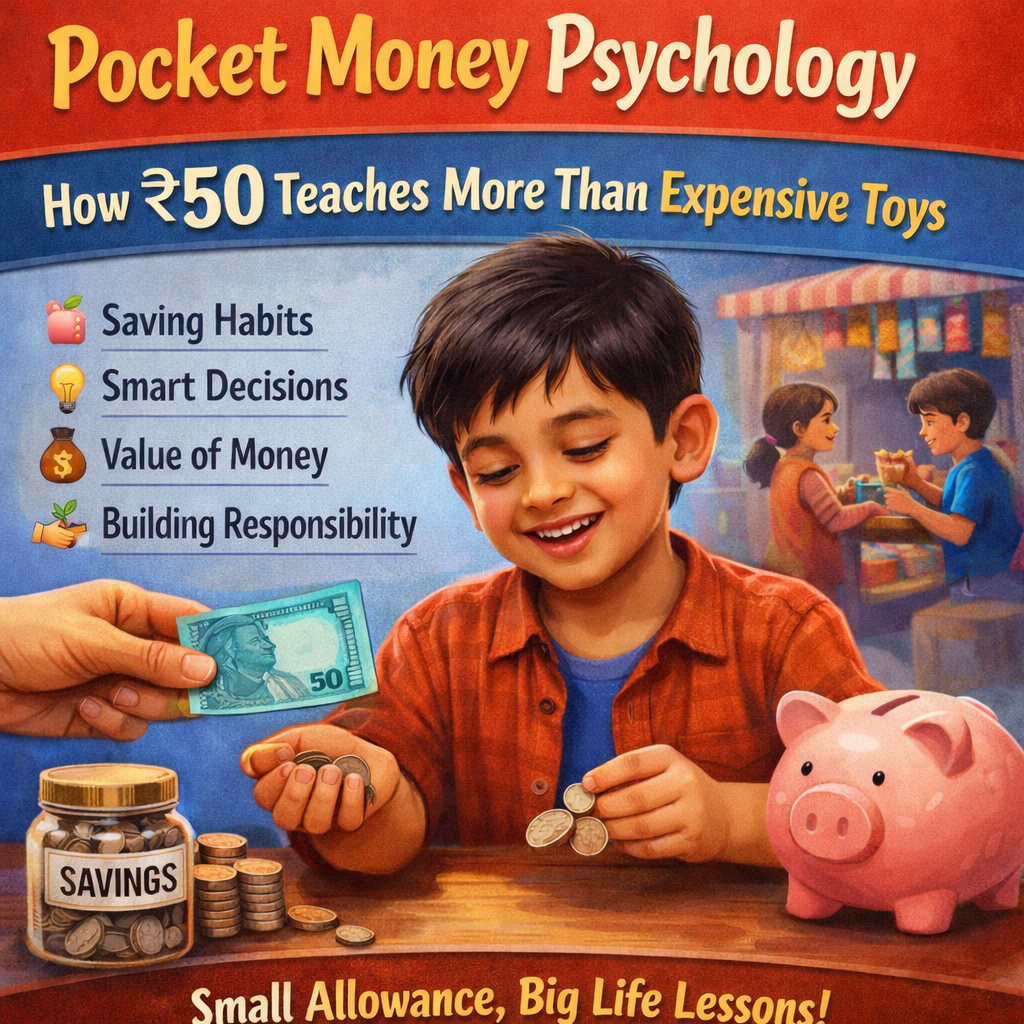
Why small allowances build smarter, responsible, and financially confident children in a big-spending world
There’s something magical about a child holding their own ₹50 note for the first time.
Not ₹500.
Not an expensive toy.
Just a simple, slightly crumpled ₹50.
They fold it carefully. Hide it in their pocket. Count it again and again. Think for hours before spending it.
And strangely… they value that ₹50 more than the ₹2,000 toy we buy without thought.
That’s not just cute behavior.
That’s psychology.
In today’s world of UPI payments, instant deliveries, and “Add to Cart” parenting, children rarely experience the feeling of earning, saving, or choosing. We give them everything — but unknowingly, we take away something more valuable:
👉 Money sense. Responsibility. Patience. Decision-making.
And this is exactly where pocket money becomes a life teacher.
Let’s understand why a small weekly ₹50 can teach lessons that even the most expensive toys never will.
The Problem: Kids Today Get Things, Not Value
Walk into any modern home.
A child wants a toy → Parents order it online.
Hungry → Food delivered.
Bored → New game downloaded.
Everything is instant.
But here’s the silent issue:
When children don’t wait, they don’t value.
Earlier generations saved coins in steel boxes or piggy banks. Today’s children often don’t even touch physical money.
And when kids don’t understand money:
- They overspend
- They demand more
- They feel dissatisfied quickly
- They lack patience
- They grow financially dependent
It’s not their fault.
It’s simply because nobody taught them how money actually works.
Pocket money quietly fills this gap.
Why ₹50 Works Better Than ₹500
Many parents think:
“If I give pocket money, let’s give more so they’re happy.”
But psychology says the opposite.
When money is too much:
- There’s no thinking
- No prioritizing
- No saving
- No learning
When money is limited:
- Kids calculate
- Compare
- Decide
- Plan
- Wait
And that’s where growth happens.
₹50 creates healthy friction.
That friction builds intelligence.
Because life is full of limited resources.
Not unlimited budgets.
Lesson 1: The Power of Waiting (Delayed Gratification)
Suppose your child wants a ₹150 toy.
If you give it immediately, happiness lasts 10 minutes.
But if they get ₹50 per week:
Week 1 → Save ₹50
Week 2 → Save ₹100
Week 3 → Finally buy
Now imagine their joy.
Three weeks of waiting. Dreaming. Planning.
That toy suddenly feels special.
This teaches one of the most important life skills:
👉 Delayed gratification
Research shows children who learn to wait:
- Perform better academically
- Handle stress better
- Make smarter financial choices later
- Become more successful adults
And all this… from ₹50.
Not tuition classes.
Not motivational speeches.
Just patience.
Lesson 2: Decision-Making Skills
When children have limited money, every purchase becomes a question:
- Chocolate or stickers?
- Save or spend?
- One big thing or many small things?
These small decisions strengthen the brain.
They learn:
- Opportunity cost
- Priorities
- Consequences
If they waste ₹50 on junk today, they can’t buy the toy tomorrow.
Life lesson learned — safely.
It’s better to make ₹50 mistakes at age 8
than ₹50,000 mistakes at age 25.
Lesson 3: Respect for Parents’ Hard Work
Something beautiful happens when kids handle their own money.
They begin to ask:
“Papa, how do you earn money?”
“Mumma, why shouldn’t we waste electricity?”
“Things cost so much!”
They slowly understand:
👉 Money doesn’t magically appear.
It comes from effort.
This builds:
- Gratitude
- Empathy
- Responsibility
Children who get everything easily often say:
“Buy this for me.”
Children who manage pocket money say:
“I’ll save and buy.”
That shift in language changes character.
Lesson 4: Confidence & Independence
Giving pocket money sends a powerful hidden message:
“I trust you.”
That trust builds confidence.
When kids pay at a shop themselves or manage savings:
- They feel grown-up
- They feel capable
- They feel independent
This reduces over-dependence on parents.
They don’t ask for every tiny thing.
They start solving small problems themselves.
And independence is one of the biggest gifts you can give a child.
Lesson 5: Teaches Saving (A Rare Skill Today)
Let’s be honest.
Even many adults don’t know how to save.
EMIs, impulse shopping, UPI spending — savings are disappearing.
Now imagine teaching saving from age 7 or 8.
A simple piggy bank can create a lifelong habit.
Try this:
- 50% Save
- 40% Spend
- 10% Donate
Children then learn:
- Saving
- Budgeting
- Sharing
They grow with a balanced mindset — not greedy, not careless.
This is financial wisdom schools never teach.
Lesson 6: Reduces Materialism
Ironically, kids who get pocket money often demand fewer expensive things.
Because they understand value.
When children buy something with their own savings, they:
- Take care of it
- Don’t break it easily
- Don’t throw it away
But when parents buy everything?
Things become disposable.
Pocket money reduces the “I want more” mindset.
It builds contentment.
And contentment leads to happiness.
How to Start Pocket Money (Simple Guide for Parents)
You don’t need a big system.
Start small and consistent.
Step-by-step:
✅ Decide a fixed day (Sunday works best)
✅ Give small amount (₹30–₹70 for younger kids)
✅ Don’t control every purchase
✅ Let them make mistakes
✅ Encourage saving
✅ Avoid giving extra money quickly
Important rule:
👉 Don’t use pocket money as punishment or reward.
It’s a learning tool, not a bribe.
Common Mistakes Parents Make
Let’s avoid these:
❌ Giving too much money
❌ Monitoring every rupee
❌ Forcing saving only
❌ Shaming them for bad spending
❌ Replacing pocket money with gifts
Remember:
They won’t learn if you control everything.
Learning needs freedom.
Real-Life Example
One mother shared something beautiful.
She started giving her 9-year-old daughter ₹50 weekly.
First month → chocolates only.
Second month → small toys.
Third month → started saving.
Fourth month → bought a storybook with her own money.
And she said:
“This is my book. I bought it myself.”
That pride?
No expensive gift can match it.
The Bigger Picture
Pocket money isn’t about money.
It’s about:
- Character
- Discipline
- Confidence
- Gratitude
- Financial literacy
In a world teaching kids to consume more, pocket money teaches them to think more.
It quietly prepares them for adult life.
Because one day:
They won’t just manage ₹50.
They’ll manage salaries, families, homes, and dreams.
And the foundation begins here.
Final Thoughts
We often believe love means giving children everything.
But sometimes love means giving less… and teaching more.
Next time instead of buying an expensive toy, try this:
Hand them ₹50.
Say,
“Use it wisely.”
And watch what happens.
You’ll see planning.
Thinking.
Saving.
Growing.
Because sometimes the smallest note teaches the biggest life lesson.
Discover more from Online Guruji
Subscribe to get the latest posts sent to your email.
Really impressed with the performance here. Everything loads quickly and the navigation is intuitive. If you are searching for a stable platform, br22ff is the way to go.
I’ve tried a few sites lately but this one feels the smoothest. The payouts are quick and the interface is very user friendly. Highly recommend checking out phjiliuno if you love slots.
Really impressed with the layout and how easy it is to navigate. It feels very professional and secure, which is exactly what I look for. idtuan88
[2927]bet winner লগইন ও অ্যাপ ডাউনলোড | বিকাশ ক্যাসিনো ডিপোজিট,bet winner লগইন করে লাইভ ডিলার ক্যাসিনো গেম উপভোগ করুন। বিকাশ দিয়ে ক্যাসিনো ডিপোজিট এবং অনলাইন স্লট গেম খেলার নিয়ম জানতে আজই ভিজিট করুন। visit: bet winner
The login process is seamless and I never have any issues with my account access. It is refreshing to find a site that actually works properly. Visit phpcomelogin for a hassle-free experience.
The app interface is super smooth and the login process is a breeze. I really love how fast the games load. Definitely a great choice for anyone looking for a reliable platform. Check out 666jililoginapp
Awesome promotions and daily rewards. It keeps the game exciting every time I log in. Definitely visit 12krwin for the best deals.
Really impressed with the security and the way they handle transactions. It feels very safe to play here. Visit ph788ph
Honestly the best experience I have had with a slot site recently. The payouts are fair and the interface is super smooth. Definitely check out jili988casinologin if you want a reliable place to play.