

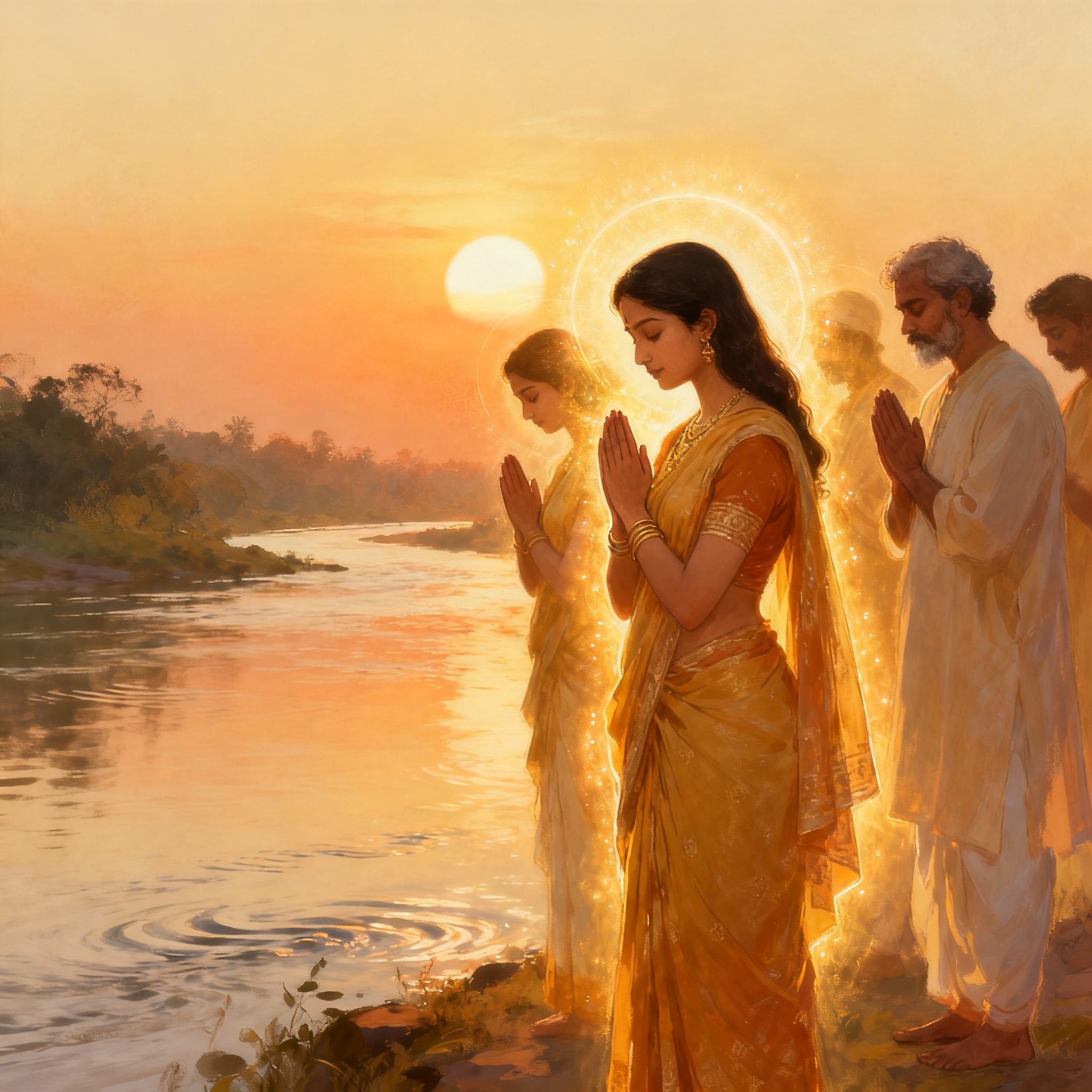
How ancient sun worship awakens modern wellness through emotion, energy, and awareness
Introduction: A Festival Beyond Offerings
When the golden sun dips into the horizon and millions gather by the riverbanks, something extraordinary happens — silence meets devotion. Chhath Puja is not just a festival; it’s a spiritual symphony of gratitude. Every offering, every mantra, and every breath taken in those serene moments reflects one timeless truth — “Gratitude heals.”
In our modern age of stress, screens, and endless wants, the essence of thankfulness often gets lost. Yet, Chhath reminds us that harmony — whether of body, mind, or spirit — begins not with consumption, but with appreciation. Ayurveda, too, agrees. According to this ancient science, gratitude shifts our inner energy, aligning the doshas (Vata, Pitta, Kapha) and cleansing the manas (mind).
This is the unseen spiritual science behind Chhath Puja — an annual detox for the soul.
The Heart of Chhath: A Festival of the Sun and the Self
Chhath Puja, primarily celebrated in Bihar, Jharkhand, and eastern Uttar Pradesh, is one of the few Vedic festivals dedicated solely to Surya Devta (the Sun God). For four days, devotees fast, cleanse, meditate, and express gratitude to the life-giving Sun — the ultimate source of prana (energy).
The ritual may appear simple: taking holy dips, preparing offerings (arghya), and facing the setting and rising sun. Yet, each action symbolizes a deep Ayurvedic and psychological principle:
- Fasting cleanses the digestive fire (Agni).
- Water immersion balances the heat (Pitta) generated during the ritual.
- Sun gazing in moderation activates serotonin and melatonin, balancing mood and sleep cycles.
- Gratitude expressed during offerings releases emotional toxins stored in the subconscious.
Thus, Chhath becomes not only a religious ritual but a holistic wellness practice.
Ayurveda and Gratitude: Healing from the Inside Out
Ayurveda teaches that the mind (Manas) plays a direct role in disease. Negative emotions — anger, jealousy, or greed — disturb mental balance and manifest as physical symptoms. Gratitude, on the other hand, restores equilibrium.
When we practice gratitude — sincerely, not mechanically — it stimulates the Sattva guna (the pure, balanced quality of consciousness). During Chhath, every devotee’s focus shifts from wanting to thanking, from consuming to offering. This sattvic vibration calms the mind, reduces cortisol (stress hormone), and enhances immunity.
In Ayurveda, this is called Manas Shuddhi — purification of the mind.
In spirituality, we call it Bhakti.
In science, it’s called neurochemical balance.
Three names. One truth.
The Sun as the Ultimate Healer
Why is the Sun so central to Chhath?
Because Ayurveda reveres Surya not merely as a deity, but as the embodiment of consciousness and life energy (Prana Shakti).
Modern research echoes this ancient understanding. Sunlight triggers Vitamin D production, regulates the biological clock, and enhances serotonin levels — the “happiness hormone.”
From an Ayurvedic lens, the Sun strengthens Pitta dosha — responsible for digestion, metabolism, and vision. A balanced Pitta brings clarity, courage, and focus — exactly the states needed for spiritual growth.
Thus, when a devotee stands in waist-deep water, eyes fixed on the horizon, and offers arghya, they are performing an ancient act of bio-energetic alignment — balancing hormones, doshas, and emotions in one sacred moment.
The Rituals as Energy Practices
Every aspect of Chhath Puja can be seen as a yogic and Ayurvedic ritual for inner balance:
- Fasting (Upavas):
Skipping food is not a punishment; it’s a reset button. According to Ayurveda, fasting gives rest to Agni (digestive fire), allowing toxins (Ama) to be eliminated naturally. It also improves concentration, clarity, and emotional control. - Water Immersion (Snan):
Standing in water for long periods soothes the nervous system. The temperature difference activates circulation and relaxes the muscles — like a natural hydrotherapy. - Pranic Offering (Arghya):
Offering water to the Sun while chanting mantras harmonizes breath and thought. It becomes a moving meditation — combining devotion, mindfulness, and breath regulation. - Early Morning Exposure:
The timing of the rituals — at sunrise and sunset — ensures optimal absorption of solar prana without the harsh midday heat. This helps reset the circadian rhythm and improve sleep quality. - Clean Living (Sattvic Lifestyle):
Devotees avoid negative speech, anger, and indulgence during the four days — a practical approach to emotional discipline and detox.
Each step is a scientific act of energy balance, rooted in Ayurveda’s holistic principles.
Gratitude and the Mind-Body Connection
Gratitude has measurable effects on the brain. Neuroscience shows that grateful people have stronger activation in the hypothalamus (which regulates stress) and better dopamine response (which drives motivation and pleasure).
Similarly, Ayurveda describes gratitude as Hridaya Prasadini — nourishing for the heart and calming for the Prana Vayu (life-force energy).
During Chhath, when a devotee thanks the Sun for life, food, and family, their entire energy field shifts from tension to trust.
This is not symbolic — it’s biological.
A heart filled with gratitude beats slower.
A mind full of faith breathes deeper.
And a soul anchored in devotion heals faster.
Chhath as a Family Detox Ritual
One of the most beautiful aspects of Chhath is its community and family participation. Everyone — from children to elders — contributes with reverence. The preparation of Thekua, cleaning the home, decorating the ghats, and singing folk songs create collective positive vibrations.
From an emotional wellness perspective, this collective gratitude generates harmony within families. Sharing rituals reduces isolation, builds empathy, and strengthens social bonds — all key to mental well-being.
In Ayurvedic psychology, these shared vibrations are called Sangha Shakti — the healing power of community.
The Cosmic Perspective: Gratitude as Alignment
In the spiritual view, gratitude aligns us with the cosmic rhythm. The Sun never demands worship — it simply gives light and energy, unconditionally. Chhath teaches humans to reflect the same quality — to give selflessly, to shine without ego.
This mirrors the Ayurvedic concept of Dharmic living — acting in harmony with nature. When one lives dharmically, health flows naturally. Disease arises only when we resist nature’s rhythm.
Thus, Chhath is more than a seasonal celebration — it’s a reminder that wellness begins when the self aligns with the source.
Modern Takeaway: Practicing Gratitude Every Day
You don’t need to wait for Chhath Puja to practice its wisdom.
Here’s how you can bring its essence into your daily life:
- Morning sunlight exposure: Spend 10 minutes in the early sun to balance your hormones and mood.
- Daily gratitude journal: Write three things you’re thankful for every night — this rewires your brain toward positivity.
- Mindful fasting: Occasionally skip a meal or eat light to rest your digestion.
- Offerings to nature: Water a plant, feed birds, or simply thank the elements around you.
- Sattvic living: Choose purity in thoughts, words, and food — your body will mirror your mind’s peace.
Chhath Puja may end in four days, but its message lasts forever: healing begins with gratitude.
Conclusion: The Sun Within You
In the end, the true Surya we worship during Chhath is not far away in the sky — it shines within us. Every act of kindness, every thankful breath, and every selfless offering becomes a ray of that inner sun.
Ayurveda calls this inner light Tejas — the brilliance of awareness.
When gratitude awakens this Tejas, the boundaries between divine and human fade away.
That’s when the true harmony of body, mind, and spirit begins.
So, this Chhath Puja, when you bow to the setting Sun, remember — you are not just worshipping light; you are becoming it.
Discover more from Online Guruji
Subscribe to get the latest posts sent to your email.
Bizzo, Bizzo, Bizzo… where do I even begin? Huge selection of games and they actually pay out. Totally recommend! Go test your luck with bizzo
Anyone having trouble with ktologin? Site looks legit. If you are signing in here is the link: ktologin Hope you get to log in!
Been using this for a while now and it is hands down the best version of the app I have tried. Fast loads and no annoying crashes. Love it! y999download
I have been searching for a reliable way to download the app for a while and this site finally made it easy. Everything works smoothly on my phone. Check out bdhbajeeapk for the best experience.
Such a refreshing take on the classic slots. The graphics are colorful and the payouts feel fair. I am having a blast at clfruitcocktail lately.
Really loving the game variety here. I had a great run last night and the bonuses are actually worth it. Check out pk888gj if you want a fun experience.
Everything is so easy to navigate. I was able to set up my account and start playing in just a couple of minutes. Big thanks to pharionplaycom
Best betting experience I have had in months. The odds are fair and the payout process is transparent. Definitely check out br881betwin.
Loving the integration with Maya, it makes deposits and withdrawals so fast and seamless. luckyplayphmaya is the way to go for convenience.
If you are looking for a place with great odds and a friendly vibe, this is it. I’ve tried a few others but br118bet feels much more honest and transparent.