

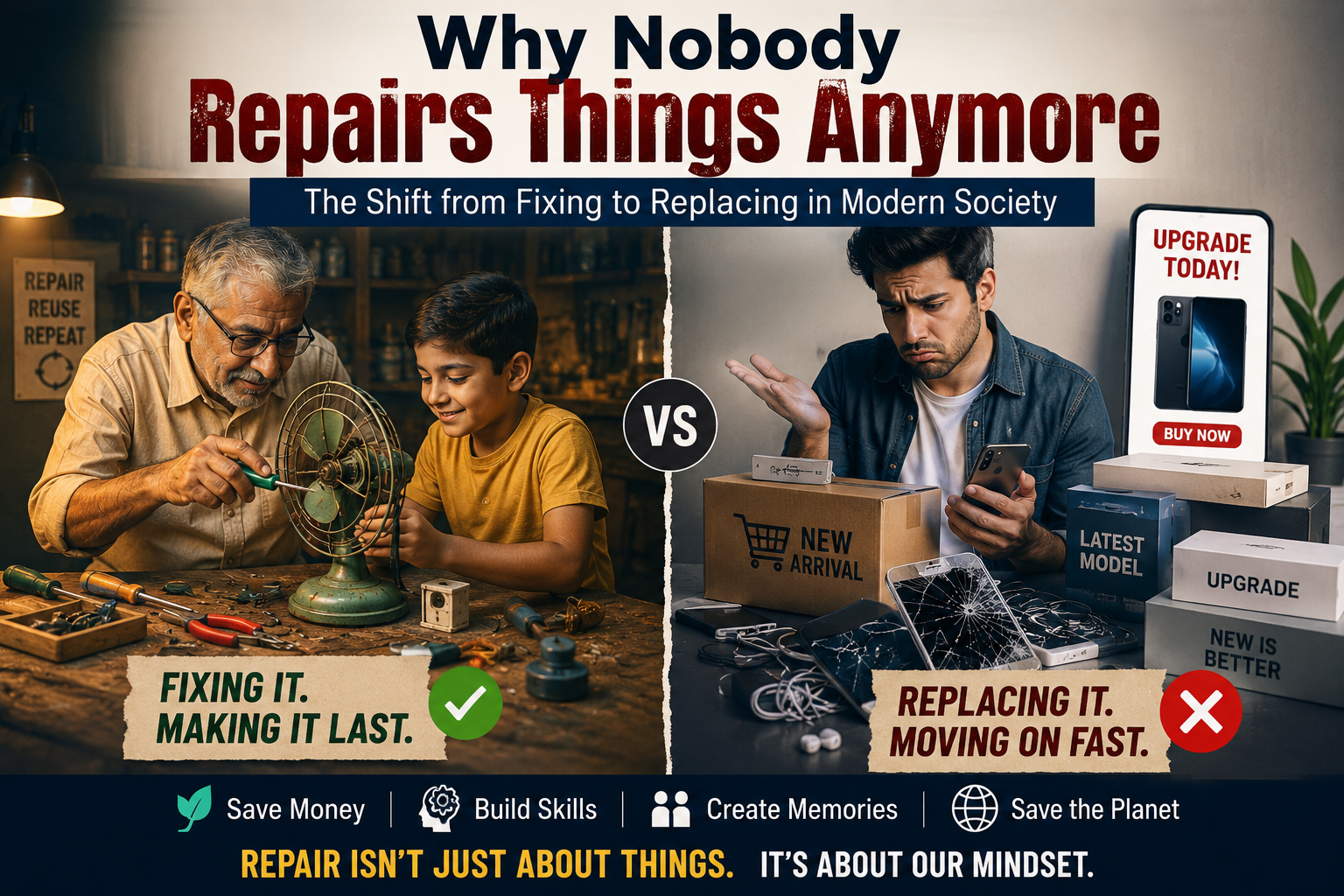
There was a time when a broken item was not the end of its story.
If a radio stopped working, someone tried to repair it. If a bicycle chain came off, it was fixed. If a wooden chair became loose, a family member would bring out a hammer and nails. Even school bags, shoes, toys, and kitchen appliances were repaired and used again.
Today, things are different.
When a mobile phone screen cracks, many people start looking for a new phone. When earphones stop working, they are often thrown away. If a mixer, microwave, or television develops a problem, replacing it sometimes seems easier than repairing it.
Somewhere along the way, society moved from a culture of fixing things to a culture of replacing them.
The change may seem small, but it says a lot about how modern life has transformed our habits, values, and way of thinking.
When Repairing Was a Normal Part of Life
For previous generations, repairing things was simply common sense.
People understood the value of money and resources. They believed that if something could be fixed, it should be fixed.
Many homes had a toolbox. Fathers and grandfathers often knew how to repair basic household items. Children watched and learned. Local repair shops were found in almost every neighborhood.
A broken fan was repaired.
A torn shirt was stitched.
A damaged toy was fixed.
Nothing was discarded without giving it a second chance.
The goal was not perfection. The goal was usefulness.
People felt proud when they made something last longer.
The Rise of the Replacement Culture
Today, replacing something often feels more convenient than repairing it.
Why spend time searching for a repair shop when a new product can be ordered online in a few minutes?
Modern technology has made purchasing easier than ever before.
With one click, a replacement arrives at the doorstep.
Companies constantly introduce newer models with better features, improved designs, and attractive discounts. Advertisements encourage consumers to upgrade frequently, even when their existing products still work.
As a result, many people no longer ask:
“Can this be repaired?”
Instead, they ask:
“What should I buy next?”
Convenience Has Changed Our Thinking
Convenience is one of the greatest achievements of modern society.
It saves time and effort.
However, convenience has also changed how people approach problems.
Repairing requires patience.
It requires investigation.
It requires effort.
Replacing requires very little thought.
When convenience becomes the default solution, people naturally become less interested in repairing.
Over time, the habit disappears.
This is not just about products.
It is about mindset.
The Disappearing Repair Skills
Many children today grow up without seeing basic repairs happen at home.
A leaking tap is fixed by a professional.
A broken toy is replaced.
A damaged electronic device is discarded.
As a result, practical repair skills are becoming rare.
Previous generations learned valuable lessons while repairing things:
- Problem-solving
- Patience
- Observation
- Creativity
- Resourcefulness
When something broke, they looked for solutions.
Today’s generation often looks for replacements.
This subtle difference shapes the way people think.
The Hidden Cost of Throwing Things Away
Every time a product is discarded, there is a cost beyond money.
Electronic waste is growing rapidly around the world.
Mobile phones, chargers, headphones, laptops, and appliances are often replaced long before their useful life is over.
Many of these products contain materials that are difficult to recycle.
Landfills continue to grow.
Natural resources continue to be consumed.
Ironically, many products that are thrown away could have been repaired and used for several more years.
What seems convenient in the short term can become costly for society in the long term.
The Childhood Lesson We Are Losing
Repairing things teaches children something important.
It teaches them that problems can be solved.
Imagine a child whose toy car breaks.
In one situation, the toy is immediately replaced.
In another situation, a parent sits with the child and repairs it together.
The second experience teaches far more than toy repair.
It teaches patience.
It teaches persistence.
It teaches that mistakes and damage do not always mean something is finished forever.
These lessons often stay with children long after the toy is forgotten.
Festivals Show the Same Change
The shift from repairing to replacing can be seen in celebrations too.
Years ago, families prepared decorations by hand.
Festival items were reused and repaired each year.
Children helped create decorations, paint diyas, and prepare festive materials.
Today, most festival supplies are purchased ready-made.
If something is damaged, it is often replaced instead of repaired.
While convenience saves time, it also reduces opportunities for creativity and involvement.
The process itself once created memories.
Now the finished product often receives more attention than the journey.
Social Media and the Upgrade Mindset
Social media has strengthened the culture of replacement.
People are constantly exposed to newer gadgets, fashion trends, furniture, and lifestyle products.
Even perfectly functional items may start to feel outdated.
A phone that works perfectly may seem old because a newer version has appeared online.
A sofa may be replaced because it no longer matches current trends.
A perfectly good item can suddenly feel inadequate when compared to what others are displaying.
This creates a cycle of continuous upgrading.
The desire for newness often becomes stronger than the appreciation of usefulness.
When Relationships Become Disposable
Perhaps the most interesting part of this discussion has nothing to do with objects.
The repair mindset affects relationships too.
In the past, people often invested time and effort in resolving misunderstandings and conflicts.
Friendships, communities, and family bonds were maintained through patience and communication.
Today, many people live in a fast-moving world where replacing often feels easier than repairing.
When applied to products, this habit seems harmless.
When applied to relationships, it becomes much more significant.
A society that loses the habit of repairing things may gradually lose the habit of repairing connections as well.
Of course, not every relationship should be preserved at all costs. But the willingness to work through difficulties remains an important human skill.
The Value of Making Things Last
There is something satisfying about using an item for many years.
An old bicycle.
A repaired wooden table.
A watch passed down through generations.
A piece of furniture with a story behind it.
These objects carry memories.
They remind us that value is not always measured by how new something is.
Sometimes value comes from durability, care, and history.
Previous generations understood this naturally.
Modern society is slowly rediscovering it.
The Growing “Right to Repair” Movement
Interestingly, many people are beginning to push back against the replacement culture.
Around the world, consumers are supporting the idea that products should be easier to repair.
People want access to spare parts, repair manuals, and affordable repair services.
The movement is not only about saving money.
It is about reducing waste and promoting sustainability. More importantly, it is about restoring a mindset that values repair over disposal
What Can Families Do?
Families can help bring back the repair mindset in simple ways:
- Involve children in basic household repairs.
- Repair toys instead of immediately replacing them.
- Teach simple sewing skills.
- Reuse and restore old items.
- Encourage creativity with broken materials.
- Show children that not every problem requires buying something new.
These small experiences teach valuable life lessons.
Final Thoughts
A generation ago, people looked at a broken object and asked:
“How can we fix this?”
Today, many people ask:
“What should I replace it with?”
The difference may seem minor, but it reflects a deeper change in society.
The decline of repair culture is not just about gadgets, furniture, or household appliances.
It is about patience, responsibility, creativity, and the belief that things still have value even after they become damaged.
Perhaps the real question is not why nobody repairs things anymore.
Perhaps the real question is whether we are also forgetting how to repair skills, traditions, communities, and relationships.
Because sometimes, the most valuable things in life are not the ones we replace.
They are the ones we choose to repair.
Discover more from Online Guruji
Subscribe to get the latest posts sent to your email.
This shift reflects planned obsolescence, not just in hardware, but in value systems. The focus moves from repairability to immediate replacement, a trend visible across digital goods too. Preserving value and sustained engagement, whether through fixing a machine or maximizing rewards on a platform like jl9 vip, remains key.
https://shorturl.fm/qGs9X
That’s a solid analysis! Seeing platforms like Buenas prioritize security – especially with 2FA & PHP transactions – is key for building trust. A secure buenas login is a must these days, and that focus on responsible gaming is great too.
https://shorturl.fm/BBKB3
https://shorturl.fm/CnHj5
https://shorturl.fm/w0APe
Man, this review nails the vibe. It’s refreshing how straightforward the whole setup feels, especially for quick mobile action. For others checking out, maybe check out ph777 link com; seems easy to jump right in.
https://shorturl.fm/YLqTe
https://shorturl.fm/VFJh5
https://shorturl.fm/yum9J
Interesting breakdown; focusing on user flow is key for any platform. The simplicity mentioned at ww888 legit really streamlines the process. Solid analysis on mobile optimization!
The evolution of online gaming really mirrors historical shifts in leisure. Observing the sheer breadth of options, like those listed for 73333 app, shows modern platform depth. Fascinating stuff!
Volatility is key when I pick slots – high enough for a thrill, but not draining my bankroll instantly! Seeing platforms like J77 Legit prioritize secure registration & local payment options (GCash, PayMaya) is great. Check out a j77 legit download apk for a smoother experience! It’s all about trust & convenience, right?
Feeling lucky, are ya? I stumbled across 600betlucky and it actually delivered a few decent wins. Could be a fluke, but hey, worth a shout! Give it a go: 600betlucky
Love how stable the connection is every time I log in. No more annoying crashes in the middle of a big win. Always trust 500jililogin
I’ve been looking for a reliable spot to play and this one really hits the mark. The interface is smooth and the payouts are surprisingly fast. Definitely my new go-to place for some action! brsorte26bet
Really impressed with the game variety here. It is definitely my new go-to spot for some weekend fun. Highly recommend giving auronplaygame a try if you love gaming.
If you are looking for a reliable betting site, this is it. The odds are competitive and the site layout is very clean. My go-to is idtmbet88
Really enjoying the vibe here. Everything is easy to navigate and the customer support is actually helpful. Highly recommend 56wgame for anyone starting out.
Honestly, the focus on probability analysis here is refreshing. It moves beyond mere chance. I’m genuinely impressed by this statistical angle; it makes evaluating platforms like 23Win Com com feel more rigorous.