

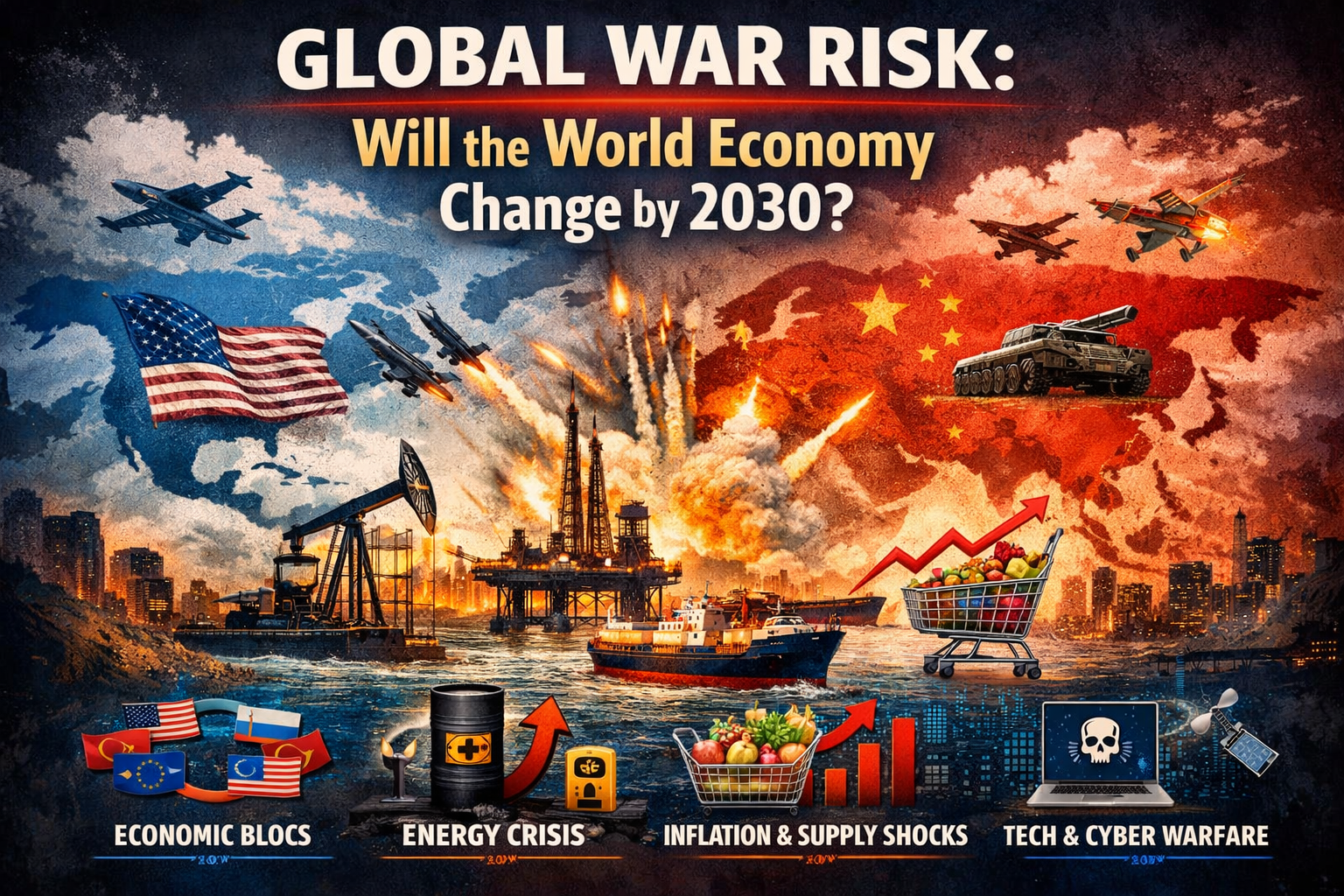
For the last three to four decades, the global economy has been driven by one major idea—globalization. Countries traded freely with each other, companies manufactured goods in the cheapest locations, and supply chains connected the entire world.
However, in recent years, several global events have started shaking this system. Conflicts, geopolitical tensions, and economic rivalries are forcing nations to rethink the way the global economy works.
Major developments such as the Russia–Ukraine War, growing tensions in the Middle East, and economic competition between major powers have raised an important question:
Could the global economy look completely different by 2030?
Let’s explore the factors that could reshape the world economy in the coming years.
1. From Globalization to Economic Blocs
Since the 1990s, globalization has encouraged countries to work together economically. But today, many nations are forming stronger regional alliances and economic blocs.
For example:
- United States and its economic partners
- China expanding its influence through trade and infrastructure
- Russia building new partnerships amid sanctions
This trend suggests that the future global economy might not function as one interconnected market. Instead, the world could be divided into multiple economic zones or blocs, each with its own trade networks and strategic alliances.
2. A Major Shift in Global Supply Chains
The COVID-19 pandemic and geopolitical conflicts exposed the vulnerabilities of global supply chains. When one region faces disruption, the entire world can experience shortages and rising prices.
To reduce these risks, companies are now:
- Moving manufacturing closer to their home countries
- Diversifying production across multiple regions
- Reducing dependency on a single country for critical goods
This strategy is often referred to as “China Plus One”, where companies maintain operations in China but also expand production to other countries.
This shift could create major opportunities for emerging economies.
3. Energy Wars and the Oil Economy
Energy remains the backbone of the global economy. Oil and gas still power transportation, industries, and electricity production in many parts of the world.
Countries such as
- Saudi Arabia
- Iran
play a crucial role in global energy supply.
If geopolitical tensions escalate in major oil-producing regions, the consequences can include:
- Rising oil prices
- Increased transportation costs
- Higher global inflation
This is why energy security is becoming one of the most important economic priorities for many nations.
4. The New Era of Inflation
Persistent conflicts and supply disruptions can create long-term inflationary pressures.
Several factors contribute to this trend:
- Supply chain disruptions
- Rising energy costs
- Trade restrictions and sanctions
- Increasing military expenditures
Some economists believe the world may be entering a “permanent inflation era,” where prices remain relatively high for a prolonged period.
This could significantly affect the purchasing power of middle-class families around the world.
5. Rising Military Spending
In response to global tensions, many countries are increasing their defense budgets.
For example:
- Germany has significantly increased military spending in recent years.
- Japan is also strengthening its defences capabilities.
Higher military spending can influence economic priorities. Governments may allocate more resources to defence, which could reduce funding for areas such as:
- Education
- Healthcare
- Infrastructure development
As a result, the structure of national economies may gradually shift.
6. Digital Economy and Cyber Warfare
Future conflicts may not only take place on battlefields. The digital world is becoming an increasingly important front.
Cyber attacks, digital surveillance, artificial intelligence, and data security are emerging as critical elements of modern geopolitics.
Technology companies and digital infrastructure providers will likely play a larger role in shaping economic power.
Countries that lead in AI, cybersecurity, and digital innovation could gain significant economic advantages.
7. The Rise of Emerging Economies
Another important trend is the gradual shift of economic power from the West to Asia and other developing regions.
Countries such as:
- India
- Vietnam
- Indonesia
are becoming attractive manufacturing and investment destinations.
As global supply chains diversify, these emerging economies may experience faster growth and increasing global influence.
8. Growing Demand for Safe Investments
Periods of geopolitical uncertainty often drive investors toward safe-haven assets.
Historically, during times of crisis:
- Gold prices tend to rise
- Silver demand increases
- Investors seek assets that preserve long-term value
This trend reflects a broader desire for financial stability during uncertain global conditions.
Possible Global Economic Scenario by 2030
If current trends continue, the global economy by 2030 may display several key characteristics:
- Slower globalization
- Stronger regional economic alliances
- Diversified supply chains
- Increased focus on energy security
- Rapid growth of emerging economies
- Greater importance of technology and digital infrastructure
Conclusion
The world appears to be standing at an economic turning point. Wars, geopolitical tensions, and inflationary pressures are gradually reshaping the global economic landscape.
While it is unlikely that the entire world economy will change overnight, the direction of change is becoming increasingly clear.
By 2030, the global economic system may look significantly different from the one that dominated the early 21st century.
Countries that adapt quickly to these evolving dynamics will likely emerge stronger in the new global economic order.
Discover more from Online Guruji
Subscribe to get the latest posts sent to your email.
Interesting points! Thinking about bankroll management is key, especially with so many game options now – slots, live casino, even sports! Considering a platform like 8k8t app download for variety is smart, but always prioritize responsible play & verification.
The shift from globalization to regional blocs underscores the critical need for resilient, diversified systems. This principle applies far beyond trade-it governs everything from supply chains to leisure. Observing how people seek diverse forms of engagement, whether through new markets or varied entertainment options like dct casino games, highlights the enduring human demand for choice and stability.
The shift from globalization to regional economic blocs is fascinating. This necessitates a pivot toward localized, resilient digital infrastructure and diversified financial ecosystems. Understanding these alternative revenue streams, like those available via platforms such as ph958 legit, will be key to navigating the fragmented global market.
It’s fascinating how online platforms like nustar ph slot are building communities around gaming – that social aspect is huge! The focus on a smooth user journey, from signup to verification, really shows they prioritize player experience. It’s about more than just the games, right?
I used to struggle with slow sportsbook updates, but this platform delivers real time odds and instant bet confirmations like a dream. The customer team is always happy to help and the loyalty program keeps getting better. Truly a top tier experience. apuestasforobet
If you are looking for big wins and a fair game, this is the place to be. Give pk777xz a try!
One of the most reliable sites I have used recently. The navigation is simple and the wins are exciting. Love phjljl4
I really enjoy the variety of slots available here. The jackpots feel reachable and the vibe is just right. Big shoutout to ph16jili!
The mobile experience is top-notch. It feels just like a native app and runs perfectly on my phone without any glitches. Download or visit b9gameapp for the best action.
Top tier service and a very generous welcome package. It is hard to find a site this consistent these days. I’m really happy with vnbet88vn