

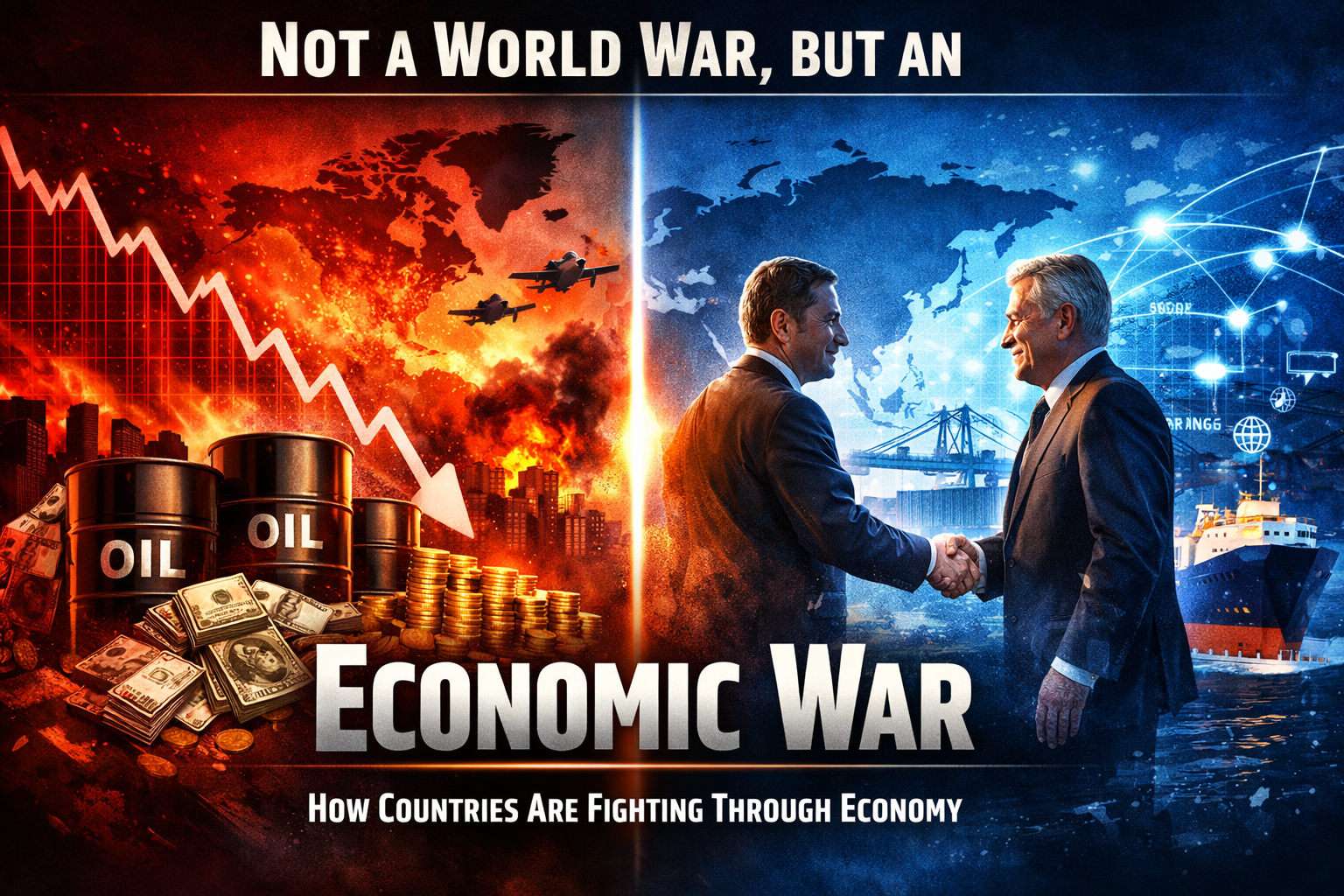
War Has Changed Its Form
When we hear the word “war,” we usually imagine tanks, missiles, and soldiers on the battlefield. But in 2026, the nature of war has evolved. A new kind of conflict is dominating the world—Economic War.
This war is fought without bombs and guns, yet its impact is often deeper and more widespread. Countries now use trade, currency, technology, oil, and financial systems as tools to weaken each other.
The big question is:
Is the real war today being fought through economies rather than weapons?
In this article, we’ll explore what economic war is, how countries are using it, and how it affects everyday life.
What Is an Economic War?
An economic war refers to a situation where countries try to weaken each other’s economies without direct military conflict.
They use tools like:
- Economic sanctions
- Trade restrictions
- Currency manipulation
- Technology bans
- Resource control (oil, gas, etc.)
It is a silent war—slow, strategic, and highly impactful.
Why Countries Prefer Economic War Today
Military War Is Too Risky
In the age of nuclear weapons, direct war is extremely dangerous. Even a small mistake can escalate into a global catastrophe.
Economic Tools Are More Effective
Targeting a country’s economy can:
- Slow down growth
- Increase inflation
Reduce job opportunities
All without firing a single shot.
Globalization Has Connected Economies
Today, countries are deeply interconnected:
- Oil imports
- Technology supply
- International trade
This dependency has turned into a strategic weapon.
Major Weapons of Economic War
1. Economic Sanctions
Sanctions are the most common tool.
For example:
- A country may ban trade with another
- Block its access to global banking systems
Result:
- Currency weakens
- Inflation rises
- Economic growth slows
2. Trade Wars
Trade wars happen when countries:
- Increase import duties
- Ban certain products
This affects industries and global supply chains.
3. Currency War
Some countries deliberately keep their currency weak to:
- Boost exports
- Gain global market advantage
This creates intense economic competition.
4. Technology Control
Technology is power in today’s world.
Countries restrict access to:
- Advanced chips
- AI tools
- Critical software
This can slow down another nation’s growth significantly.
5. Resource Control (Oil & Gas)
Oil and gas are the backbone of the global economy.
If supply is disrupted:
- Fuel prices rise
- Transport costs increase
- Inflation spreads
This directly impacts everyday life.
Real-World Examples of Economic War
1. US–China Trade War
- Tariffs increased
- Tech companies restricted
Result: Global supply chains were disrupted.
2. Russia–West Sanctions
- Banking restrictions
- Oil export controls
Result: Energy prices surged worldwide.
3. Middle East Tensions (2026)
- Oil supply risks
- Shipping routes under threat
Result: Rising fuel prices and global inflation.
Impact on Common People (Most Important Section)
Economic war affects ordinary people the most.
1. Rising Fuel Prices
Disrupted oil supply leads to higher petrol and diesel prices.
2. Expensive Daily Essentials
Higher transport costs increase prices of:
- Food
- Vegetables
- Everyday goods
3. Job Market Pressure
Companies reduce costs and slow down hiring.
4. Falling Stock Markets
Uncertainty causes investors to withdraw money.
5. Reduced Value of Savings
Inflation reduces the purchasing power of money.
Impact on India
India, being a developing economy, feels the effects more strongly.
🇮🇳 1. Oil Dependency
India imports a large portion of its oil.
War → expensive oil → higher inflation
🇮🇳 2. Rupee Pressure
A strong dollar weakens the rupee.
Imports become more expensive
🇮🇳 3. Pressure on Middle Class
- Higher EMIs
- Rising daily expenses
- Reduced savings
The middle class faces the biggest burden.
The Hidden Side: Who Benefits?
Every war has winners.
In economic war:
- Oil-exporting countries earn more
- Defense industries grow
- Investors profit from gold and commodities
Even in crisis, some sectors gain.
Future: Are Economic Wars the New Normal?
Experts believe:
- Military wars may reduce
- Economic wars will increase
Because:
✔ Lower risk
✔ Greater control
✔ Global impact
Countries are turning economies into their primary weapon.
Conclusion: The Silent War We All Experience
Today’s wars are not just fought on battlefields, but in:
- Markets
- Currency systems
- Economic policies
Economic war is silent, but its impact reaches every household.
When fuel prices rise
When grocery bills increase
When jobs become uncertain
You are witnessing the effects of this invisible war.
Final Thought
“In today’s world, the most powerful country is not the one with the strongest military,
but the one with the strongest economy.”
Discover more from Online Guruji
Subscribe to get the latest posts sent to your email.
Just found a gem for Filipino players! The localized payments and 24/7 support on AH77 slot download make betting seamless, especially with GCash integration.
King PH App offers a vibrant Filipino gaming community with easy local payments like GCash. Explore thrilling slots and live dealers at king ph app app casino today!
This analysis correctly identifies the shift to non-kinetic conflict. The vulnerability lies in the interconnected digital financial rails. Ensuring stable, secure digital access-whether for global trade or personal entertainment via a platform like the queen ph app-highlights how critical digital infrastructure is to modern economic resilience.
The shift to economic conflict underscores that trust and secure digital infrastructure are now strategic resources. Global instability makes the integrity of financial transactions paramount. Ensuring robust, regulated digital access, such as through the 2026jl login, is key to maintaining stability in this new era of digital commerce.
Really impressed with the bonus structure here. It feels like they actually value their players. Had a great run last night and the withdrawal process was surprisingly fast. mmygn9
The selection of slots is amazing. I love how easy it is to navigate through the different categories. It feels just like being in a real casino from the comfort of my home. tragamonedasecuador
The no signup option is a game changer. I hate filling out endless forms just to try a few games. This is the kind of efficiency I look for in a gaming site. colbertcasinosingup
Everything is so well organized on this site. The sports betting section is comprehensive and very user friendly. I am sticking with trportobet from now on.
Been playing here for a week and the customer service is surprisingly helpful. Everything is transparent and easy to navigate. Love phyamanplus.
The live dealer games are amazing and feel just like being in a real casino. Very immersive and fair. Check out vnao88bet for the best action.
I love the daily bonuses they offer. It keeps things exciting even when I am just playing for fun. Big thanks to 56bbet for the great vibes
Really impressed with the payout speed here. It is rare to find a site that is this honest and fast. Great job to the phkishph team!
Very stable connection and the registration was a breeze. I appreciate how they keep things simple and efficient. Big thumbs up for jili178login.
Really enjoying the variety of games here. The graphics are top notch and I haven’t experienced any lag during my sessions. Highly recommend 777daulatgame to everyone.
Login is instant and the site loads very quickly on my mobile phone. Perfect for playing on the go. I highly suggest 55wwbetlogin.