

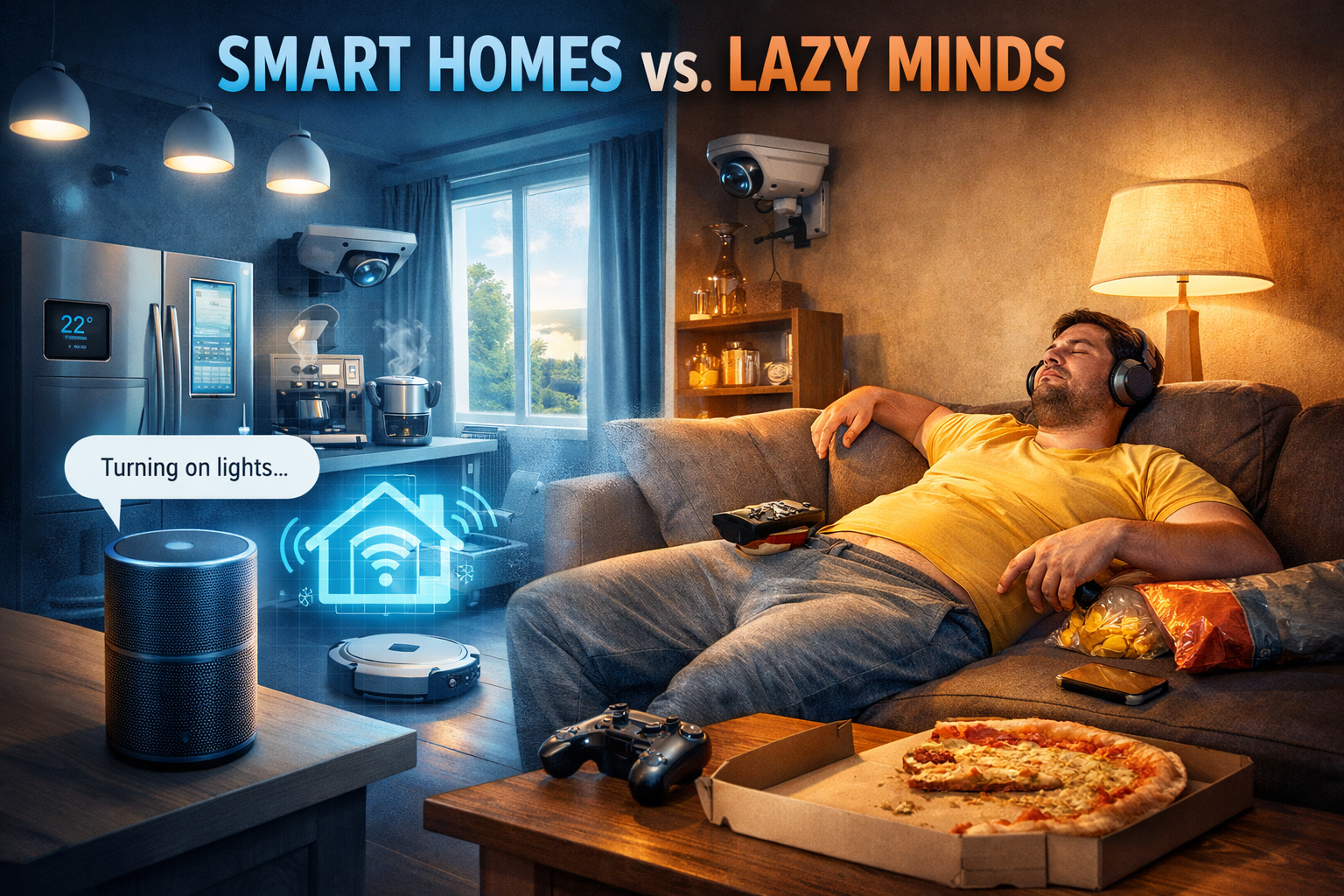
Imagine waking up in the morning and your curtains open automatically. The lights adjust based on the sunlight. Your coffee machine starts brewing before you even leave the bed. You simply say, “Turn on the TV,” and it turns on. You ask a digital assistant about the weather, and it tells you instantly.
This is the reality of smart homes today.
Technology has transformed houses into intelligent living spaces where devices communicate with each other and perform tasks automatically. From smart speakers and voice assistants to automated lighting and security systems, everything is designed to make life easier.
But there is an important question many experts are beginning to ask:
Is this comfort slowly making humans mentally and physically lazy?
While smart technology saves time and increases convenience, some researchers believe it may also reduce basic human skills such as memory, problem-solving, physical activity, and independence.
Let’s explore both sides of this fascinating debate.
What Exactly Is a Smart Home?
A smart home is a house equipped with internet-connected devices that can be controlled remotely or automatically.
Common smart home technologies include:
- Voice assistants like Alexa or Google Assistant
- Smart lighting systems
- Automated thermostats
- Smart refrigerators
- Robot vacuum cleaners
- Smart security cameras and doorbells
These devices are connected through the Internet of Things (IoT), allowing them to communicate and perform tasks without manual effort.
For example, a smart thermostat can learn your daily routine and automatically adjust the temperature. A smart refrigerator can remind you when groceries are running low.
In simple words, your home begins to think and act for you.
The Comfort Revolution: Why People Love Smart Homes
The popularity of smart homes is growing rapidly around the world. Millions of households are adopting automation technology because it provides several benefits.
1. Saves Time and Effort
Automation removes many small daily tasks.
You no longer need to:
- Walk to turn off lights
- Adjust fans or thermostats manually
- Remember security settings
- Clean floors regularly with manual effort
For busy families, this convenience can save hours every week.
2. Improves Home Security
Smart security systems allow homeowners to monitor their houses remotely.
Features include:
- Motion detection alerts
- Smart doorbells with cameras
- Remote door locking
- Mobile notifications for unusual activity
This gives people peace of mind, especially when they are traveling.
3. Energy Efficiency
Smart homes can reduce electricity consumption.
For example:
- Smart lights turn off automatically when no one is in the room.
- Smart thermostats reduce heating or cooling when the house is empty.
- Energy monitoring apps track power usage.
Over time, this can lower electricity bills and reduce environmental impact.
4. Accessibility for Elderly and Disabled People
For elderly individuals or people with physical limitations, smart homes can be life-changing.
Voice commands allow them to control:
- Lights
- Fans
- Doors
- Entertainment systems
Without needing to move around constantly.
In this way, technology improves independence and safety.
The Hidden Concern: Are Humans Becoming Less Skilled?
While the benefits are impressive, experts warn about a subtle long-term impact.
When technology starts doing everything for us, our brains and bodies may become less active.
Let’s explore how this might happen.
1. Decline in Memory Skills
In the past, people remembered many things:
- Phone numbers
- Directions
- Shopping lists
- Important dates
Today, we rely on smartphones and digital assistants for everything.
If you ask a voice assistant a question, it answers instantly. This convenience reduces the need to remember information.
Psychologists call this phenomenon “digital memory outsourcing.”
When the brain knows that information is easily available online, it stops storing it actively.
Over time, this habit can weaken natural memory skills.
2. Reduced Problem-Solving Ability
Smart technology often solves problems before we even notice them.
For example:
- Navigation apps automatically guide us through traffic.
- Smart thermostats adjust temperatures automatically.
- Digital assistants answer questions instantly.
While this saves time, it also means we practice problem-solving less frequently.
Human intelligence grows when we think, analyze, and figure things out ourselves. If machines handle most decisions, the brain may become less engaged.
3. Physical Laziness
Another concern is physical inactivity.
Automation removes many small movements from daily life:
- Getting up to switch off lights
- Walking to adjust fans
- Cleaning floors manually
- Opening curtains or windows
Individually these activities seem small, but collectively they contribute to daily physical movement.
When machines replace these tasks, our overall activity level decreases.
This can contribute to lifestyle issues such as:
- Weight gain
- Reduced stamina
- Poor muscle strength
4. Overdependence on Technology
One of the biggest risks of smart homes is overdependence.
Imagine if:
- Your smart assistant stops working
- The internet connection fails
- A system glitch disables automation
Many people might suddenly feel helpless.
Simple tasks that were once natural may become difficult again.
For example, some people today struggle to navigate cities without GPS because they have become completely dependent on navigation apps.
5. Impact on Children’s Development
Children growing up in highly automated homes may also experience certain challenges.
If everything is automated, kids may:
- Do fewer household chores
- Engage less in physical activities
- Rely heavily on voice assistants for answers
When children instantly ask devices for answers, they may skip the thinking process that builds curiosity and creativity.
Learning often happens through effort, exploration, and even small mistakes.
Automation may reduce these learning opportunities.
The Psychology of Convenience
Human beings naturally prefer convenience.
Our brains are wired to conserve energy. When a task becomes easier, we quickly adopt the easier method.
This is why technologies that simplify life spread rapidly.
However, convenience can sometimes lead to passive behavior if not balanced with conscious effort.
In other words, technology itself is not harmful — but how we use it matters.
Finding the Balance: Smart Use of Smart Technology
Instead of rejecting technology, the smarter approach is to use it wisely.
Here are some ways to maintain balance.
1. Keep Certain Tasks Manual
Not everything needs automation.
For example:
- Turn off lights manually sometimes
- Do light cleaning yourself
- Open windows instead of relying only on automated systems
These small habits keep your body active.
2. Encourage Thinking in Children
Parents can encourage kids to:
- Solve puzzles
- Search answers in books first
- Ask questions before asking digital assistants
This helps maintain curiosity and learning skills.
3. Limit Voice Assistant Dependence
Voice assistants are helpful, but try not to use them for every small question.
Sometimes challenge your brain by:
- Remembering information
- Doing mental calculations
- Thinking through problems
This keeps the mind sharp.
4. Maintain Physical Activity
Even in a smart home, daily movement is important.
Simple habits help:
- Walking regularly
- Doing household chores
- Exercising regularly
Technology should support health, not replace physical activity.
The Future of Smart Homes
Experts predict that smart homes will become even more advanced in the future.
Possible innovations include:
- AI-driven home management systems
- Health-monitoring furniture
- Predictive energy systems
- Emotion-sensing assistants
Homes may eventually anticipate our needs before we even express them.
While this may sound futuristic and exciting, it also makes the conversation about human independence and skill preservation even more important.
Conclusion: Comfort Should Not Replace Capability
Smart homes represent one of the most exciting technological transformations of modern life. They offer convenience, safety, efficiency, and accessibility that previous generations could only imagine.
However, every technological advancement comes with a responsibility.
If we allow machines to do everything, we risk losing some of the very abilities that make us human — memory, creativity, problem-solving, and physical activity.
The goal should not be to reject smart technology, but to use it thoughtfully.
A truly smart lifestyle is not one where machines do everything for us.
It is one where technology supports human intelligence rather than replacing it.
Because in the end, the smartest home is not the one filled with gadgets.
It is the one where technology and human skills grow together.
Discover more from Online Guruji
Subscribe to get the latest posts sent to your email.
Interesting analysis! Seeing platforms like ph25 online casino focus on localized payment options (GCash, PayMaya) is smart for the Philippine market. Strategic play and easy access – a good combo for lottery fans!
Found this gem while zoning out! The 365 Login app offers classic casino vibes with modern tech, perfect for those seeking refined entertainment. 365 login download seems secure enough to try when I’m free from meetings!
Understanding RTP and house edge is key to smart play – Jillbb’s transparency (96.2% RTP!) is refreshing. Managing your bankroll with those stats in mind is crucial. Check out jillbb vip for more insights! It’s all about informed decisions.
Honestly, the payment flexibility mentioned is solid, but the real test is the depth of the game mechanics. Curious how the live dealer integration stacks up against pure slot RNG. Check out epicwin slot download for a baseline feel!
The KYC process is key; don’t just focus on the game variety. For serious play, check out 35555 app ক্যাসিনো first. Understanding the backend mechanics beats just knowing the jackpot size.
The UI seems quite polished! As a former teacher, I appreciate solid structure. For more deep dives, check out arion games download apk. It’s fascinating how these platforms evolve!
[4525]Quickbet অফিসিয়াল লগইন | বিকাশ পেমেন্ট ও অনলাইন স্লট গেম,quickbet অ্যাপ ডাউনলোড করে সেরা অনলাইন স্লট গেম ও লাইভ ক্যাসিনো উপভোগ করুন। বিকাশ পেমেন্টের মাধ্যমে দ্রুত লেনদেন করে আজই জয়েন করুন। visit: quickbet
Finally found a site that doesn’t lag during big wins. The login process is quick and everything just works. Try rakyatslotlogin
This place is a hidden gem! The jackpot hits are more frequent than other sites I have used. Check out phsz777asia now.
The app is lightweight and works perfectly without any lag. Downloading the apk was simple and fast. Great job x111gamedownloadapk
Honestly this has been my favorite spot for unwind time after long shifts. The slots load quickly and I never had any trouble claiming my rewards. It feels like a place that values a chill gaming vibe over everything else. co777casino