

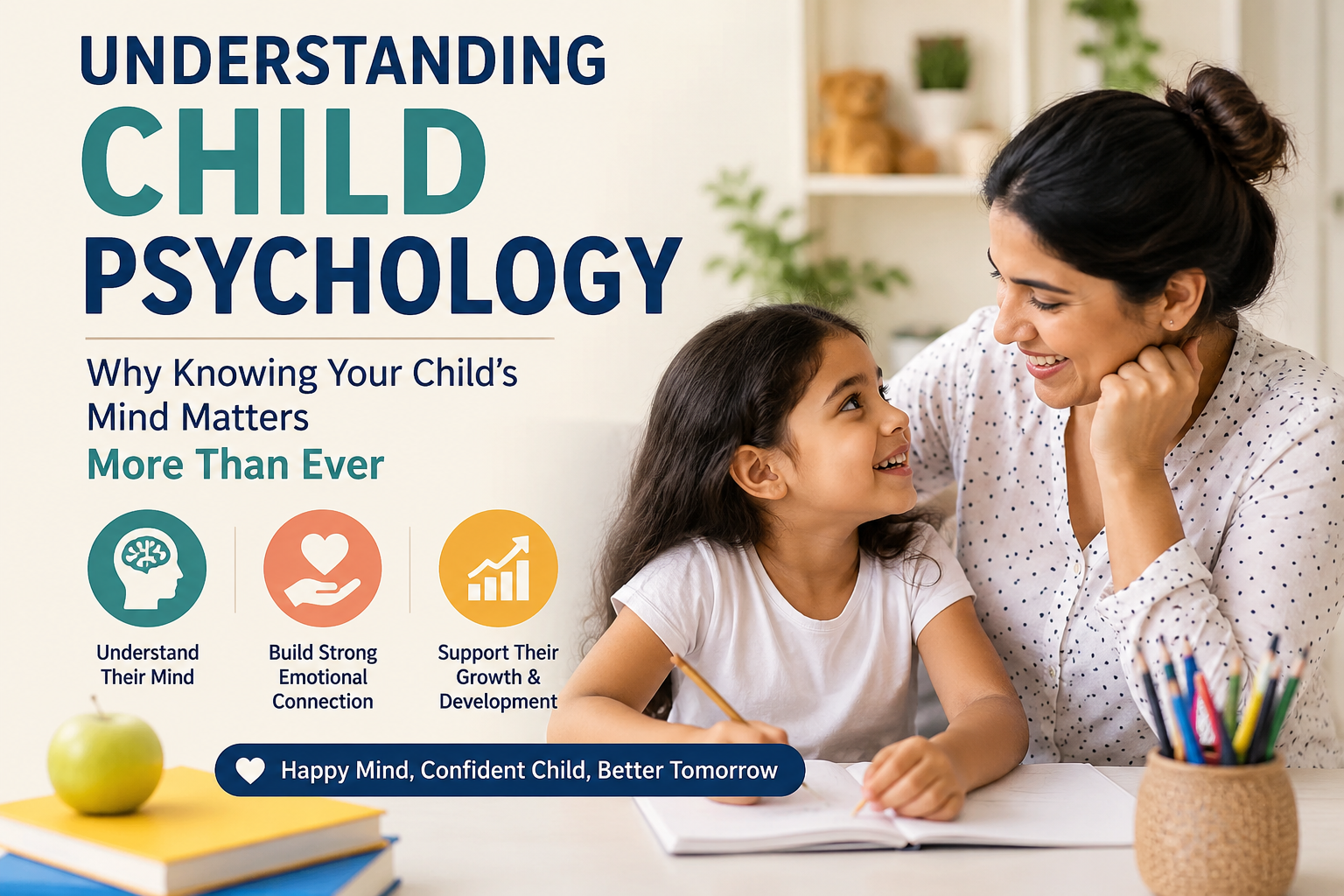
Modern childhood is more complex than ever before. Today’s children can be cheerful in the morning, frustrated by afternoon, and emotionally withdrawn by evening. They laugh, cry, get irritated, become excited, and experience many emotions that they often struggle to express in words. For parents, understanding these changing emotions can be difficult, yet it is one of the most important parts of raising emotionally healthy and confident children.
Every parent wants their child to grow into a happy, confident, and successful individual. Yet many parents focus mainly on physical health, education, and discipline while overlooking something equally important—child psychology.
Child psychology is the study of how children think, feel, learn, and behave as they grow. Understanding a child’s mind helps parents build stronger relationships, improve communication, and support healthy emotional development.
In today’s fast-changing world, where children are exposed to screens, social media, academic pressure, and changing family dynamics, understanding child psychology has become more important than ever.
What Is Child Psychology?
Child psychology focuses on the mental, emotional, social, and cognitive development of children from birth through adolescence.
It helps answer questions such as:
- Why do children behave differently at different ages?
- Why do some children become shy while others are outgoing?
- How do children learn emotions and social skills?
- What factors influence a child’s confidence and behavior?
By understanding these aspects, parents can respond to their children more effectively rather than reacting with frustration or punishment.
Why Child Psychology Matters
Many behavior problems are actually communication attempts.
A child who throws tantrums may be feeling overwhelmed.
A child who becomes silent may be struggling emotionally.
A child who refuses to study may be dealing with stress or low confidence.
Understanding the psychology behind behavior helps parents identify the real cause instead of only addressing the symptoms.
Example-Imagine three siblings growing up in the same home, under the same roof, with the same parents. Surprisingly, each child may develop a completely different personality. One may become confident and emotionally strong, another may struggle with self-doubt, while the third may become highly independent and rebellious.
Example-Consider a child who struggles in a particular subject. Despite putting in extra effort, attending classes regularly, and gradually improving, the child is constantly criticized by both parents and teachers for poor performance. Over time, the fear of making mistakes becomes stronger than the desire to learn. As a result, when the final exam arrives, the child becomes extremely anxious and nervous. Even though they know the answers and have prepared well, the pressure and fear of failure make it difficult to think clearly and perform effectively.
This is a powerful example of how psychological pressure can affect a child’s confidence and academic performance. Sometimes, children do not fail because they lack knowledge—they struggle because stress, fear, and constant criticism prevent them from showing their true abilities.
This happens because children do not simply experience life—they interpret it differently. Child psychology helps us understand these unique interpretations.
The Early Years Shape the Future
Experts often describe early childhood as the foundation of life.
During the first few years, children develop:
- Emotional security
- Language skills
- Social behavior
- Confidence
- Learning abilities
Positive experiences during these years help children build resilience and healthy self-esteem.
Negative experiences, constant criticism, or lack of emotional support can affect long-term development.
The Importance of Emotional Development
Many parents focus heavily on academic success.
However, emotional intelligence is equally important.
Children need to learn:
- How to express feelings
- How to manage anger
- How to handle disappointment
- How to build friendships
- How to solve conflicts peacefully
A child who understands emotions is often better prepared to face life’s challenges.
Understanding Age-Specific Behavior
Toddlers (1–3 Years)
At this stage children are curious and eager to explore.
Common behaviors include:
- Saying “No” frequently
- Tantrums
- Testing boundaries
This behavior is a normal part of developing independence.
Preschoolers (3–5 Years)
Children begin developing imagination and social skills.
They often:
- Ask endless questions
- Engage in pretend play
- Seek attention from adults
Parents should encourage curiosity rather than dismissing questions.
School-Age Children (6–12 Years)
This is a period of learning, friendships, and self-confidence.
Children become more aware of:
- Academic performance
- Social acceptance
- Personal strengths and weaknesses
Positive encouragement plays a major role during this stage.
Teenagers
Adolescence brings emotional and physical changes.
Teenagers often seek:
- Independence
- Identity
- Peer acceptance
Open communication becomes essential during these years.
How Parents Influence Child Psychology
Parents are a child’s first teachers.
Children learn by observing adults.
They watch how parents:
- Handle stress
- Communicate with others
- Express emotions
- Solve problems
A calm and supportive home environment helps children feel secure.
The Impact of Technology
Modern childhood is very different from previous generations.
Many children spend significant time:
- Watching videos
- Playing games
- Using smartphones
While technology offers educational benefits, excessive screen time may affect:
- Attention span
- Sleep quality
- Social interaction
- Physical activity
Parents should aim for balance rather than complete restriction
Signs That a Child May Need Extra Support
Every child has occasional mood swings or difficult days.
However, parents should pay attention if they notice:
- Persistent sadness
- Extreme anxiety
- Aggressive behavior
- Sudden decline in school performance
- Social withdrawal
- Sleep disturbances
Early support can make a significant difference.
Practical Tips for Parents
Listen More Than You Speak
Children often reveal their feelings when they feel heard.
Spend Quality Time
Even 15–20 minutes of focused attention daily can strengthen emotional bonds.
Praise Effort, Not Just Results
Instead of saying:
“You are so smart.”
Try saying:
“You worked really hard.”
This encourages a growth mindset.
Maintain Consistent Rules
Children feel safer when expectations are clear and consistent.
Encourage Open Communication
Create an environment where children feel comfortable discussing their thoughts and emotions.
Common Parenting Mistakes
Many parents unintentionally:
- Compare children with others
- Overprotect them
- Ignore emotions
- Focus only on grades
These habits can affect confidence and emotional well-being.
Every child develops at their own pace.
The Future of Child Psychology
As awareness grows, more parents are recognizing the importance of emotional health alongside academic achievement.
Schools, educators, and families are increasingly focusing on:
- Mental wellness
- Emotional intelligence
- Positive parenting
- Social development
This shift is helping create healthier environments for children.
Conclusion
Child psychology is not just a subject for professionals—it is valuable knowledge for every parent.
When parents understand how children think, feel, and develop, they can respond with empathy rather than frustration.
Children do not simply need food, education, and discipline. They also need understanding, emotional support, and a sense of security.
The more we understand a child’s mind, the better we can help them grow into confident, resilient, and emotionally healthy adults.
Final Thought
“Every behavior tells a story. When parents learn to understand the story behind the behavior, they unlock the key to a child’s heart and future.”
Discover more from Online Guruji
Subscribe to get the latest posts sent to your email.
This site’s structure is interesting; the payout mechanics feel quite robust. For more deep dives into game odds, check out juan360 download apk. Seems like a solid place to analyze some variance!
https://shorturl.fm/VhEAn
https://shorturl.fm/z6bRt
https://shorturl.fm/PCzau
https://shorturl.fm/t6V1H
https://shorturl.fm/1FD6H
The focus on emotional intelligence highlights that development is a complex system of variables. Viewing childhood emotions through a strategic, pattern-recognition lens-understanding the odds and probabilities-is key. This data-minded approach to human behavior is valuable whether analyzing family dynamics or optimizing a platform like 7plus online casino.
https://shorturl.fm/MvLm0
Bored in meetings makes me crave quick wins; this platform’s local payments and verified slots look solid. Check if 88Lucky Ph legit before signing up at 88Lucky Ph legit.
I’ve tried a few sites but this one is definitely the smoothest. The login process is fast and I didn’t run into any glitches. Highly recommend super89login for anyone looking for a reliable spot.
I’ve tried a few sites lately, but this one really stands out for its smooth interface. Definitely spending more time on phjuanph from now on!
I love the daily rewards and the loyalty program. It really keeps things interesting and rewarding for regular players. Cheers to vn55xin88
Dude, check out the game variety on this site! The product info is cool, but for beginners, gk444 স্লট ডাউনলোড is super easy to start with. Seriously fun stuff! ✨
Just finished a wild weekend session! That dopamine hit from PH96 is unreal. The seamless flow state you get after logging in keeps me hooked. Check out the ph96 slot download if you crave instant thrills without any delay, it’s pure adrenaline for modern players seeking excitement today.
Solid article! Thinking about bankroll management & adapting to different game types is key for long-term success. Exploring platforms like jili 56 club can offer diverse options, but always play responsibly! It’s all about informed decisions.
Intriguing approach to slot mechanics! The simplicity mentioned for quick entry is key. For more tool scouting, check out Poppy Playtime app download; it seems user-centric.
I’ve been looking for a reliable spot like this for a while. The interface is super smooth and everything loads fast. Definitely worth checking out! vnzxx88