

A Museum Unlike Any Other
Imagine walking into a museum in the year 2055.
You expect to see dinosaur fossils, ancient pottery, or centuries-old paintings. Instead, you find something completely unexpected.
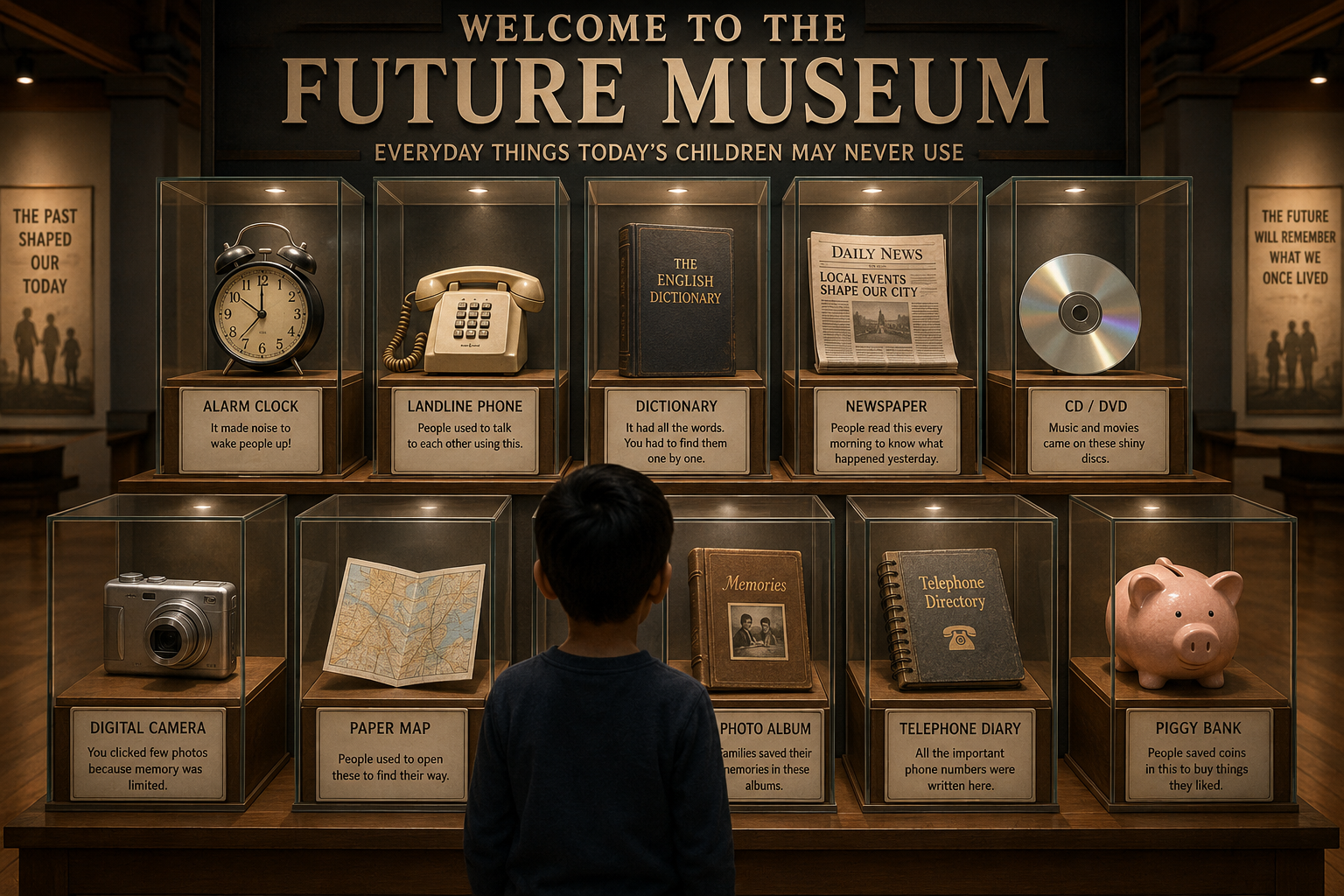
Behind a glass display sits an old-fashioned alarm clock.
A few steps away, there is a landline telephone with a coiled wire, a printed dictionary thicker than a brick, a newspaper neatly folded on a wooden stand, a CD labeled “Best Songs of 2005,” and a family photo album with slightly faded pictures.
A little boy raises his hand and asks the guide,
“People actually used these every day?”
The guide smiles.
“Yes. Not long ago, almost every home had them.”
Another child points at the newspaper.
“Why didn’t people just ask AI what happened yesterday?”
The room fills with laughter.
But for many adults, that moment feels strangely emotional.
Because these are not just objects.
They are pieces of childhood.
They are memories.
And perhaps, one day, they really will belong in a Future Museum.
More Than Objects—They Were Part of Everyday Life
Every generation believes that the things around them will always exist.
Our grandparents probably thought handwritten letters would never disappear.
Our parents believed landline phones would always ring in every home.
Today, we assume smartphones, cloud storage, and AI assistants will stay forever.
History tells a different story.
Technology doesn’t just invent new things—it quietly retires old ones.
The objects disappear first.
Then the habits.
Eventually, even the memories fade.
Let’s take a walk through this imaginary museum and meet the everyday heroes that quietly shaped millions of lives.
Exhibit 1: The Alarm Clock
Long before smart speakers greeted us with weather updates and calendar reminders, mornings began with one sound…
Ring! Ring! Ring!
The alarm clock never cared if you wanted five more minutes.
It demanded that you wake up.
Many people still remember stretching half asleep across the bedside table just to silence that loud bell before it woke everyone else.
Today’s children often wake up because their smartwatch vibrates, their phone plays soft music, or an AI assistant gently says,
“Good morning! You have school in one hour.”
Convenient?
Absolutely.
But the noisy little alarm clock taught something modern technology rarely does—
discipline without negotiation.
Exhibit 2: The Landline Phone
For today’s children, a phone belongs to one person.
Years ago, a phone belonged to the entire family.
Everyone shared it.
If the phone rang, nobody knew who the call was for.
Children raced toward it.
Parents shouted from another room,
“See who it is!”
Grandparents waited patiently for weekly calls from relatives living in another city.
There were no private conversations behind passwords or headphones.
Sometimes the entire family listened to exciting news together.
A landline wasn’t just a communication device.
It was a family event.
Exhibit 3: The Printed Dictionary
Today, finding the meaning of a word takes less than two seconds.
Type.
Speak.
Or simply ask AI.
But dictionaries asked for something different.
Patience.
Finding one word often meant discovering ten new words along the way.
Children accidentally improved their vocabulary simply because they had to turn pages.
Learning felt like exploration rather than searching.
Today’s technology gives answers instantly.
Yesterday’s dictionary rewarded curiosity.
Exhibit 6: Digital Cameras
Today’s children click hundreds of photos in one afternoon.
Deleting unwanted pictures takes seconds.
Years ago, every photograph mattered.
Memory cards were limited.
Before that, even film rolls had only a few exposures.
People smiled carefully.
Parents checked everyone’s face before pressing the shutter.
Nobody wanted to waste a photograph.
Ironically, we now have thousands of pictures stored in the cloud but rarely sit together to enjoy them.
Sometimes having fewer memories made each one more valuable.
Exhibit 7: Paper Maps
Before GPS became our constant companion, traveling meant unfolding a giant paper map.
Road trips were adventures.
Families stopped to ask strangers for directions.
Children learned place names by following colorful lines across maps.
Sometimes getting lost became the best part of the journey.
Today GPS almost never lets us lose our way.
But perhaps it also prevents us from discovering unexpected places.
Exhibit 8: Family Photo Albums
Perhaps the most emotional corner of our Future Museum.
A thick photo album.
Plastic sheets.
Printed photographs.
Handwritten dates.
Tiny notes saying:
“Summer Vacation – 2004.”
Families once gathered after dinner to flip through these albums together.
Stories accompanied every picture.
Children laughed.
Grandparents remembered.
Parents explained.
Today’s photos often remain trapped inside phones, forgotten among thousands of screenshots and downloaded images.
We have never taken more pictures.
Yet perhaps we have never revisited them less.
What Are We Really Losing?
This article isn’t about saying technology is bad.
Technology has made life safer, faster, smarter, and more connected.
The problem isn’t replacing objects.
The problem is accidentally replacing the experiences attached to them.
A newspaper wasn’t only paper.
It was morning conversation.
A landline wasn’t only a telephone.
It was shared excitement.
A dictionary wasn’t only a book.
It was patient learning.
A photo album wasn’t only photographs.
It was family storytelling.
Sometimes, objects quietly teach values.
When the objects disappear, the lessons often disappear too.
The Next Museum Pieces
Think about today’s everyday items.
Will tomorrow’s children recognize them?
Maybe not.
Perhaps museums of the future will also display:
- USB drives
- ATM cards
- School report cards printed on paper
- Wallets full of cash
- TV remotes
- Password notebooks
- House keys replaced by biometric locks
- Physical boarding passes
- Printed restaurant menus
- Charging cables in a wireless world
The pace of technology suggests today’s normal could become tomorrow’s curiosity.
What Should Parents Preserve?
We cannot stop technology.
Nor should we.
But we can preserve the human experiences hidden behind disappearing objects.
Instead of only showing children digital photographs, print a few every year.
Let them create a real family album.
Keep a printed map during your next road trip, even if GPS is on.
Read a newspaper together on Sunday mornings.
Visit a library and let children discover the joy of browsing books instead of only searching for answers.
Teach them that some experiences become richer when they are slower.
The goal isn’t to reject innovation.
It’s to protect the memories that innovation should never erase.
The Real Museum Is Being Built Today
The Future Museum does not exist yet.
But every year, another ordinary object quietly earns its place there.
One day, today’s children may stand in front of a glass case looking at a newspaper, a landline, or an alarm clock with the same curiosity that we feel when looking at ancient artifacts.
They won’t just be seeing old technology.
They’ll be looking at a different way of living.
A slower morning.
A shared phone call.
A family gathered around a photo album.
A child searching for a word one page at a time.
Those moments cannot be downloaded.
They cannot be streamed.
And they cannot be recreated by artificial intelligence.
Because the greatest treasures in any museum are never the objects themselves.
They are the stories people carried with them.
So before another everyday object quietly disappears from our homes, perhaps we should pause for a moment—not to resist the future, but to remember the simple things that made the past feel so wonderfully human.
Maybe the most valuable exhibit in tomorrow’s museum won’t be an alarm clock or a newspaper.
It will be the reminder that ordinary things once brought extraordinary people together.
Discover more from Online Guruji
Subscribe to get the latest posts sent to your email.
https://shorturl.fm/Csb4p
https://shorturl.fm/vNiMV
https://shorturl.fm/Ku7ln
https://shorturl.fm/eAJxE
Just tried 5jili for real; their security and game variety are solid. Sign up via 5jili download to start winning big now!
https://shorturl.fm/zUbwI
https://shorturl.fm/lN8kU
Honestly, the flow described for AO 88 sounds smooth, but the feeling of ease is key. Checking out ao 88 slot made me think about seamless UX. Hope the actual platform matches that vibe!
Had an amazing run here last night! The atmosphere is exciting and the payouts are very fair. jili178casino
I’ve been trying a few sites lately and this one really stands out. The interface is smooth and the payouts are fast. Definitely recommend checking out plataforma7brwin if you want a reliable spot.
Really digging the immersive feel here; it goes beyond just listing features. For a smoother dive into live dealer action, check out beunas bonus. Their focus on clean navigation, even with all the options, is top-notch.
The UI flow feels solid; good UX really boosts perceived RTP! For more deep dives into slot mechanics, check out bunny casino app casino. The product’s structure seems quite thoughtful overall.
The variety of games here is just insane. I spend most of my free time on okfunphapp because it just feels more rewarding than the rest. Give it a go!
I love the vibe of this site. It feels professional yet exciting. I’ve had a few big wins already at casinowinoui.