

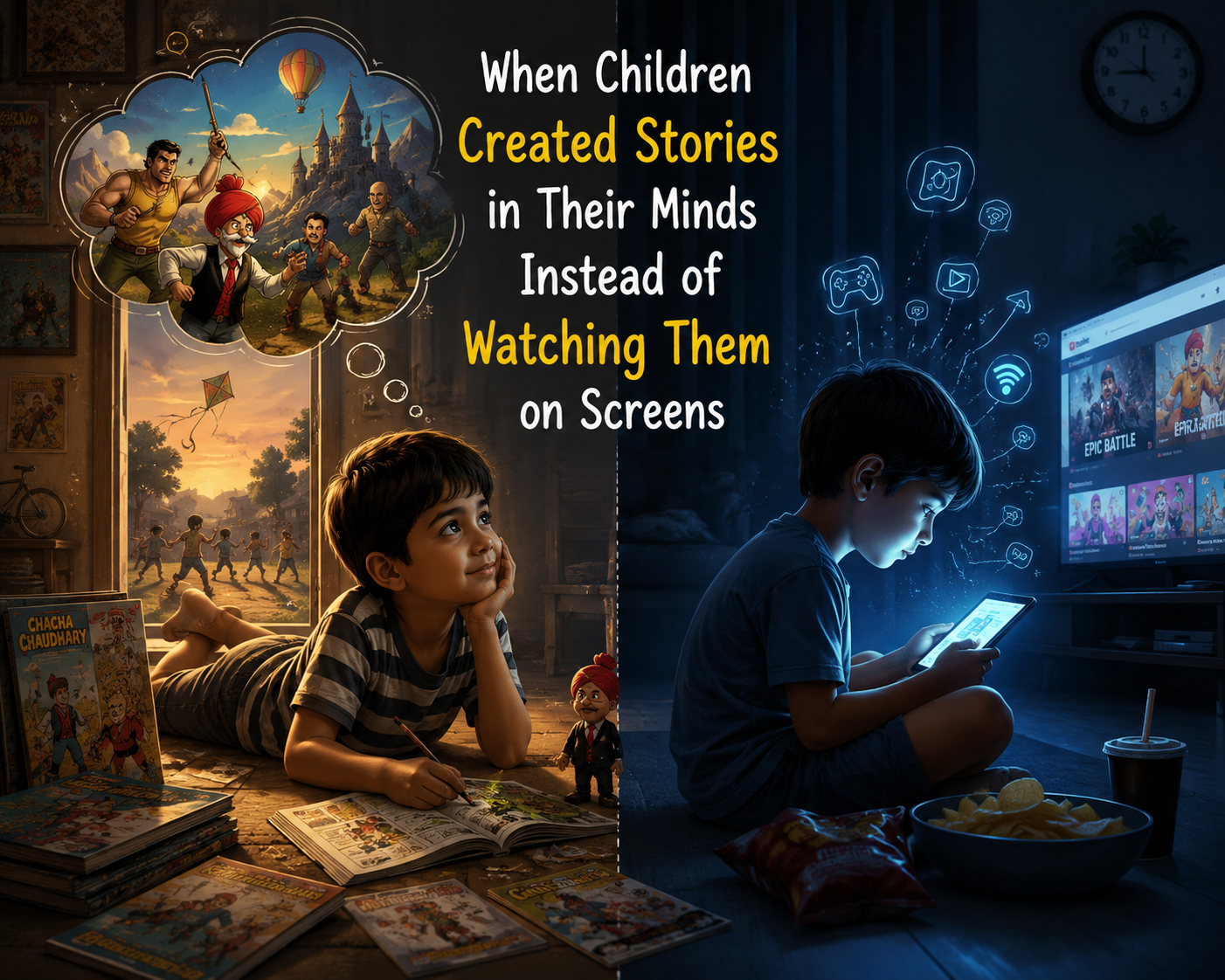
There was a time when children did not need endless videos, fast animations, or constant notifications to stay entertained. A single comic book, a bedtime story, or even a cloudy sky outside the window was enough to create entire worlds inside their minds.
Children imagined heroes while riding bicycles.
They turned pillows into mountains and bedsheets into secret caves.
A wooden stick became a sword.
A cardboard box became a spaceship.
Stories were not always watched — they were created.
But childhood in 2026 looks very different.
Today’s children are growing up in a world filled with:
- short-form videos,
- AI-generated entertainment,
- instant cartoons,
- gaming platforms,
- and nonstop digital stimulation.
Modern children consume more content than any generation before them. Yet many parents quietly notice something strange:
Kids are entertained all the time… but imagination seems weaker than before.
So what changed?
And what happens when children stop creating stories in their minds and start only watching them on screens?
Childhood Once Relied on Imagination
Before smartphones and streaming apps, boredom was a normal part of childhood.
And surprisingly, boredom was not considered dangerous.
It was during these “empty” moments that imagination naturally grew.
Children:
- invented games,
- created fictional characters,
- made up adventures,
- and built imaginary conversations.
A child sitting alone with a comic book did not just read the story.
They expanded it.
After the last page ended, the imagination continued:
- “What happened next?”
- “What if I had those powers?”
- “What if the villain returned?”
The brain actively participated in storytelling.
That mental participation was extremely important for creativity and emotional growth.
Screens Give Ready-Made Worlds
Today’s entertainment works differently.
Modern content is designed to:
- move fast,
- capture attention instantly,
- and reduce waiting time.
Everything is already visually prepared:
- characters,
- emotions,
- sounds,
- backgrounds,
- reactions,
- even jokes.
Children no longer need to imagine the dragon.
The dragon already appears in ultra-HD animation within seconds.
They no longer need to visualize a magical world.
The screen builds it for them immediately.
While this looks impressive, it also changes how the brain engages with stories.
Imagination requires effort.
Screens reduce that effort.
And when the brain stops practicing imagination regularly, creative thinking slowly weakens.
Why Old Comics Felt More Magical
Old comics and storybooks had limitations:
- simple drawings,
- fewer colors,
- slower storytelling,
- and no moving visuals.
But those limitations actually activated imagination.
A child reading comics mentally added:
- voices,
- movement,
- expressions,
- sounds,
- and emotions.
The brain became part of the creative process.
This is why many adults still remember old comics emotionally.
It was not just the story they loved.
It was the experience of mentally living inside that story.
Today’s digital entertainment often creates excitement, but not always deep emotional memory.
Because passive watching and active imagining are not the same thing.
Fast Entertainment Is Changing Attention Spans
One major difference between older childhood and modern childhood is speed.
Earlier:
- stories unfolded slowly,
- suspense built gradually,
- patience was natural.
Now:
- videos switch every few seconds,
- content is skipped quickly,
- and algorithms constantly push new stimulation.
As a result, many children struggle with:
- sitting quietly,
- reading long stories,
- deep concentration,
- or imagining scenes independently.
The brain becomes used to instant dopamine.
And imagination cannot grow in constant hurry.
Creative thinking needs:
- silence,
- patience,
- observation,
- and mental wandering.
But modern digital life rarely leaves room for those things.
Children Are Consuming More Stories but Creating Fewer
This is one of the biggest shifts of modern childhood.
Children today watch:
- thousands of videos,
- endless cartoons,
- gaming streams,
- AI-generated content,
- and social media clips.
But how often do they:
- invent stories,
- draw imaginary characters,
- narrate made-up adventures,
- or create fantasy worlds on their own?
Consumption has increased.
Creation has reduced.
This matters because imagination is not only about entertainment.
It is deeply connected to:
- problem-solving,
- emotional intelligence,
- communication skills,
- and independent thinking.
A child who imagines stories also learns how to imagine possibilities in real life.
The Emotional Side of Imagination
Imagination also helped children emotionally.
Earlier generations often processed emotions through:
- pretend play,
- storytelling,
- drawing,
- and fantasy games.
For example:
- a lonely child created imaginary friends,
- an anxious child became a superhero in their mind,
- a shy child expressed confidence through fictional worlds.
Imagination gave emotional escape and emotional safety.
Today many children are constantly stimulated but emotionally restless.
Because passive entertainment distracts emotions temporarily — but imagination helps process them.
There is a big psychological difference between:
watching content
and emotionally participating in it.
Parents Are Also Trapped in the Same Digital Culture
This change is not only happening with children.
Adults too are becoming dependent on:
- fast scrolling,
- short attention content,
- constant notifications,
- and instant entertainment.
Families often sit together physically but experience separate digital worlds.
Parents themselves sometimes struggle to:
- read books patiently,
- stay away from screens,
- or spend slow, distraction-free time.
As a result, children naturally copy the same habits.
Modern life rewards speed.
But imagination grows slowly.
That is why many homes today have more devices than conversations.
Why Boredom Was Secretly Important
Modern parenting often tries to remove boredom immediately.
The moment a child says:
“I’m bored,”
a screen appears.
But boredom itself was once the starting point of creativity.
When children had “nothing to do,” they:
- invented games,
- observed nature,
- explored ideas,
- and created imaginary scenarios.
The brain learned to entertain itself.
Today external entertainment is available every second.
As a result, children rarely experience the mental space where imagination naturally develops.
Nature Once Helped Stories Grow
Older childhoods had stronger connection with nature.
Children spent time:
- climbing trees,
- watching insects,
- collecting stones,
- staring at clouds,
- and playing outdoors for hours.
Nature naturally stimulates imagination because it is unpredictable and open-ended.
A tree could become:
- a castle,
- a jungle,
- or a secret hiding place.
Modern indoor digital environments are visually rich but mentally fixed.
Everything is already designed.
Nature, on the other hand, leaves room for interpretation.
And imagination grows best where not everything is predefined.
Can Modern Children Still Develop Strong Imagination?
Yes — absolutely.
Technology itself is not the enemy.
The real issue is imbalance.
Children still have powerful imagination naturally.
They simply need opportunities to use it.
Small changes can help:
- reading physical storybooks,
- allowing unstructured play,
- limiting nonstop screen exposure,
- encouraging drawing and storytelling,
- spending time outdoors,
- and allowing boredom sometimes.
Even simple activities like:
“Tell me your own story”
can activate creativity beautifully.
Children do not need perfect environments.
They need mental space.
The Future of Childhood Depends on Creativity
he future world will increasingly depend on:
- innovation,
- original thinking,
- emotional intelligence,
- and creativity.
Interestingly, these qualities grow strongest through imagination.
AI may generate content faster than humans.
But imagination is what helps humans think differently.
A child who creates stories learns:
- curiosity,
- empathy,
- exploration,
- and independent thought.
These skills remain valuable no matter how advanced technology becomes.
Conclusion
There was a quiet magic in older childhoods.
A comic book could create an entire universe.
A bedtime story could live in the mind for weeks.
A simple afternoon could become a grand adventure through imagination alone.
Today children are surrounded by more entertainment than ever before.
Yet many rarely get the chance to create worlds inside their own minds.
Screens can show beautiful stories.
But imagination allows children to become part of the story themselves.
And perhaps that is what modern childhood is slowly missing:
not entertainment…
but the joy of creating something invisible, personal, and endlessly magical inside the mind.
Discover more from Online Guruji
Subscribe to get the latest posts sent to your email.
That LoL match was insane! Seeing teams adapt strategies on the fly is what esports is all about. Data-driven insights are key – kinda like how ph947 login optimizes player experiences! Solid analysis wins, both in-game & with betting.
Honestly, the psychology behind those growing jackpots is fascinating-it’s pure sunk cost fallacy in action. Makes you think about risk vs. reward. Check out Progressive jackpot online casino if you’re curious about the mechanics.
https://shorturl.fm/pYu26
This observation hits on the core difference between ‘consumption’ and ‘creation.’ Modern digital platforms, even highly engaging ones like the TA77 app casino, are designed for instant reward loops. We must teach children to find that deep satisfaction in the unstructured ‘boredom’ that fuels genuine imaginative narrative development.
Honestly, the vibe here is super chill. Love how easy it is to navigate, even for a newbie. Checking out ga88 cc app made me realize how smooth the whole platform is! ✨
Finding this guide helpful! It reminds me how much structure matters-even in slots. For disciplined play, checking out x777 link keeps the focus sharp. Great read overall! ☀️
Diving into math-heavy roulette strategies, I found superh games offers a robust platform with diverse options beyond just slots, perfect for serious players seeking regulated entertainment in the Philippines today.
Honestly, the security protocols mentioned for 6613 are quite detailed. It’s more about risk mitigation than pure chance. For deeper analysis, check this: 6613 download.
The statistical structure here suggests pattern recognition is key. Analyzing the odds requires more than just browsing; check out debet mx download for deeper insights. Objective analysis beats mere chance!
Intriguing analysis! The structural depth here echoes advanced probability concepts. I’m curious how this applies to live math models; check out f1689 app download for more context.
Login is fast and the games start instantly. No lagging or crashes which is exactly what I need when gaming. 168jililogin makes everything so effortless.
Best experience so far! The bonuses are actually fair and the withdrawal process is smooth as butter. Highly recommend for anyone looking for a reliable site. pkbaji888
This observation on the decline of imaginative play is profound. It highlights a shift from internal creation to external consumption. The need for high-stimulation, immersive digital experiences is undeniable. Companies are constantly innovating in engagement, whether through narrative arcs or structured entertainment like those found at kkkk ph com. The key is finding balance between stimulation and genuine mental ’empty’ space.
Wondering about the odds in these games? Remember, even with great features like those mentioned, understanding basic probability is key! For more deep dives, check out joya 999 ক্লাব. Patience pays off in every bet!
Honestly, this is one of the smoothest platforms I have used lately. The interface is clean and the payouts are surprisingly fast. Highly recommend phrubyph for anyone looking for a reliable spot.