

Introduction
The Bhagavad Gita is not just a spiritual text but a manual for living a meaningful life. Among its 18 chapters, Chapter 12 – Bhakti Yoga (The Path of Devotion) stands out because of its simplicity and universal appeal. While some chapters focus on Karma (action) and others on Jnana (knowledge), this one reveals the power of Bhakti (devotion).
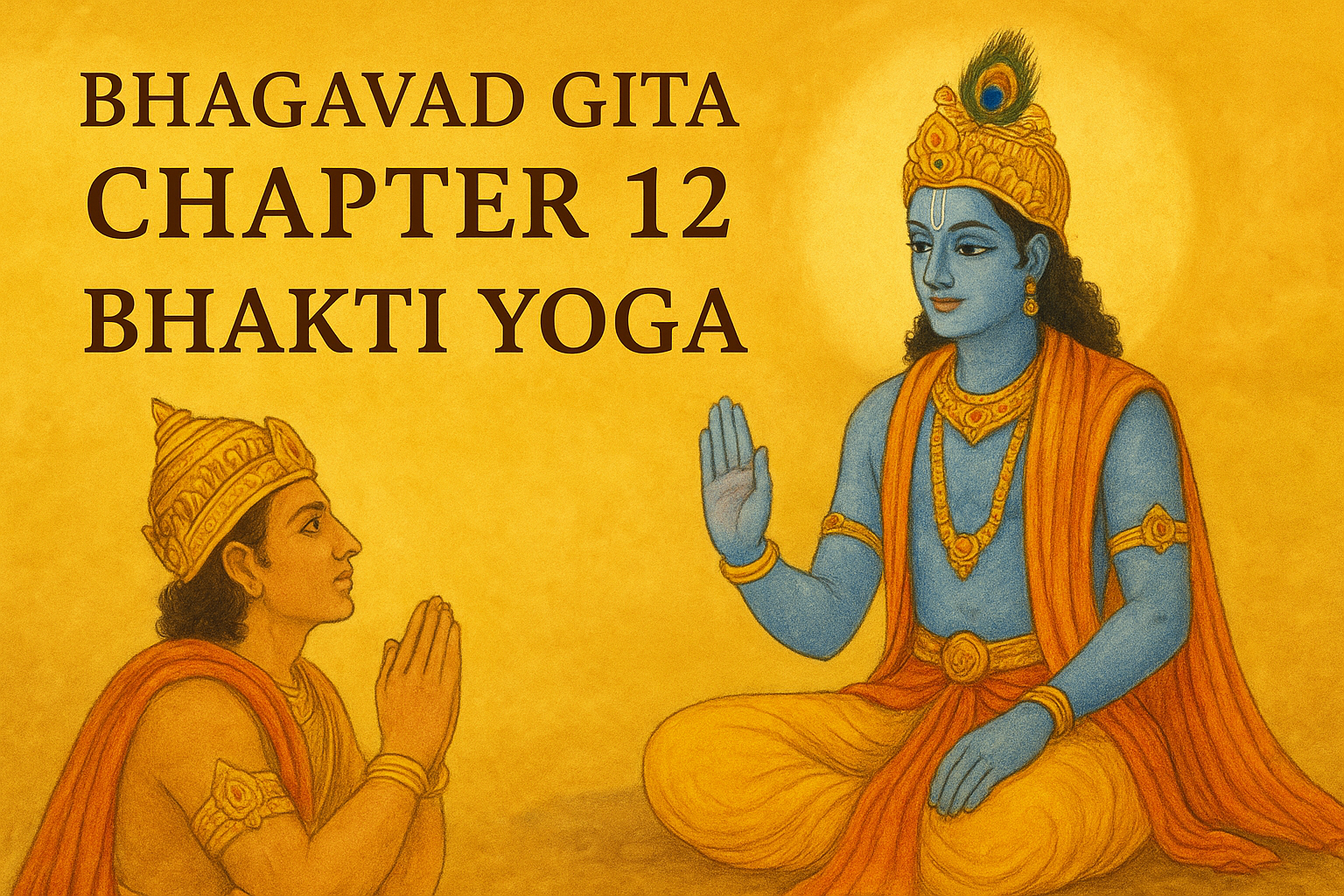
Arjuna, confused and seeking clarity, asks Krishna: “Who is greater—the one who worships the formless Absolute (Nirguna Brahman) or the one who worships You in a personal form (Saguna Brahman)?”
Lord Krishna’s answer forms the essence of this chapter: both are valid paths, but devotion to the personal form of God is easier and more natural for most people.
In today’s fast-paced world, where stress and ego dominate, Bhakti Yoga provides a simple yet profound way to live with love, surrender, and peace. Let us explore this beautiful chapter in detail.
Section 1: For the Formless or the Form – Which Path is Greater?
Krishna explains that:
- Worshipping the formless, infinite, all-pervading Brahman is very difficult. It requires mental steadiness, detachment, and renunciation—qualities rare to find.
- Worshipping God in personal form (like Krishna, Rama, Shiva, or even as Divine Mother) is easier. It allows one to express emotions—love, surrender, and devotion.
Practical lesson for us: Many people today find meditation on the abstract difficult. But chanting a name like “Om Namo Bhagavate Vasudevaya” or offering flowers before an image of God feels natural. This is why Krishna recommends the path of Bhakti for the majority.
Section 2: Steps of Devotion – A Ladder for Everyone
Not everyone can directly meditate or surrender fully. Krishna provides a step-by-step ladder:
- Surrender completely to Me – Offer mind and heart to God.
- If not possible, practice regularly – Engage in prayers, japa, or daily puja.
- If not possible, serve others selflessly – Work for the welfare of society without expecting reward.
- If still difficult, at least renounce the fruits of your actions – Do your duty without attachment to results.
This ladder shows that no one is excluded from Bhakti. Whether you are a student, parent, or professional, you can choose the level that suits you.
Section 3: The Qualities of a True Devotee (Bhakta Lakshanas)
One of the most inspiring parts of Chapter 12 is Krishna’s description of His beloved devotee. These qualities are timeless:
- Adveshta (Non-hatred): Free from jealousy and hatred.
- Maitra (Friendliness): Friendly and compassionate to all beings.
- Kshamavan (Forgiving): Forgives mistakes easily.
- Santushta (Content): Always content and balanced in life.
- Yogi (Self-controlled): Controls desires and emotions.
- Sama (Balanced): Remains calm in pleasure and pain.
- Anasakta (Detached): Free from excessive attachment to possessions.
- Bhakti-yukta (Devoted): Fully surrendered to God with love.
Practical Application: Imagine applying even a few of these in modern life. Hatred would reduce, relationships would improve, and inner peace would become natural.
Section 4: Why Bhakti Yoga is Supreme
Krishna declares Bhakti as the most accessible and natural path. Why?
- Universal: Anyone can practice it—rich or poor, learned or uneducated.
- Emotional Connection: Humans are emotional beings. Devotion transforms emotions into divine love.
- Stress Relief: Surrender reduces anxiety. When you trust that God is guiding you, worries naturally fade.
- Inclusive: Even small offerings—a leaf, a flower, a fruit, or a drop of water—become sacred if offered with love.
Section 5: Comparing Bhakti with Karma & Jnana
- Jnana Yoga requires intellectual pursuit and meditation on the abstract truth.
- Karma Yoga demands selfless action and discipline.
- Bhakti Yoga is easier because it flows naturally from the heart through love and surrender.
That is why Krishna emphasizes that Bhakti can be practiced by anyone, anywhere, at any stage of life.
Section 6: Modern Relevance of Chapter 12
The teachings of Bhakti Yoga are not limited to temples or rituals. They can shape our daily life:
- In Relationships: Qualities like compassion, forgiveness, and humility strengthen bonds.
- In Career: Non-attachment to results reduces stress at work.
- In Parenting: Teaching children prayer, gratitude, and kindness gives them emotional balance.
- In Mental Health: Chanting, meditation, and surrender calm the restless mind.
In an age of anxiety and competition, Bhakti Yoga is like medicine for the soul.
Section 7: Simple Practices to Follow Bhakti Yoga
If you want to practice what Krishna teaches in Chapter 12, start small:
- Daily Prayer or Japa: Even 5 minutes of chanting God’s name can center your mind.
- Selfless Service: Help someone without expecting return.
- Reading Scriptures: Spend a few minutes daily with spiritual texts like the Gita.
- Offering Gratitude: Before meals, silently thank God for food and health.
- Balanced Living: Remain calm in success and failure.
Section 8: Summary of the Chapter (20 Verses in Short)
- Verses 1–4: Arjuna asks about form vs formless worship. Krishna replies both are valid, but devotion to form is easier.
- Verses 5–8: Bhakti requires surrender, but if difficult, practice steadily.
- Verses 9–12: Krishna gives the ladder of devotion—surrender, practice, service, or renunciation of fruits.
- Verses 13–20: Krishna lists the qualities of His dear devotees.
This summary makes Chapter 12 one of the most practical chapters of the Gita.
Conclusion
Bhagavad Gita Chapter 12, Bhakti Yoga, teaches that love and devotion are the highest paths to God. While knowledge and action are important, they find fulfillment in Bhakti.
Krishna reassures us that God is not far away—He lives in every act of love, compassion, and surrender. The qualities of a true devotee are not just spiritual ideals but practical life lessons.
In today’s restless world, Chapter 12 reminds us: You don’t need big rituals or extreme renunciation to reach God—just a pure heart full of love.
Discover more from Online Guruji
Subscribe to get the latest posts sent to your email.
Looking new interface for 188Bet. They always are the best! Time to enjoy with taiapp188bet: taiapp188bet
Luckykingphlogin is where it’s at! I’ve had some awesome wins here, and the community is pretty chill. Definitely recommend luckykingphlogin
CX777gamelogin alright, here we go! Easy to find your favorite games and get playing. A good choice. Log in now at cx777gamelogin
Lada777 is where I always go! Honestly, the games are great and easy, and I always feel like I have a fair shot. Definitely worth checking out for a casual player like me. Give lada777 a shot, you might just like it!
BJ38dangnhap caught my eye lately. Getting started was smooth. Been back since. Easy to get around which is A+ for me. Give bj38dangnhap a peek!
Word on the street is xshn is where its at. I have been browsing around and pretty happy! xshn
Nesine iddaa, well it’s pretty much a one-stop-shop for placing bets on all sorts of games! Easy to use, good selection of sports… what more could you ask for? Definitely solid. nesine iddaa
Been messing around on phplus casino recently. The casino games are pretty decent, nothing ground breaking but enjoyable enough. Give it a whirl if you’re bored! More fun here phplus casino.
[12]tk10 login করুন এবং সেরা অনলাইন স্লট গেম খেলুন,tk10 login করুন এবং সেরা অনলাইন স্লট গেম উপভোগ করুন। বিকাশ দিয়ে ক্যাসিনো ডিপোজিট ও tk10 app download করে আজই খেলা শুরু করুন। visit: tk10
I’ve tried a few sites recently and this one really stands out. The interface is smooth and the payouts are fast. Definitely worth checking out braaabetplataforma
I was a bit skeptical at first but after a few wins I am totally sold. The system is transparent and very easy to navigate. Cheers to jilipark311login.
Really impressed with the fast payouts and the overall interface. It makes everything so much easier. Highly recommend bdsky999 to everyone.
I’ve been using this platform for a while now and the interface is super smooth. Fast payouts and a great variety of games. Highly recommend 1xbetphlogin for anyone looking for a reliable site.