

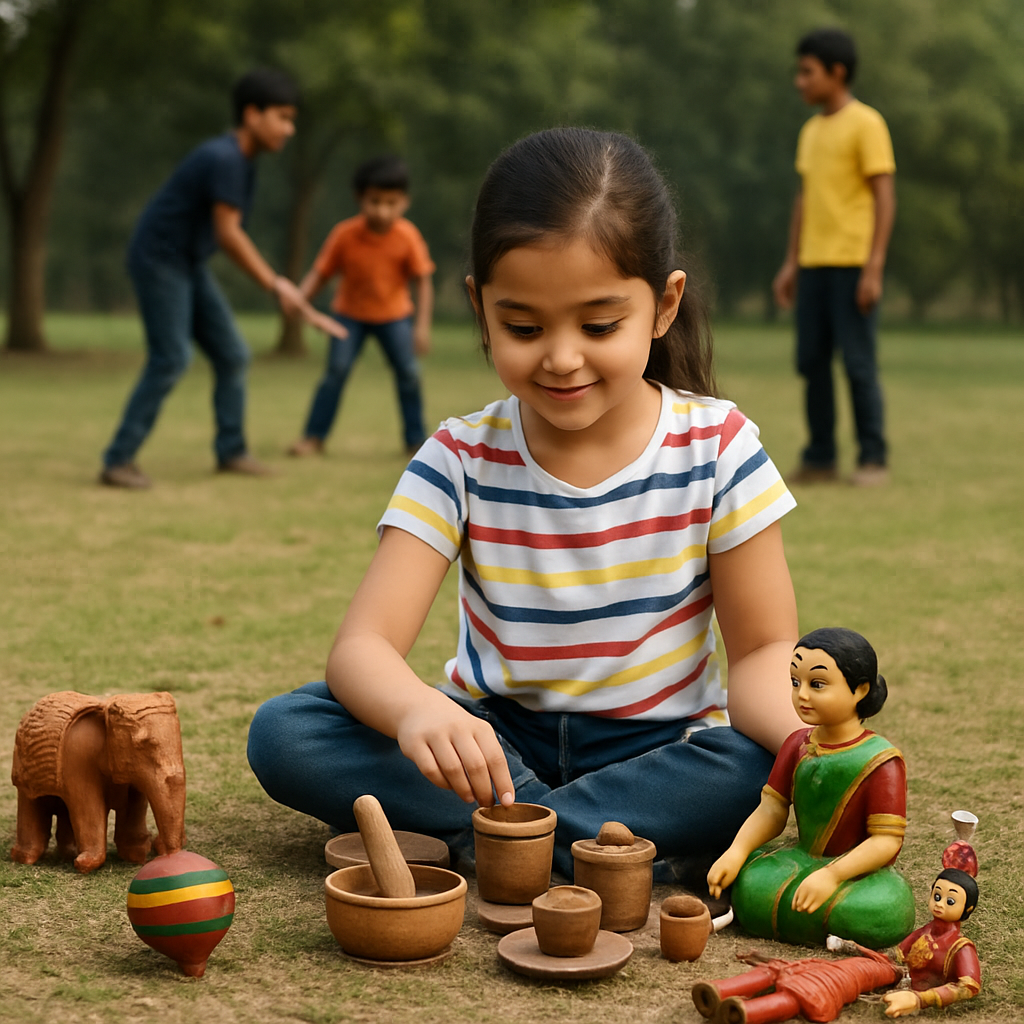
“Chhoti si gudiya, mitti ka haathi – inse hi toh banti hai bachpan ki seekh.”
Yes, in India, where stories echo from generations, even toys whisper wisdom. Traditional Indian toys are not just pieces of clay, wood, or cloth – they are carriers of culture, creators of curiosity, and teachers of timeless life skills.
In today’s digital world, where a tap on a screen can entertain a child for hours, it’s easy to forget the magic of simple, hands-on play. But let’s step back for a moment. Let’s open that old wooden trunk in our memory and rediscover the toys that once shaped not just our smiles – but also our souls.
The Philosophy Behind Traditional Play
Traditional toys in India are deeply rooted in “Khel-Khel Mein Siksha” – learning through play. Be it a spinning top (lattu), a wooden kitchen set, or clay animals, these toys are grounded in simplicity and deep developmental value.
These toys are:
- Eco-friendly – made from wood, cloth, clay, or metal.
- Handmade with love – crafted by local artisans.
- Culturally rich – reflecting stories, traditions, and festivals.
They’re not just toys. They’re tools of transformation.
Life Skills That Traditional Toys Naturally Teach
Let’s decode the hidden curriculum of these timeless treasures:
1. Creativity and Imagination
A small clay stove or a wooden dollhouse unlocks a whole world. Children imitate real-life roles – mother, cook, doctor, teacher – and build emotional intelligence through role play.
This develops storytelling, empathy, and problem-solving.
2. Fine Motor Skills and Coordination
Toys like lattu (top), gilli-danda, or knitting kits help refine hand-eye coordination and dexterity. Without a single screen or battery, children build muscular control and patience.
3. Social Skills and Sharing
Board games like Pachisi, Chaupar, or Snakes and Ladders (Moksha Patam) were always played in groups. These foster turn-taking, healthy competition, negotiation, and team spirit.
4. Resilience and Focus
Making a kite fly, spinning a top till it balances, or threading beads into a mala — all these require repeated efforts. Kids learn to handle failure and build focus without giving up.
5. Cultural Values
When a child plays with a Ramlila set, a dandiya toy, or Krishna-Balram figures, they subconsciously absorb festivals, rituals, and moral stories. This anchors their identity and heritage.
Science Behind Play-Based Learning
Studies show that hands-on play stimulates neural pathways that digital screens cannot. The process of touching, building, and imagining forms deep memory traces.
It enhances cognitive flexibility
Strengthens executive functions (decision-making, impulse control)
Increases emotional regulation
Traditional toys are especially beneficial because they don’t direct the child — they let the child lead the play. This autonomy builds confidence and self-learning.
What’s Missing in Modern Toys?
Modern toys, especially digital ones:
- Often dictate the play with pre-recorded commands.
- Are designed for passive consumption.
- Rarely spark imagination.
“Press this to make it sing” can never replace “Let’s make it sing together.”
Children lose patience faster, become more irritable, and are less engaged with physical surroundings.
Real-Life Examples: When Toys Taught More Than Games
- Madhuri, a mother from Lucknow, noticed her daughter became more confident after playing daily with a kitchen set and pretending to host guests.
- In Gujarat, many schools use Chaupar to teach children math and probability.
- In Andhra Pradesh, teachers use Bommalattam (puppets) to enhance storytelling and language fluency.
Reviving Traditional Toys in Modern Homes
You don’t need a village fair to bring these toys home. Here’s how you can make them a part of daily life:
- Visit local haats, craft fairs, or websites supporting rural artisans.
- Involve your child in making toys – like a DIY kite, doll, or puppet.
- Replace screen time with family board game time.
- Create a corner at home called “Mitti ka Ghar” for traditional play.
Global Recognition of Indian Toys
The world is waking up to the magic of Indian toys:
- The Government of India’s “Toycathon” encourages innovations in traditional toy designs.
- Many Montessori schools worldwide now integrate Indian handcrafted toys.
- UNESCO and UNICEF endorse play-based learning over rote systems.
Bonus: Top Traditional Indian Toys Worth Exploring
| Toy Name | Region | Skill Developed |
| Lattu (Top) | Pan-India | Focus, coordination |
| Chaupar | Uttar Pradesh | Math, strategy |
| Gilli Danda | Rural India | Agility, reflexes |
| Ramlila Set | North India | Storytelling, moral values |
| Clay Kitchen | South India | Role play, creativity |
| Wooden Cart | Rajasthan | Motor skills, building |
Final Thoughts: A Return to Roots
In our pursuit of modernity, let’s not lose what grounded us.
“Bachpan wahi achha hota hai jismein mitti lagi hoti hai.”
(Life’s best childhoods are the ones touched by earth.) Traditional toys not only make children smarter but also happier, kinder, and more rooted. Through Khel-Khel Mein Siksha, we give our kids what no app can: real connection, real creativity, and real confidence
Discover more from Online Guruji
Subscribe to get the latest posts sent to your email.
Yo galera, Egurobetbr tá mandando bem no mundo das apostas online! Tem de tudo um pouco, desde esportes até jogos de cassino. O site é fácil de usar e tem umas promoções maneiras. Visitem lá: egurobetbr.
Anyone else having trouble with their 5777cxlogin? Thankfully, it’s pretty reliable these days! Solid experience overall 5777cxlogin.
Kuvip789? Heard some stuff about it, decided to check it out myself. Pretty easy to use. If you like what you see, here’s the link: kuvip789
Zalv? Oh man, that’s my jam! If you’re lookin’ for somethin’ new, give it a whirl. Legit place. Check it out here: zalv
Aight, so betcom88.com is pretty cool. I’ve had some good times over there. Might even see ya around! Check it out here: betcom88.com
[2865]bet9 Official Login | অনলাইনে ক্যাসিনো ও স্লট গেম খেলুন,bet9 অ্যাপ ডাউনলোড করে সেরা স্লট গেমের নিয়ম জানুন। বিকাশ দিয়ে টাকা জমা করে আজই আপনার অ্যাকাউন্ট খুলুন এবং খেলা শুরু করুন। visit: bet9
[7853]iclub88 Login Link | Trusted Online Slot Site Malaysia,iclub88 offers a fast login link and easy apk download for players. Enjoy a trusted tpg casino malaysia experience with online casino touch n go payments. Join now. visit: iclub88