

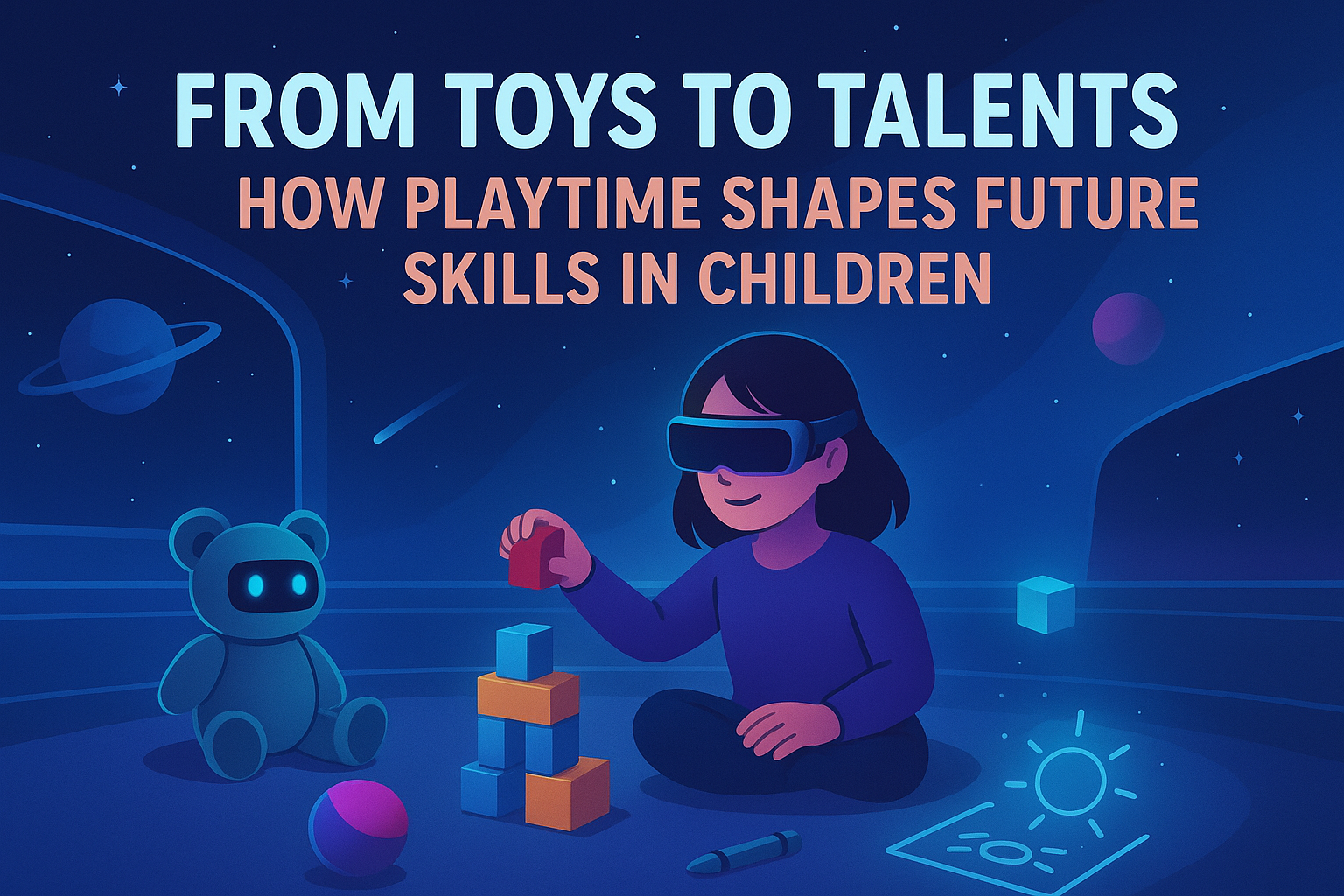
Introduction: The Seeds of Success Are Planted in Play
When you watch a child stacking blocks, drawing a rainbow, or pretending to run a shop, it might look like simple fun. But beneath the giggles and scattered toys, something extraordinary is happening—skills for the future are taking shape.
Playtime is not just a way to keep children occupied. It’s a natural workshop for creativity, problem-solving, social skills, and emotional intelligence—traits they will need for careers and life. In fact, the link between early play and later success is so strong that child development experts call it the foundation of lifelong learning.
In this article, we’ll explore how different types of play shape future talents, why parents should value it as much as formal education, and practical ways to nurture these skills at home.
The Science: Why Play Builds Skills for the Future
Brain researchers agree—early experiences literally shape the architecture of the brain. Between birth and age 8, a child’s brain forms over a million neural connections per second. Play is one of the most powerful ways to stimulate these connections.
Here’s how:
- Role-play builds communication and leadership skills.
- Construction play (blocks, LEGO) develops spatial thinking and problem-solving.
- Art and craft encourage creativity and fine motor control.
- Outdoor play improves physical coordination, teamwork, and resilience.
Fact: Studies show children engaged in diverse play activities in early years perform better in creativity and collaboration tests as adults.
How Play Turns into Future Talents
1. Creativity and Innovation
When children imagine a cardboard box as a spaceship or draw a fantastical creature, they are exercising creative thinking—an essential skill in industries like design, marketing, tech, and entrepreneurship.
How to encourage:
- Provide open-ended toys like building blocks, clay, and art supplies.
- Avoid overly scripted games that limit imagination.
2. Problem-Solving and Critical Thinking
Puzzles, building challenges, and even simple games like hide-and-seek train kids to assess situations, test solutions, and adapt strategies.
How to encourage:
- Introduce age-appropriate puzzles and STEM toys.
- Let children figure out solutions without rushing to help.
3. Communication and Social Skills
Role-play games—like pretending to run a restaurant or act out a story—teach kids how to express themselves, listen, negotiate, and collaborate.
How to encourage:
- Invite friends or siblings for group play sessions.
- Use toys that require teamwork, like board games or collaborative building sets.
4. Emotional Intelligence
Play helps children recognize and manage emotions. For example, when they lose a game, they learn resilience; when they take turns, they learn patience.
How to encourage:
- Play games where winning isn’t the main goal.
- Discuss feelings after play—“How did you feel when that happened?”
5. Leadership and Teamwork
Group play often needs someone to take the lead—deciding the rules, guiding the activity, or solving disputes. This is the first step toward leadership.
How to encourage:
- Give kids opportunities to organize small play events.
- Rotate leadership roles in games so everyone gets a chance.
6. Focus and Perseverance
Completing a complex LEGO model or mastering a new game teaches persistence. In a world full of distractions, this ability to stay focused is a superpower.
How to encourage:
- Choose activities that take time to complete.
- Celebrate effort, not just the end result.
7. Early Career Pathways
Believe it or not, play can also hint at a child’s future career interests:
- A child obsessed with building might become an engineer or architect.
- A storytelling child could thrive as a writer, teacher, or filmmaker.
- A budding “shopkeeper” might be a natural entrepreneur.
Practical Tips for Parents to Turn Play into Talent-Building
- Balance Traditional and Modern Toys – Wooden blocks can teach as much as coding kits—each has its place.
- Create a Play-Friendly Environment – A dedicated play corner encourages longer and more meaningful play.
- Join the Play (Sometimes) – Children learn more when adults model problem-solving and creativity.
- Rotate Toys – Keeps play fresh and challenges different skills.
- Mix Independent and Group Play – Both solo exploration and teamwork are vital.
The Hidden Benefit: Confidence for the Future
Children who regularly engage in skill-rich play grow up feeling capable. They’ve practiced trial and error, communication, and resilience from an early age, so challenges in school and work feel less intimidating.
Play plants seeds of confidence that blossom into success later in life.
Real-Life Example
Eight-year-old Aarav loved building with LEGO since he was three. His parents noticed he would spend hours creating cities, bridges, and vehicles. By age 10, he joined a robotics club and quickly picked up programming. Today, at 14, he’s already designing functional robots for school competitions—all because his early play built the foundation for engineering skills.
Conclusion: Play Is Not a Waste of Time—It’s the Foundation of Tomorrow
As parents, it’s tempting to think structured classes and academic achievements are the only path to success. But the truth is, the ability to imagine, adapt, and create starts on the play mat, not just in the classroom.
The toys you provide today may just be the tools that shape tomorrow’s innovators, leaders, and problem-solvers. So, the next time your child is lost in play, remember—you’re not just watching them have fun. You’re watching their future take shape.
Discover more from Online Guruji
Subscribe to get the latest posts sent to your email.
Ưu đãi fun88 luck – Fun88 always has the best promotions. Let’s get those bonuses! I love playing with Fun88, always worth a try to get a big win! ưu đãi fun88 luck
MX37, another one of those sites. Nothing really stands out, but also nothing really wrong with it. If you are looking for something simple this is it! More information is on mx37
Linkvaom888 is the place to be. Gets you access quick fast and in a hurry! Check It Out: linkvaom888
Yo, 13winokvip… VIP treatment for everyone, that’s the slogan, right? Solid site with a good selection of games. Worth a look. 13winokvip
Hey, I stumbled upon 8k77777 the other day. Pretty cool! Give it a shot, you might just dig it! Check it out here 8k77777.
Looking for a new casino and Kwinvn popped up. Their signup bonuses are pretty tempting, if I’m honest: kwinvn.