

Introduction: When Toys Start Talking Without Words
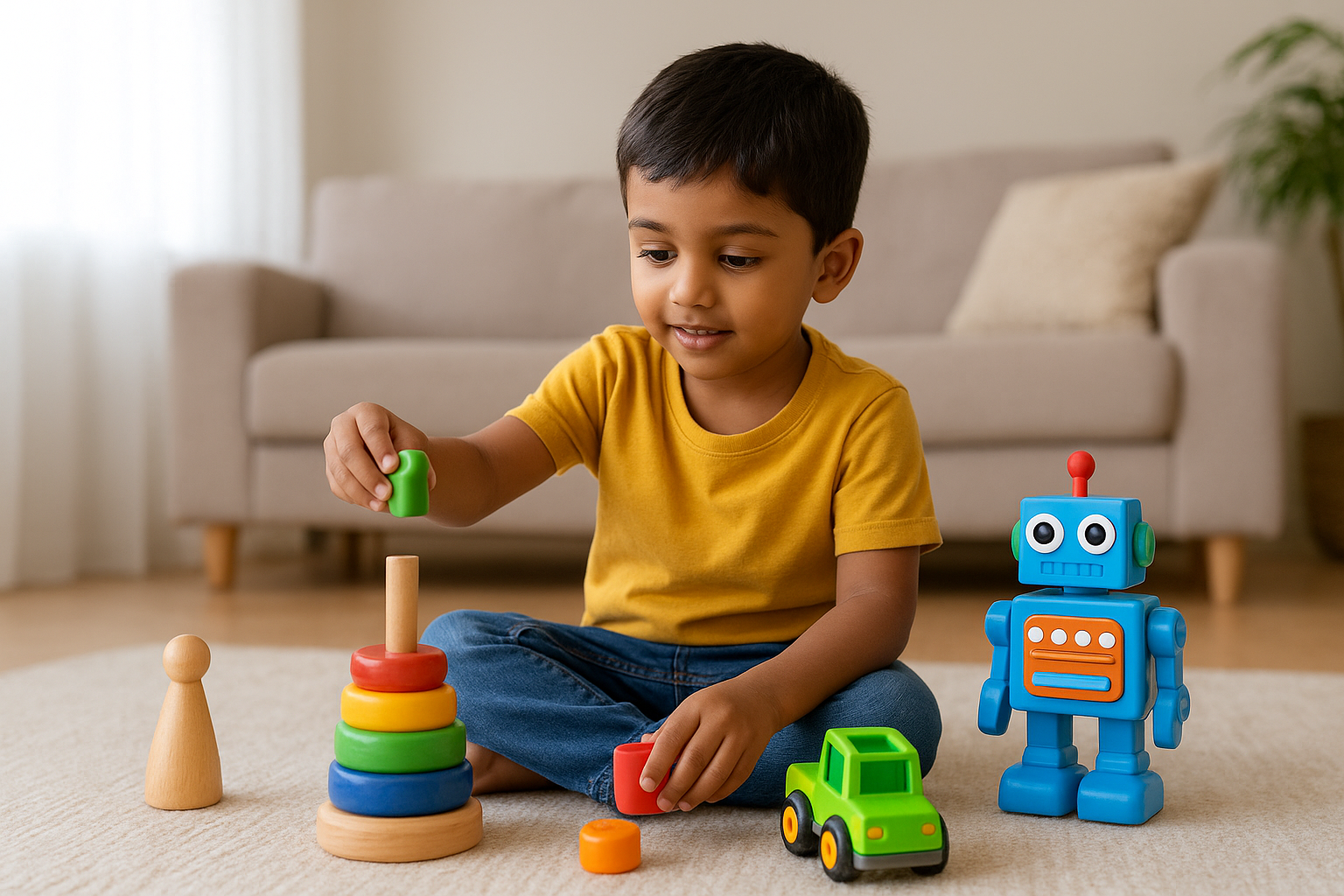
Imagine a toddler stacking colorful wooden blocks. To us, it looks like simple play. But for the child, every block is a lesson in balance, patience, and problem-solving. Before a child ever holds a pencil or opens a textbook, toys become their first teachers—shaping not just learning, but also curiosity, creativity, and confidence.
This is why play is often called a child’s “first classroom.” In this article, we’ll explore how toys—traditional and modern—quietly teach life lessons, and why parents should treat playtime as seriously as school time.
1. The Science of Learning Through Play
Child development experts agree that play is the brain’s favorite way of learning. When children play:
- Their brains form new neural connections, boosting memory and focus.
- They learn to experiment without fear of failure.
- Emotional and social skills—like sharing, empathy, and negotiation—grow naturally.
In short, toys are not just entertainment; they are early education tools in disguise
2. How Toys Teach More Than Textbooks
a) Problem-Solving & Critical Thinking
- Puzzles and building blocks force kids to think, adjust, and try again.
- This teaches resilience and the idea that “mistakes are just steps toward success.”
b) Language & Communication Skills
- Dolls, action figures, and pretend kitchens encourage children to create stories.
- These activities develop vocabulary, storytelling ability, and even leadership skills.
c) Motor Skills & Coordination
- Clay modeling, stacking toys, and board games improve fine motor skills.
- Outdoor toys like balls, skipping ropes, and bicycles strengthen gross motor abilities.
d) Emotional Intelligence
- Playing “house” or role-playing games lets kids express feelings safely.
- Toys become a way to practice empathy and understand others’ emotions.
3. Traditional Toys: Timeless Teachers
In India, traditional toys like lattu (spinning tops), gilli-danda, and dolls made of cloth or clay were never just for fun. They were designed to:
- Teach focus, patience, and balance (spinning tops).
- Build team spirit and strategy (gilli-danda, kabaddi-related toys).
- Strengthen creativity and cultural identity (handmade dolls, puppets).
These toys were simple but full of life lessons—something many modern plastic toys lack.
4. Modern Toys: New-Age Learning Tools
Today, children also have access to STEM kits, digital learning toys, and coding games. While screens need balance, smart modern toys can be powerful teachers:
- STEM toys introduce math and science in a playful way.
- Interactive toys boost problem-solving and logical reasoning.
- Educational apps with moderation can expand imagination and global awareness.
The key is balance between traditional and modern toys—so that kids learn both roots and wings.
5. Parents’ Role: Becoming Co-Teachers in Playtime
Playtime becomes more powerful when parents participate. Simple actions like:
- Asking questions during play (“Why did you choose this block first?”)
- Encouraging storytelling with dolls or toy animals.
- Allowing children to fail safely while solving puzzles.
These small interventions transform play into quality learning moments.
6. Real-Life Lessons Learned Through Toys
- A child who plays board games learns patience, rule-following, and fair play.
- A child who plays with clay develops focus, creativity, and stress relief.
- A child who plays with group toys learns leadership and teamwork.
Every toy, in its own way, is a silent teacher.
7. The Future of Play-Based Learning
Education systems worldwide are beginning to recognize play as education. Montessori and Waldorf schools already emphasize toys and play in teaching. In fact, research shows that children who engage in structured play perform better in problem-solving and social adaptability later in life.
The future classroom may not always look like four walls—it may look like a playroom full of learning toys.
Conclusion: A Classroom Without Walls
So, the question is—Toy or Teacher?
The answer is both. Toys are often the first teachers children ever meet. They prepare young minds for school, relationships, and life itself. As parents, choosing the right balance of toys—and engaging with children during play—can turn every playroom into a mini-classroom of wisdom and wonder.
Because in the end, playtime is not just about fun. It’s about building the foundation of a child’s lifelong learning journey.
Discover more from Online Guruji
Subscribe to get the latest posts sent to your email.
Betfairapp1, handy betting on the go? I’m in! Let’s see how smooth this app is. betfairapp1
Alright, gotta say, ggbbbet has been pretty decent to me. The site’s easy to navigate, and I haven’t had any major issues cashing out. Plus, their bonuses are actually worth grabbing sometimes. Check it out at ggbbbet.